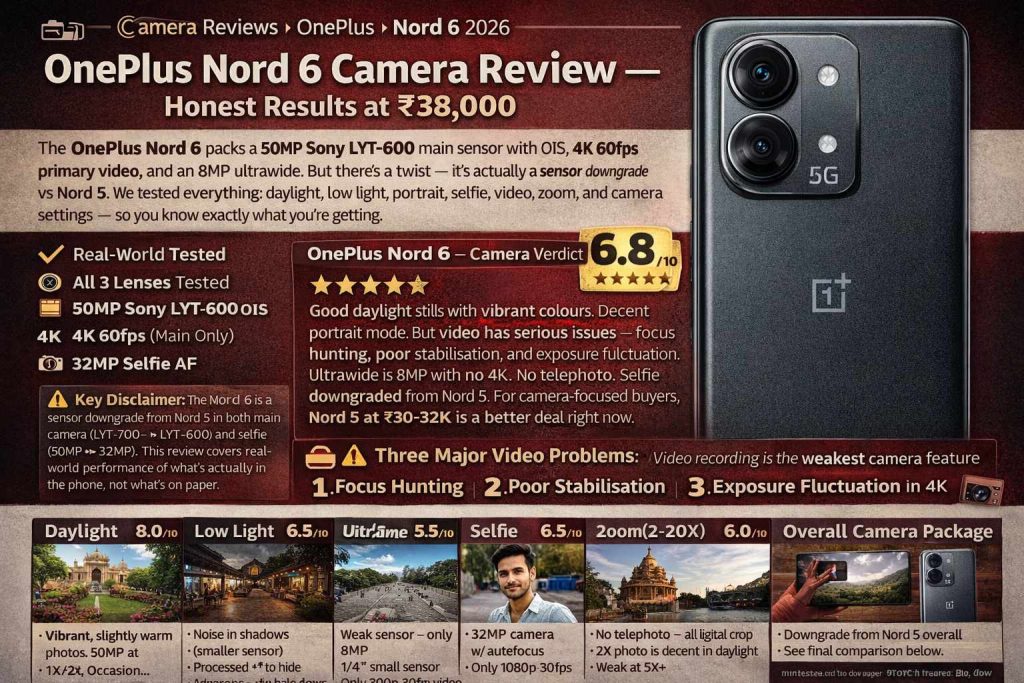
OnePlus Nord 6 Camera Review — Honest Results at ₹38,000
The OnePlus Nord 6 packs a 50MP Sony LYT-600 main sensor with OIS, 4K 60fps primary video, and an 8MP ultrawide. But there’s a twist — it’s actually a sensor downgrade vs Nord 5. We tested everything: daylight, low light, portrait, selfie, video, zoom, and camera settings — so you know exactly what you’re getting.
📋 OnePlus Nord 6 — Full Camera Specs
The Nord 6 shoots 4K 60fps from its main rear camera. However, the ultrawide is capped at 1080p 30fps, and the selfie goes up to 4K 30fps only. No telephoto lens is included. Compared to Nord 5, both main sensor and selfie have been downgraded in size.
Overall Camera Scores
Main Camera — 50MP Sony LYT-600 OIS
The 50MP Sony LYT-600 sensor is the main camera on the Nord 6. In bright daylight, it delivers vibrant, punchy photos with good centre-to-edge sharpness. Skin tones come out slightly warm — which works well for Indian skin tones in outdoor shots. Dynamic range is handled decently in most situations.
However, there’s an HDR consistency issue that shows up occasionally — especially in backlit situations where the phone sometimes over-exposes highlights (like the sun) while trying to balance shadows. This inconsistency is the biggest frustration with the main camera in daylight. Sometimes it handles backlit scenes excellently; other times the highlights blow out completely.
Shadow performance is decent in good light. When you crop into daylight shots, detail is good for photos taken in proper sunlight. Skin tone in portraits looks natural, which is appreciated. The camera does occasionally over-sharpen at 2X zoom — producing an artificial, over-processed look.
Low Light Performance
In low light, the processor and software do a clever but obvious trick: photos are deliberately made more contrasty to hide noise. Since the sensor is smaller (LYT-600 vs Nord 5’s LYT-700), the phone compensates by increasing contrast — which makes noise less visible but gives an artificial, over-processed look in dark scenes.
Noise control is acceptable for the sensor size. You will notice noise in shadows, but photos are usable. Exposure is generally well-handled in indoor artificial light scenes. In very dark environments, expect noisy photos with loss of fine detail when zoomed in.
✅ Main Camera Pros
- Vibrant, punchy daylight photos
- Good sharpness centre-to-edge in sunlight
- Warm skin tones suit Indian complexions
- Backlit dynamic range — good in many scenes
- OIS helps in handheld photos
- Low noise in sufficient light
❌ Main Camera Cons
- Sensor downgrade from Nord 5 (LYT-700 → LYT-600)
- Highlight management inconsistent — sun blows out
- Shadow noise visible in low/mixed light
- 2X zoom sometimes over-sharpened
- HDR inconsistency — not reliable every shot
- Yellowy/warm tone can be too much at times
Ultrawide Camera — 8MP Only
The ultrawide camera is the weakest link on the Nord 6. At just 8MP with a 1/4″ OmniVision sensor, it is a budget-grade sensor in a ₹38,000 phone. The 16mm focal length gives a wide angle of view that is useful for landscapes and group shots.
In bright daylight, centre sharpness is acceptable for 8MP. Colours and white balance are decent. However, as soon as you crop into the corners or use this camera in any challenging lighting, quality drops noticeably. The sensor simply does not have enough pixels or light-gathering capability.
The biggest limitation: this sensor cannot shoot 4K video. Maximum resolution in video mode is 1080p 30fps. Even at 1080p, you cannot use the ultrawide at 60fps. This means anyone who wants to use the ultrawide for smooth, high-quality video will be disappointed.
There is also a colour and exposure inconsistency between the main camera and ultrawide. When you switch between 1X and 0.66X, you’ll notice a clear shift in colour processing — the ultrawide tends to be more contrasty while the main camera is more natural. This makes it difficult to use both cameras in the same scene coherently.
✅ Ultrawide Pros
- 16mm gives good wide field of view
- Centre sharpness decent in daylight
- Decent white balance outdoors
- Useful for landscape/architecture
❌ Ultrawide Cons
- Only 8MP — crops show degradation
- 1/4″ sensor — very small for the price
- No 4K video — max 1080p 30fps
- Extremely poor in low light
- Colour/exposure inconsistency vs main cam
- No 60fps even at 1080p
Portrait Mode — 1X & 2X, Multiple Filters
Portrait mode on the Nord 6 offers 1X and 2X focal lengths with adjustable aperture from F1.4 (maximum blur) to F16 (minimum blur). The default F4.5 gives a natural-looking bokeh that works well in good light. You also get multiple filters including Misty, Glowing, and Dreamy effects in portrait mode.
When it works, portrait mode delivers pleasing skin tones, decent edge detection, and a natural background blur that doesn’t look too artificial. Full-body portrait shots are also handled well. Backlit portrait scenes often show good dynamic range.
However, the mode has a consistency problem. In several shots — particularly at 2X — the phone produces over-sharpened, over-processed portraits with visible ghosting in the background. Edge selection is sometimes careless, especially around hair and complex backgrounds. There are shots where the background shows a clear “ghosting” or double-processed effect that looks very unnatural.
⚠️ The 2X Portrait Ghosting Issue
At 2X zoom in portrait mode, the Nord 6 frequently produces an over-processed look with visible ghosting artifacts in the background. The camera seems to struggle with separating subject from background accurately at this focal length. This is a real-world issue that may improve with software updates, but is present as of launch.
Selfie Camera — 32MP Downgrade from Nord 5
The 32MP selfie camera (f/2.0, 1/3.1″) has autofocus — which is a plus. It delivers good daylight selfies with natural skin tones and reasonable detail. The face comes out slightly warm, which looks flattering for most users. Edge detection in selfie portrait mode is decent.
However, Nord 5 had a 50MP (1/2.76″) selfie camera — significantly larger and higher resolution. The Nord 6 is a clear downgrade here. Photos from the Nord 6 selfie camera show less detail when zoomed in, and skin tones can feel a bit flat compared to what the Nord 5 produced.
The front camera supports 4K 30fps video (but not 4K 60fps — that’s missing at this price). Three focal lengths are available: 0.8X (wide group selfies), 1X, and 2X. Portrait selfies show good blur with decent face detection in most situations.
The selfie camera’s low-light performance is acceptable — noise is controlled, but detail suffers. In indoor artificial light, the camera does reasonably well. You will notice the selfie output is slightly processed/beautified even without manual settings.
✅ Selfie Pros
- AF selfie camera — rare feature
- Natural, warm skin tones
- 3 focal lengths (0.8X, 1X, 2X)
- 4K 30fps front video
- Portrait selfie with good blur
- Decent low-light handling
❌ Selfie Cons
- Downgrade from Nord 5’s 50MP → 32MP
- Smaller sensor (1/3.1″ vs 1/2.76″)
- No 4K 60fps front video
- Slightly processed/beautified by default
- Skin tones slightly washed or flat vs Nord 5
Video Performance — 4K 60fps but Serious Issues
This is where the OnePlus Nord 6 genuinely disappoints. On paper, 4K 60fps from the primary camera sounds great at ₹38,000. In practice, three major problems make the video output frustrating for everyday use.
⚠️ Three Major Video Problems
1. Focus Hunting — Constant and Distracting
The most serious video issue: the autofocus constantly hunts — going in and out of focus while recording, especially when the subject or camera moves slightly. This is particularly bad in 4K video. At a ₹38,000 price point, this level of focus hunting is unacceptable. In 2X mode, focus hunting is less severe.
2. Very Poor Video Stabilisation
Even walking at a normal pace while recording 4K video results in very visible shake and jitter. The stabilisation is so poor that the footage feels like it was shot on a budget phone. The phone has optical image stabilisation (OIS) for photos, but it does not translate effectively to smooth video. Reviewers noted this feels like output from a ₹20,000 phone, not ₹38,000.
Ultra Steady mode is available and does help, but crops the frame and is limited to 1080p resolution — not 4K.
3. Exposure Fluctuation — Brightness Keeps Changing
A third recurring issue: the exposure keeps flickering — going bright, then dark, then bright again — while recording video. This is especially visible in outdoor scenes or when moving from shade to sunlight. It creates a very amateurish, pulsating effect in the footage.
Ultrawide Video — Only 1080p 30fps
If you want to use the ultrawide for video, you are limited to 1080p 30fps only. No 60fps. No 4K. Given the ₹38,000 price, this is a major limitation. Stabilisation on the ultrawide is even worse than the main camera.
Selfie Video — 4K 30fps, No 60fps
The front camera delivers 4K 30fps video, which is okay for vlogging. Quality is acceptable in daylight. However, 4K 60fps is missing from the front camera — which many vloggers prefer for slow-motion selfie clips.
✅ Video Pros
- 4K 60fps from main camera
- Good colour science and white balance
- Natural skin tones in video
- 1080p 240fps slow motion
- Portrait video mode (1080p)
- Dual video mode available
- Low-light noise control is decent
❌ Video Cons
- Severe focus hunting in 4K mode
- Very poor video stabilisation (OIS not effective)
- Constant exposure fluctuation outdoors
- Ultrawide: 1080p 30fps max — no 4K
- Selfie: no 4K 60fps
- Video max zoom only 10X (vs 20X in photo)
Zoom Test — 2X to 20X
The Nord 6 has no dedicated telephoto camera. All zoom beyond the main camera’s focal range is digital — a crop from the 50MP sensor. Maximum zoom in photo mode is 20X; in video mode it’s 10X.
At 2X zoom, quality is genuinely good because the 50MP sensor has enough resolution to crop without major quality loss. Daylight 2X shots are sharp with good dynamic range. Backlit 2X shots also handle well in many conditions. This is the recommended maximum zoom for usable photos.
At 5X, quality starts to drop but photos remain usable in good light. At 10X, you can make out subjects but fine details are lost. Beyond 10X, quality degrades significantly and is only suitable for rough reference shots.
Camera Settings Guide — Best Settings for Nord 6
Nord 6 vs Nord 5 — Camera Comparison
The most important camera comparison for potential buyers. Note: the Nord 6 is actually a camera downgrade in two key areas while having a better processor.
| Camera Feature | OnePlus Nord 5 | OnePlus Nord 6 | Winner |
|---|---|---|---|
| Main Sensor | Sony LYT-700 | 1/1.56″ | Sony LYT-600 | 1/1.95″ | Nord 5 ✅ |
| Main Megapixels | 50MP | 50MP | Tie |
| Main Camera OIS | Yes | Yes | Tie |
| Selfie Camera | 50MP | 1/2.76″ | 32MP | 1/3.1″ | Nord 5 ✅ |
| Ultrawide | 8MP | 8MP | Tie (Same) |
| Rear Video Max | 4K 60fps | 4K 60fps | Tie |
| Front Video Max | 4K 60fps | 4K 30fps only | Nord 5 ✅ |
| Portrait Mode | 1X & 2X | 1X & 2X | Tie |
| Daylight Photos | Very Good | Good (Slightly Less) | Nord 5 ✅ |
| Low Light Photos | Better (Larger Sensor) | Average | Nord 5 ✅ |
| Video Stabilisation | Decent | Poor (Major Issue) | Nord 5 ✅ |
| AI Camera Features | Good | Good (Similar) | Tie |
| Processor | Snapdragon 8s Gen 3 | Snapdragon 8s Gen 4 | Nord 6 ✅ |
| Current Price (Apr 2026) | ~₹30,000–32,000 | ~₹38,000–40,000 | Nord 5 (Value ✅) |
🏁 Final Verdict — OnePlus Nord 6 Camera
The OnePlus Nord 6 camera is a story of mixed results. Daylight stills from the main camera are good — vibrant, sharp, and pleasing for everyday photography. Portrait mode works well when conditions align. The selfie camera is decent with natural skin tones.
But video performance is where this phone genuinely disappoints at its price. Focus hunting, poor stabilisation, and exposure fluctuation make it a frustrating camera for video creators. The ultrawide at 8MP with no 4K is sub-standard for ₹38,000. And the decision to use a smaller sensor (LYT-600 vs Nord 5’s LYT-700) while also downgrading the selfie from 50MP to 32MP makes the Nord 6 a camera downgrade — not an upgrade — over its predecessor.
Camera Score: 6.8/10. If the camera is your priority at ₹38,000, consider the Nord 5 (available cheaper now), or look at alternatives from other brands that offer telephoto lenses and better ultrawide cameras in this range. If you want the Nord 6 for its battery, performance, or IP ratings — that’s a different, stronger story.