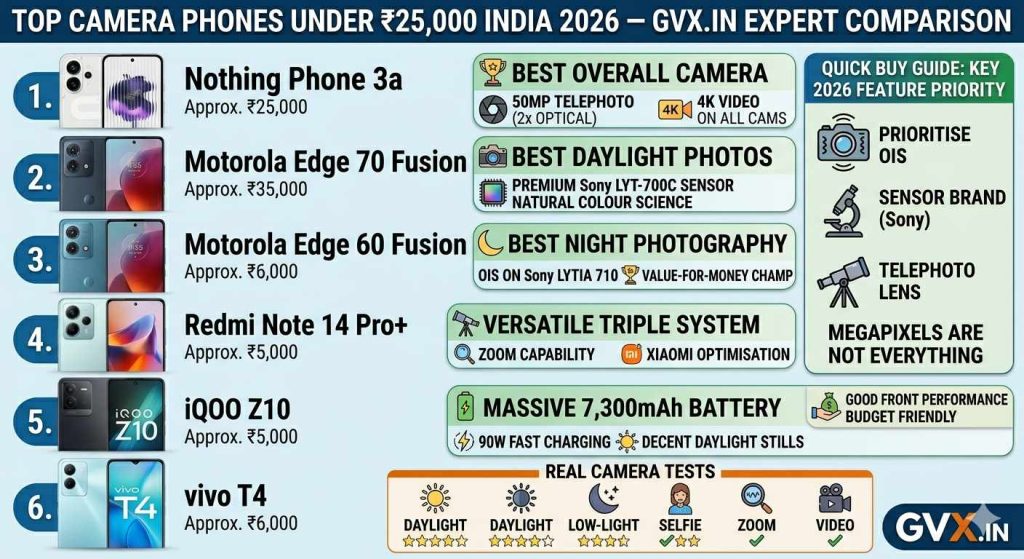
Best Camera Smartphone Under
₹25,000 in India 2026
— Top 6 Picks, Real Specs, Honest Verdict
Nothing Phone 3a, Motorola Edge 70 Fusion, iQOO Z10, Redmi Note 14 Pro+, Motorola Edge 60 Fusion and vivo T4 — camera systems compared across daylight, low-light, selfie, OIS, zoom and 4K video. Every buyer type covered.
⚡ Quick Rankings — Best Camera Phone Under ₹25,000 India 2026
The best camera phone segment under ₹25,000 has never been more competitive. In 2026, you get 50MP main sensors, OIS, telephoto zoom, 4K video, and Sony-grade imaging at prices that would have been impossible two years ago. The key differences are no longer megapixels — they are sensor quality, OIS availability, telephoto presence, software processing, and video capability. This guide cuts through the noise.
Camera Buying Guide — What Actually Matters in 2026
📸 Stop Counting Megapixels. Start Looking at These Instead.
In 2026, almost every phone under ₹25,000 has a 50MP main camera. Megapixels are no longer a differentiator. What separates a great camera phone from a mediocre one at this price is: sensor brand and size, OIS availability, telephoto lens presence, ultrawide quality, night mode processing, and 4K video support.
Sensor brand matters enormously. A Sony LYT-700C sensor in the Motorola Edge 70 Fusion processes light fundamentally differently from an unnamed 50MP sensor in a generic mid-ranger. Sony sensors are renowned for natural colour science — what you see is what you get, without aggressive AI over-sharpening.
OIS (Optical Image Stabilisation) is the single most practical camera upgrade for real users. It stabilises your handheld shots, dramatically improves low-light photography (allows longer exposure without blur), and eliminates the jitter from video recording. Phones without OIS produce noticeably shakier video and blurrier night shots.
OIS (Priority 1)
Optical Image Stabilisation. Makes low-light photos sharper and video stable. Only a few phones under ₹25K have it — a massive advantage.
Sensor Brand (Priority 2)
Sony LYT series sensors produce the most natural colour science. More accurate, less AI-processed results. Better high-ISO performance.
Telephoto Lens (Priority 3)
True optical zoom without quality loss. Only Nothing Phone 3a has one under ₹25K. Digital zoom on all other phones degrades quality significantly.
Ultrawide (Priority 4)
Essential for travel, groups, and architecture. Quality varies widely — aperture and pixel size matter more than resolution here.
4K Video (Priority 5)
4K@30fps is now achievable at this price. Not all phones offer 4K on both main and selfie — Nothing Phone 3a does both.
Night Mode (Priority 6)
Computational photography processing for low-light scenes. Quality depends on software tuning — Motorola and Nothing both excel here.
🏆 Rank #1 — Nothing Phone 3a
The Nothing Phone 3a is the most complete camera system available under ₹25,000 in India in 2026. The headline feature is the 50MP telephoto camera with 2x optical zoom — a genuine optical zoom lens at this price is unprecedented. Every other competitor in this segment relies on digital zoom after 1x, which degrades quality significantly. With 2x optical zoom, you get portrait photography, subject separation, and zoom shots at full quality.
The phone records 4K video from every camera — main, telephoto, and selfie. This is a content creator’s dream at this price. Most competitors either limit 4K to the main camera only or don’t offer it at all. The 32MP selfie camera with 4K recording makes this the most capable front-camera package in the segment.
✅ Nothing Phone 3a Camera Pros
- Only phone with optical zoom under ₹25K
- 4K video on ALL cameras including selfie
- 32MP selfie — best in class
- OIS on main camera
- Clean Nothing OS — fast camera app
- IP64 + NFC + in-display fingerprint
- 3 years of major Android updates
❌ Nothing Phone 3a Camera Cons
- Telephoto struggles in low light
- 8MP ultrawide is weakest in comparison
- Some bloatware added in recent updates
- Snapdragon 7s Gen 3 — not the fastest chip
🥈 Rank #2 — Motorola Edge 70 Fusion
The Motorola Edge 70 Fusion is the phone to buy if pure image quality in daylight is your top priority. The Sony LYT-700C sensor is a premium imaging component that Motorola has used in this ₹24,999 phone — this is the same class of sensor found in phones costing ₹40,000–₹60,000 in previous generations. Sony sensors are characterised by natural colour reproduction, accurate skin tones, and superior high-ISO low-light performance compared to generic CMOS sensors.
The combination of Sony LYT-700C + OIS + Snapdragon 7s Gen 4 + Android 16 makes this the most future-proof camera phone in the comparison. The 1.5K OLED display at 5200 nits peak brightness is also the best screen in this roundup — excellent for reviewing your shots outdoors.
✅ Edge 70 Fusion Camera Pros
- Sony LYT-700C — best sensor in segment
- OIS on main camera
- Best daylight photo quality overall
- Natural colour science — no over-processing
- Android 16 — latest OS
- 7000mAh battery + Snapdragon 7s Gen 4
- 5200 nit display — best screen here
❌ Edge 70 Fusion Camera Cons
- No telephoto camera — digital zoom only
- Only 2 rear cameras (no ultrawide depth)
- No OIS on ultrawide
- Not available under ₹22,000 yet
📷 — Motorola Edge 60 Fusion (₹20,900)
The Motorola Edge 60 Fusion is the hidden gem of this comparison — it features a Sony LYTIA 710 sensor with OIS at ₹20,900, nearly ₹4,000 cheaper than the Nothing Phone 3a and Edge 70 Fusion. For photography-focused buyers on a tighter budget, this is extraordinary value.
The Sony LYTIA 710 is a step below the LYT-700C in the Edge 70 Fusion but still delivers significantly better results than generic 50MP sensors. OIS ensures stable low-light performance and smooth video. If your use case is daylight photography and occasional videos without the need for zoom, this is the most cost-efficient camera phone in the list.
✅ Edge 60 Fusion Pros
- Sony LYTIA 710 sensor + OIS at ₹20,900
- Best value camera phone in comparison
- 32MP selfie + 4K video
- Clean Moto OS — fast camera performance
- 256GB storage in base variant
❌ Edge 60 Fusion Cons
- No telephoto
- Lower resolution ultrawide vs Edge 70
- Dimensity 7300 is weaker than SD 7s Gen 4
- 1600 nit display vs 5200 on Edge 70
🔋 — iQOO Z10 — Battery King with Decent Camera
The iQOO Z10 is not primarily a camera phone — and buyers considering it for camera should understand this clearly. It has only two rear cameras (50MP main + 2MP depth sensor) with no ultrawide and no OIS. Camera performance in daylight is decent, but without OIS, low-light and video quality fall behind the Nothing Phone 3a and both Motorola Edge models.
Where iQOO Z10 dominates: 7300mAh battery with 90W charging — the best battery life in this entire comparison by a significant margin. It also has an excellent AMOLED display, IP65 water resistance, and solid performance. Buy it for longevity between charges, not for photography versatility.
✅ iQOO Z10 Pros
- 7300mAh — best battery life here
- 90W fast charging — fastest charging
- Decent 50MP daylight photography
- 5000 nit AMOLED display
- IP65 water resistance
❌ iQOO Z10 Camera Cons
- No OIS — shaky video, blurry night shots
- No ultrawide camera
- No telephoto / zoom
- 2MP depth sensor is essentially useless
- Weakest camera system in comparison
📱 — Redmi Note 14 Pro+ (50MP Telephoto, IP68)
The Redmi Note 14 Pro+ has an impressive camera spec sheet — 50MP main + 50MP telephoto (2.5x optical) + 8MP ultrawide + OIS + IP68. However, its price has largely drifted above ₹25,000 on major platforms (₹24,995–₹26,999). If you can catch it at or below ₹24,999 during a sale, it becomes one of the strongest camera options here.
The IP68 rating (full submersion protection) is exceptional — better than the IP64 on Nothing Phone 3a. For users near water or in humid environments, this is meaningful. The 50MP telephoto at 2.5x optical is also slightly stronger than the 2x on the Phone 3a. However, the 20MP selfie camera is the weakest selfie shooter in this comparison.
✅ Redmi Note 14 Pro+ Pros
- IP68 — best water resistance here
- 50MP telephoto with 2.5x optical zoom
- OIS on main camera
- Excellent build quality
- Triple camera system
❌ Redmi Note 14 Pro+ Cons
- Price drifts above ₹25,000 on most platforms
- 20MP selfie — weakest in comparison
- MIUI bloatware
- 45W charging is slower vs competitors
📱 — vivo T4 — Portrait Photography Specialist
The vivo T4 excels at portrait photography with its Aura Light ring flash for soft, flattering portrait illumination — a feature unique to vivo phones. The 32MP selfie camera is strong for video calls and social media. However, no OIS and no ultrawide limit its versatility compared to the Motorola Edge models or Nothing Phone 3a.
✅ vivo T4 Pros
- Aura Light portrait flash — unique
- 32MP selfie — great for portraits
- 6500mAh + 90W — excellent battery
- Good value pricing
❌ vivo T4 Cons
- No OIS — blurry night shots
- No ultrawide camera
- Portrait depth sensor is basic
- vivo OS has heavy bloatware
Full Camera Comparison Table
| Feature | Nothing Phone 3a | Moto Edge 70 Fusion | Moto Edge 60 Fusion | iQOO Z10 | Redmi Note 14 Pro+ | vivo T4 |
|---|---|---|---|---|---|---|
| Price | ₹24,999 | ₹24,999 | ₹20,900 | ₹24,999 | ₹24,995+ | ₹21,999 |
| Main Camera | 50MP OIS | 50MP Sony LYT-700C OIS | 50MP Sony LYTIA 710 OIS | 50MP f/1.8 | 50MP OIS | 50MP f/1.88 |
| OIS | ✅ Yes | ✅ Yes | ✅ Yes | ❌ No | ✅ Yes | ❌ No |
| Telephoto Lens | ✅ 50MP 2x Optical | ❌ None | ❌ None | ❌ None | ✅ 50MP 2.5x Optical | ❌ None |
| Ultrawide Lens | ✅ 8MP | ✅ 13MP | ✅ 13MP | ❌ None | ✅ 8MP | ❌ None |
| Selfie Camera | 32MP (4K) | 32MP | 32MP | 32MP | 20MP | 32MP |
| Selfie 4K Video | ✅ Yes | Full HD | Full HD | Full HD | Full HD | Full HD |
| Main Camera 4K | ✅ 4K@30fps | ✅ 4K@30fps | ✅ 4K@30fps | 1080p only | ✅ 4K@30fps | 1080p only |
| Max Optical Zoom | 2x | 1x (digital only) | 1x (digital only) | 1x (digital only) | 2.5x | 1x (digital only) |
| IP Rating | IP64 | None listed | None listed | IP65 | IP68 | None listed |
| Battery | 5000mAh | 7000mAh | 5000mAh | 7300mAh | 5110mAh | 6500mAh |
| Fast Charging | 50W | Rapid charge | 68W | 90W | 45W | 90W |
| Android Version | Android 15, 3yr updates | Android 16 | Android 15 | Android 15 | Android 14 | Android 15 |
| NFC | ✅ | ✅ | ✅ | ❌ | ✅ | ❌ |
Buy Guide — By Buyer Type
Content Creators
Nothing Phone 3a — 4K on all cameras including selfie, OIS, optical zoom for versatile reels and YouTube shorts.
Photo Enthusiasts
Motorola Edge 70 Fusion — Sony LYT-700C sensor produces the most natural, professional-grade daylight images in this price range.
Selfie Lovers
Nothing Phone 3a — 32MP front camera with 4K video recording. Best selfie and front-camera video in the comparison.
Zoom Photography
Nothing Phone 3a or Redmi Note 14 Pro+ — only phones with optical zoom. Phone 3a at 2x, Note 14 Pro+ at 2.5x optical.
Battery Priority + Camera
Motorola Edge 70 Fusion — 7000mAh battery + Sony camera sensor. Best of both worlds.
Budget Camera Pick
Motorola Edge 60 Fusion (₹20,900) — Sony LYTIA 710 sensor + OIS at significantly lower price. Best camera value in this list.
Water-Resistant Camera
Redmi Note 14 Pro+ — IP68 rating + OIS + telephoto. Best for outdoor photographers near water.
Gaming + Camera Balance
Motorola Edge 70 Fusion — Snapdragon 7s Gen 4 + Android 16 + 7000mAh battery + Sony camera. Most powerful chipset here.
🎯 Final Verdict — Best Camera Phone Under ₹25,000 India 2026
Frequently Asked Questions (FAQ)
📌 Sources: Specifications verified via 91mobiles, Smartprix, and official brand pages for all six phones. Pricing confirmed on Amazon.in and Flipkart as of April 12, 2026. Camera rankings based on published expert reviews, sensor specifications, and comparative camera analysis from multiple technology publications. Nothing Phone 3a, Motorola Edge 70 Fusion, and Motorola Edge 60 Fusion pricing and availability verified live.
For more smartphone buying guides, visit Gvox.in.