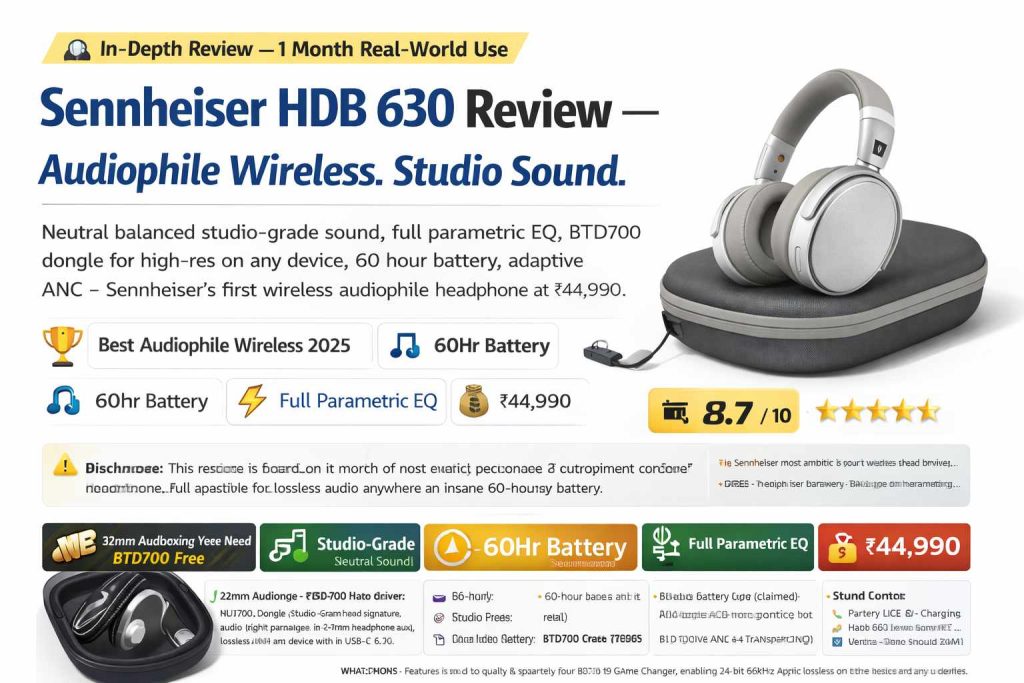
Sennheiser HDB 630 Review —
Audiophile Wireless. Studio Sound.
Neutral balanced studio-grade sound, full parametric EQ, BTD700 dongle for high-res on any device, 60-hour battery, adaptive ANC — Sennheiser’s first wireless audiophile headphone at ₹44,990. Is it worth it?
⚡ Quick Summary — HDB 630 at a Glance
This is not a casual everyday ANC headphone — it is a full blown audiophile machine. Built for people who understand sound — who value clarity, detail, instrument separation, and balanced neutral tuning over punchy bass. The free BTD700 dongle makes lossless audio accessible on any device, which is genuinely unique.
What’s in the Box
The HDB 630 arrives in premium packaging with a High-Resolution Audio badge prominently displayed. Inside, a sturdy hard-shell carry case houses everything neatly organised — a thoughtful setup designed for travellers.
Build Quality & Design
🏗️ German Engineering — Designed to Disappear
Sennheiser didn’t design the HDB 630 to impress you in a shop. They designed it to disappear on your head. Once you put it on, it is so comfortable and lightweight that you forget you’re wearing it. That’s the entire design philosophy — pure sound, zero fatigue.
Design language: Minimalist matte finish, no flashy elements. Business-casual aesthetic — handsome and understated. The silver yoke accents add contrast, though some reviewers note they are plastic rather than metal.
The build quality is solid. Hinges feel sturdier than most headphones in this segment. The balanced clamping force is one of the most noteworthy comfort features — worn for 3–4 hours continuously in testing without any pressure or discomfort. Multiple reviewers clocked 5–6 hour sessions with zero fatigue.
The Ideatex ear pad material is soft and comfortable, though it doesn’t breathe much — expect slight warmth during longer outdoor use. The headband has been improved over the Momentum 4 with a slight centre detent that relieves pressure on top of the head during extended wear.
✅ Build Strengths
- Extremely comfortable for long sessions
- Solid sturdy hinges
- Soft premium ear pads (replaceable)
- Balanced clamping force
- Matte premium finish — no fingerprints
- Compact hard-shell carry case included
❌ Build Notes
- Does not fold compact — bulkier carry case
- Silver accents are plastic (not metal)
- Slightly heavier than Sony XM6
- Ear cups not the deepest — smaller ears preferred
- Touch panel slightly floppy on joints
BTD700 Dongle — The Real Game Changer
🔌 BTD700 — High-Res Audio on Any Device. Free.
Only 15–20% of smartphones natively support proper high-resolution audio codecs. The BTD700 solves this entirely. Plug it into any USB-C device and instantly get 24-bit 96kHz AptX Lossless audio — regardless of whether your device supports it natively.
This means your ₹5,000 budget phone gets the same wireless audio quality as a flagship. And if you buy this dongle separately in the market, it costs ₹5,000–₹6,000. With HDB 630, it is completely free.
The BTD700 works as a Bluetooth transmitter from the USB-C port side — it still uses Bluetooth to connect to the headphones, but gives access to higher-end codecs than what most phones or laptops natively support. In testing, Bluetooth range exceeded 50 feet through multiple walls with no dropouts.
Auracast support is a particularly cool feature — connect 2, 3, or 4 compatible headphones simultaneously and share the same audio content. Perfect for watching something on a plane with a companion.
Sound Quality — Deep Analysis
🎵 Studio-Grade Neutral Sound — The HDB 630’s Core Identity
The HDB 630 uses Sennheiser’s in-house SYS38 / audiophile-grade transducer engineered for neutral natural tuning. This headphone doesn’t boost bass to impress you on first listen — it delivers what the artist actually recorded. Mature, refined, and engaging — that’s the sound signature.
Sennheiser deployed enhanced magnetic damping, acoustic baffle mesh, and optimized back volume — these engineering choices shape the treble, reduce distortion, and open up the sound stage to feel more airy than a typical closed-back headphone.
🎸 Bass — Tight, Controlled, Accurate
The bass on the HDB 630 is tight and controlled — not boosted. Sub-bass extends cleanly without any distortion. The focus is accuracy over quantity — which means long listening sessions won’t give you a headache. This is not the headphone for people who want to “feel the bass in their skull.” It’s for people who want to hear every note the bassist played.
Out of the box, some reviewers found the bass slightly heavy. With the parametric EQ, applying a 6dB bass shelf reduction transforms the low end — giving it definition, texture, and genuine impact rather than a muddy blob.
🎤 Mid-Range — The Strongest Area
This is where the HDB 630 genuinely outclasses everything in its price range. Crystal clear, natural, honest vocals that feel realistic. Male and female vocals, duets, solo performances — across multiple genres, the mid-range reproduces voices with a naturalness and presence that is rarely heard in wireless headphones. Instrument separation is exceptional — every instrument has its own distinct space and layer in the sound stage.
✨ Treble — Detailed Without Harshness
The treble delivers fine detail without any sharpness or sibilance. Even at high volumes, no piercing high frequencies. The treble sparkle is controlled — you hear the shimmer without it cutting into your ears. This protects both your ears and your long-session enjoyment.
Out of the box the treble is slightly elevated — reviewers who listened analytically applied 2 parametric EQ filters at ~12kHz to reduce by approximately 12dB total. The result: exceptional clarity with no harshness.
🎭 Sound Stage — Open Despite Closed-Back Design
For a closed-back headphone, the HDB 630’s sound stage feels surprisingly open and spacious. The acoustic engineering — baffle mesh, optimised back volume — creates a sense of air and space that blurs the line between closed and open-back listening.
ANC & Transparency Mode
The ANC on the HDB 630 is effective and reliable — AC noise, fan noise, traffic, airplane engine hum all get cancelled well. But the most impressive ANC feature is something competitors don’t do: sound quality is fully maintained when ANC is turned on. On most headphones, enabling ANC introduces compression or colour changes to the audio. On the HDB 630, the sound stays clean.
In terms of raw ANC suppression strength, Sony XM6 and Bose QC Ultra Gen 2 have the edge for the loudest environments (planes, loud trains). But interestingly, the HDB 630’s ANC background hiss is completely silent — the Bose has a slight hiss at maximum ANC that the Sennheiser does not.
Parametric EQ — The Power Feature
🎛️ Full Parametric EQ — Not a Toy. Not a Preset. Real Control.
This is the feature that makes the HDB 630 genuinely special and justifies its premium pricing. Most headphones — including Sony XM6 — offer only graphic EQ with fixed frequency bands. The HDB 630 offers a full parametric EQ where you control exact frequency, amplitude, and Q-factor for each of 5 bands.
The result: you can fix any sound issue with surgical precision. Too much treble? Kill exactly the frequency that bothers you. Want more mid-range presence? Boost precisely where you need it. This is what audiophiles have always wanted in a wireless headphone — and no other Bluetooth headphone at this price delivers it.
The Sennheiser Smart Control+ app offers parametric EQ, ANC control, transparency mode adjustment, crossfeed, and sound personalisation. The parametric EQ is the standout — tap anywhere on the frequency graph to create a point, drag to adjust frequency, set amplitude and Q-factor with precision.
Crossfeed is a feature borrowed from Sennheiser’s legendary HD 800 series. It blends left and right channels slightly to simulate speaker listening — particularly useful for older recordings where instruments are panned hard left or right, reducing listening fatigue on long sessions.
Parametric EQ
5 bands, exact frequency, Q-factor, ±6dB. Fix any sound problem surgically.
Crossfeed
Blends L/R channels for natural speaker-like listening. Reduces fatigue on hard-panned recordings.
ANC Control
Adaptive, custom level, or off. Anti-wind mode available. Adjustable from the app.
Sound Zones
Auto-switches EQ profile based on your GPS location. Different sound at home vs office vs commute.
Find My Headphone
Shows headphone location on a map from within the app.
Multiple Profiles
Save and switch between multiple EQ profiles. Bring different sound for different moods or genres.
Battery Life & Charging
Battery life is genuinely best-in-class. Sony XM6 gets approximately 20–30 hours. Bose QC Ultra Gen 2 gets around 24 hours. The HDB 630 delivers 53–55 hours in real-world testing with ANC on — that means you charge it once a week even with heavy daily use. Multiple reviewers went weeks without needing to charge.
The 10-minute fast charge giving 7 hours of playback is a genuine emergency lifesaver. Forgot to charge overnight? 10 minutes at the socket before you leave covers your full commute and work day.
HDB 630 vs Sony XM6 — Full Comparison
| Feature | Sennheiser HDB 630 ⭐ | Sony XM6 |
|---|---|---|
| Sound Signature | Neutral, balanced, audiophile | Warm, bass-forward, consumer |
| Sound Quality (out of box) | Studio-grade, detailed | Bass-heavy, slightly muddy |
| EQ Type | Full Parametric EQ ✅ | Graphic EQ only (fixed bands) |
| EQ Precision | Exact frequency + Q-factor | Fixed 10-band graphic |
| Battery Life | ~53-55 hrs (ANC on) | ~20-30 hrs |
| ANC Strength | Very good — clean & balanced | Stronger suppression ✅ |
| ANC + Sound Quality | Sound maintained ✅ | Slight compression |
| Transparency Mode | Good — natural but not best | More transparent ✅ |
| Wind Noise Handling | More susceptible | Less susceptible ✅ |
| High-Res Audio | 24-bit 96kHz via BTD700 ✅ | Limited codec support |
| Dongle Included | BTD700 free ✅ (₹5-6K value) | Not included |
| Crossfeed Feature | ✅ Yes | ✗ No |
| Touch Controls | Oversensitive — accidental triggers | More reliable ✅ |
| Foldable Design | Folds flat only | Compact fold ✅ |
| Build Feel | Solid but slightly floppy joints | Feels cheaper but more compact |
| Long Session Comfort | Better for 5-6hr sessions ✅ | Good for 2-3hr sessions |
| Call Quality | Indistinguishable from phone mic ✅ | Good |
| India Price | ₹44,990 | Similar segment |
💬 Honest Opinion — After 1 Month of Real Use
The Sennheiser HDB 630 is the most sophisticated wireless headphone you can buy right now if you actually care about sound. The neutral balanced studio-grade sound signature is genuinely unlike anything else in the Bluetooth headphone market — it sounds like a high-end wired audiophile headphone, but wireless.
The parametric EQ is a game changer. Every other headphone at this price gives you a few preset modes or a basic graphic EQ. The HDB 630 gives you real tools — the same tools a recording engineer uses. Once you learn how to use it (and it does have a learning curve), you can dial the sound into exactly what you want.
The BTD700 dongle being included for free is genuinely extraordinary value. A ₹5,000–₹6,000 accessory that unlocks lossless audio on any device — free in the box. This alone changes what’s possible with the headphone.
But honesty requires calling out the issues too. The touch controls are oversensitive — accidental triggers when picking up or adjusting the headphone are a consistent frustration across reviewers. The ANC, while clean and balanced, is not at the level of Sony or Bose for raw suppression in the loudest environments. The wind noise susceptibility is a real issue outdoors. And the headphone doesn’t fold compact, which makes the carry case larger than Sony’s or Bose’s.
Bottom line: If you’re a serious listener who prioritises sound quality, long sessions, and the precision to tune your headphone exactly how you want — the HDB 630 is the right choice. If you want the best ANC appliance headphone for planes and commutes, the Sony XM6 or Bose QC Ultra may serve you better as a daily driver.
🎯 Final Verdict — Who Should Buy HDB 630?
Frequently Asked Questions (FAQ)
📌 Sources: This review is based on 6 independent reviewer experiences with the Sennheiser HDB 630 — covering 1+ month real-world use, comparative testing with Sony XM6, Bose QC Ultra Gen 2, Focal Batiste, and Sennheiser Momentum 4. Includes frequency response analysis and in-app parametric EQ deep-dive testing.
For more audio gear reviews and tech coverage, visit Gvox.in.