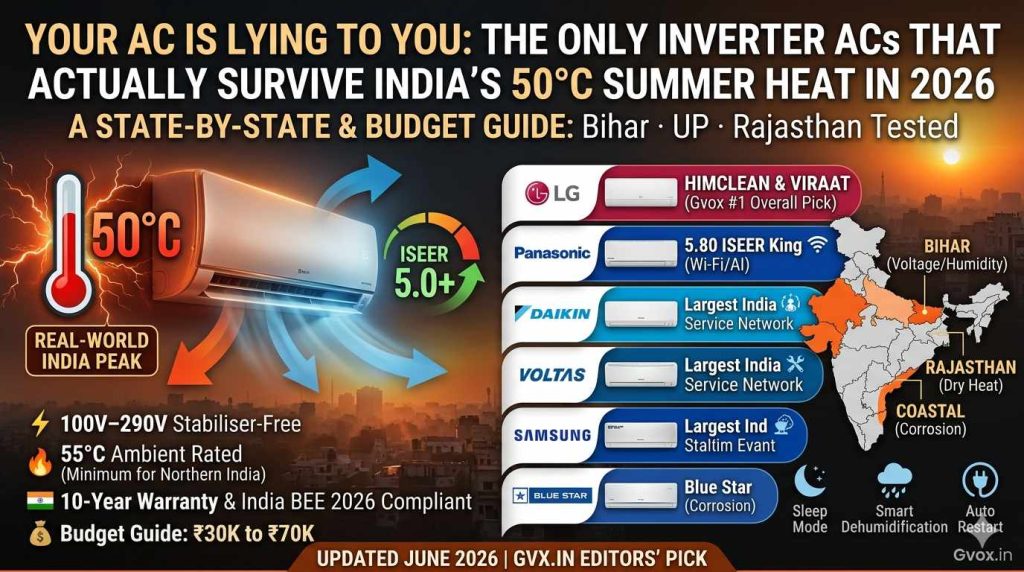
Your AC Is Lying to You: The ONLY Inverter ACs That Actually Survive India’s 50°C Summer Heat in 2026
Most ACs sold in India fail silently above 45°C — throttling cooling, burning extra electricity, or tripping compressors entirely. This is the complete truth about which inverter ACs genuinely perform in Indian summer conditions, state by state, budget by budget. Specs, brand comparisons, buying checklist, and a clear final verdict — updated June 2026.
Complete Guide — What’s Inside
01. Why Most ACs Sold in India Are Not Built for India
Here is the uncomfortable truth that most AC brands and retailers don’t want you to think about: the vast majority of split ACs sold in India are engineered for temperate climates — typically tested and rated for ambient temperatures up to 43°C. They meet BEE star rating requirements and look great on spec sheets. But India’s 2026 summer is not 43°C. It’s 47°C, 48°C, even 50°C in cities across Bihar, Uttar Pradesh, Rajasthan, Madhya Pradesh, and Telangana.
When ambient temperature exceeds an AC’s rated limit, several damaging things happen simultaneously. First, the compressor discharge pressure spikes significantly — in some cases 20–30% above design parameters. The compressor, working far harder than it was designed to, begins consuming substantially more electricity. Cooling output drops, often by 15–25%. In extreme cases — and this happens far more commonly than brands admit — the compressor’s high-pressure protection switch trips, shutting the AC down entirely. You are left in a 47°C room with a non-functioning AC and no recourse until the outdoor temperature drops. This is not a malfunction. This is the AC doing exactly what it was designed to do — protect itself. The problem is that it was designed for a different climate than yours.
Compounding this is India’s voltage infrastructure. In tier-2 and tier-3 cities, towns, and rural areas across Bihar, UP, Jharkhand, and Odisha, voltage regularly fluctuates between 160V–220V, with sags to 140V during peak load hours in the evening. An AC with a narrow stabiliser-free range (say, 180V–240V) may compressor-trip multiple times per evening, causing wear and erratic operation. The right AC for India needs a wide stabiliser-free range, ideally 100V–290V.
Then there is the monsoon problem. India’s summer doesn’t end in May. It transitions into a humid, heavy monsoon from June through September. A room at 32°C and 85% relative humidity feels far more uncomfortable than 36°C at 40% humidity, yet many ACs are optimised purely for dry-bulb cooling. The best ACs for India have dedicated Smart Dehumidification or Dry modes that actively remove humidity without overcooling — this is a genuinely meaningful feature from June to September in coastal, eastern, and central India.
Understanding these three failure modes — high ambient throttling, voltage sensitivity, and humidity mismanagement — is the entire foundation of choosing a genuinely good AC for Indian conditions. Everything that follows in this guide is built on these realities.
The 5 Numbers Every Indian AC Buyer Must Know
02. The 8 Features That Separate Real Indian-Grade ACs from Everything Else
03. ISEER & BEE Star Ratings — What They Really Mean for Your Electricity Bill
ISEER stands for Indian Seasonal Energy Efficiency Ratio — it is the Bureau of Energy Efficiency’s (BEE) primary measurement of how efficiently an air conditioner cools your home across a full Indian cooling season. Unlike simple EER which measures efficiency at one specific condition, ISEER measures across the range of temperatures typical of Indian conditions throughout the summer. A higher ISEER means the AC produces more cooling for each unit of electricity consumed, averaged across a realistic Indian season.
For 2026, the BEE 5-star minimum ISEER for split inverter ACs has been raised to 4.60 — up from earlier thresholds. This ongoing tightening means an AC that earned 5 stars in 2022 may only qualify for 3 stars under 2026 BEE standards. Always check that the star rating on the AC you’re buying carries a 2025 or 2026 BEE label — an older 5-star label on a 2022 model may represent substantially lower efficiency by today’s standards.
Among the top brands in 2026, ISEER values range from 5.00 (Voltas’s top 5-star model) to 5.80 (Panasonic’s NU18BKY5WX — India’s current highest certified ISEER for any 1.5-ton split AC). Each 0.5-point increase in ISEER saves roughly ₹200–₹300 per year at standard usage. The practical implication: choosing a 5.80 ISEER model over a 5.00 ISEER model saves approximately ₹160–₹240 per year, or ₹1,600–₹2,400 over 10 years — at 8 hours/day usage during the season.
The Real-Money Impact of ISEER at ₹8/Unit
04. Top 6 Inverter ACs for India’s Hot Weather in 2026 — Ranked
| Rank | Model | ISEER | Max Ambient | Approx Price (Jun 2026) | Best For | Key Advantage |
|---|---|---|---|---|---|---|
| #1 🥇 | Panasonic CS/CU-NU18BKY5WX | 5.80 — India’s Best | 55°C | ₹52,000–₹57,000 | Maximum electricity savings | Highest ISEER in India, Wi-Fi, 8-in-1 modes, PM 0.1 filter |
| #2 🥈 | Carrier Ester Neo / Flexicool 5 Star | 5.60 | 52°C | ₹45,000–₹52,000 | Delhi/Rajasthan extreme dry heat | Insta Cool rapid pulldown, strong service in North India |
| #3 🥉 | Blue Star IA518DXU 5 Star 2026 | 5.41 | 55°C | ₹48,000–₹54,000 | Coastal & commercial-grade | Nano shield blue fins, acoustic insulation, 7-in-1 convertible |
| #4 | LG AS-Q19YNZE1 / PWZE 5 Star | 5.20 | 55°C | ₹43,490–₹49,400 | Best all-rounder under ₹50K | HimClean auto-evaporator wash, VIRAAT 116% turbo, Diet Mode+ 83% savings |
| #5 | Samsung WindFree Elite 5 Star | 5.15 | 52°C | ₹50,000–₹58,000 | Smart home users, no-draft sleeping | WindFree micro-holes, Freeze Wash self-clean, Wi-Fi, PM 2.5 |
| #6 | Voltas 185V Vectra Prism 5 Star | 5.00 | 52°C | ₹38,000–₹44,000 | Budget-conscious buyers, tier-2 service | Largest service network in India 5,600+, competitive price |
05. Brand-by-Brand Deep Breakdown — Strengths, Weaknesses, and Ideal Buyer
06. Full Specifications Comparison Table — All Top Brands Side by Side
| Specification | LG AS-Q19YNZE1 | Panasonic NU18BKY5WX | Blue Star IA518DXU | Carrier Ester Neo | Samsung WindFree Elite | Voltas 185V Vectra Prism |
|---|---|---|---|---|---|---|
| ISEER Rating | 5.20 | 5.80 ⭐ Best | 5.41 | 5.60 | 5.15 | 5.00 |
| BEE Star 2026 | 5 Star | 5 Star | 5 Star | 5 Star | 5 Star | 5 Star |
| Annual Energy | ~671 kWh | ~581 kWh | ~640 kWh | ~620 kWh | ~690 kWh | ~708 kWh |
| Max Ambient Temp | 55°C ✅ | 55°C ✅ | 54°C–55°C | 52°C | 52°C | 52°C |
| Compressor Type | Dual Inverter | Dual Inverter | Inverter Rotary | Inverter | BLDC Inverter | Inverter Rotary |
| Cooling Modes | 6-in-1 (AI+) | 8-in-1 (True AI) | 7-in-1 | 5-in-1 | 4-in-1 CY | 5-in-1 Adjustable |
| Turbo/Boost Mode | VIRAAT 116% — No Time Limit | Turbo Cool — No Time Limit | Turbo Cool | Insta Cool Rapid | Fast Cool | Turbo Cool |
| Self-Cleaning | HimClean Ice-Wash Auto | Self-Cleaning | Self-Clean | Auto Self-Clean | Freeze Wash Auto | Auto Self-Clean |
| Stabiliser-Free Range | 120V–290V | 130V–285V | 130V–280V | 130V–285V | 130V–290V | 110V–285V |
| Copper Coil | 100% Copper + Ocean Black | 100% Copper | 100% Copper + Nano Shield | 100% Copper + Gold Fin | 100% Copper | 100% Copper + Blue Fin |
| Wi-Fi / Smart | No (This Variant) | Yes — ThinQ / Matter | Selected Models | Selected Models | Yes — SmartThings | Selected Models |
| Noise Level (IDU) | ~31 dB | ~30 dB | ~32 dB | ~32 dB | ~19 dB (WindFree) | ~33 dB |
| Air Throw | ~15 metres | ~13 metres | ~15 metres | ~14 metres | ~13 metres | ~14 metres |
| Refrigerant | R32 — Eco | R32 — Eco | R32 — Eco | R32 — Eco | R32 — Eco | R32 — Eco |
| Auto Restart | Yes | Yes | Yes | Yes | Yes | Yes |
| Compressor Warranty | 10 Years | 10 Years | 10 Years | 10 Years | 10 Years | 10 Years |
| Product Warranty | 1 Year Comprehensive | 1 Year | 1 Year | 1 Year | 1 Year | 5 Year Comprehensive |
| Service Network | ~4,800+ | ~2,900+ | ~3,200+ | ~2,800+ | ~3,800+ | ~5,600+ — Largest |
| Approx Price Jun 2026 | ₹43,490–₹49,400 | ₹52,000–₹57,000 | ₹48,000–₹54,000 | ₹45,000–₹52,000 | ₹50,000–₹58,000 | ₹38,000–₹44,000 |
07. Real Electricity Savings — A 10-Year Cost Analysis Indian Buyers Never See
The single most valuable calculation you can do before buying an AC is a 10-year total cost of ownership analysis. Virtually no retailer or brand presents this to you — because it makes premium 5-star inverter ACs look dramatically better value than they appear from purchase price alone. Here is what the numbers actually say.
Consider a buyer in Patna, Bihar, running their 1.5-ton AC for 8 hours per day from April through September — approximately 180 days. That’s 1,440 hours of annual AC usage. At a local electricity rate of ₹7/unit (Bihar Bijli Vitran Nigam’s current domestic tariff for medium usage):
A 3-star non-inverter AC consuming ~900 kWh per BEE test conditions in practice runs closer to 1,100–1,300 kWh at Indian summer temperatures — generating an annual electricity cost of approximately ₹7,700–₹9,100 just for the AC. A Panasonic ISEER 5.80 model consuming ~581 kWh under the same usage generates approximately ₹4,067/year. The annual saving is approximately ₹3,600–₹5,000. Over 10 years: ₹36,000–₹50,000 in pure electricity savings — the entire purchase price of a good AC recovered in electricity savings alone. This is why BEE’s push toward higher ISEER standards is one of the most important consumer protection initiatives in India.
Even within the 5-star inverter category, the difference between an ISEER 5.00 model (Voltas, ~708 kWh) and an ISEER 5.80 model (Panasonic, ~581 kWh) is approximately 127 kWh/year — saving approximately ₹890/year at ₹7/unit. Over 10 years: ₹8,900 in additional savings. This is a meaningful number that often exceeds the price premium between the Voltas and Panasonic model.
The Maintenance Cost Nobody Calculates
Beyond electricity, Indian ACs require annual cleaning to maintain efficiency. Without cleaning, evaporator grime reduces cooling output by 10–20% and increases electricity consumption by a proportional amount. Professional AC servicing in India costs ₹500–₹1,500 per visit for standard cleaning, with deep cleaning or gas charging adding ₹1,500–₹3,500. An AC without auto-cleaning technology needs 2–3 professional services per year to maintain efficiency — costing ₹1,500–₹4,500 annually.
ACs with auto self-cleaning (LG’s HimClean, Samsung’s Freeze Wash) can reduce professional service needs to 1–2 visits annually, saving ₹1,000–₹3,000/year. This maintenance cost difference alone can justify a ₹5,000–₹8,000 price premium for a self-cleaning AC over its lifespan.
| AC Type | Purchase Price | Annual Electricity | 10-Yr Electricity | Annual Maintenance | 10-Yr Total Cost | Saving vs 3-Star |
|---|---|---|---|---|---|---|
| 3-Star Non-Inverter | ₹28,000 | ~₹8,400 | ~₹84,000 | ~₹3,000 | ~₹1,42,000 | — |
| Voltas 5-Star ISEER 5.00 | ₹41,000 | ~₹4,956 | ~₹49,560 | ~₹2,500 | ~₹1,16,060 | ₹25,940 saved |
| LG AS-Q19YNZE1 ISEER 5.20 | ₹46,000 | ~₹4,697 | ~₹46,970 | ~₹1,200 (HimClean) | ~₹1,05,970 | ₹36,030 saved |
| Blue Star IA518DXU ISEER 5.41 | ₹51,000 | ~₹4,480 | ~₹44,800 | ~₹2,000 | ~₹1,17,800 | ₹24,200 saved |
| Carrier Ester Neo ISEER 5.60 | ₹48,000 | ~₹4,340 | ~₹43,400 | ~₹2,000 | ~₹1,13,400 | ₹28,600 saved |
| Panasonic NU18BKY5WX ISEER 5.80 | ₹54,000 | ~₹4,067 | ~₹40,670 | ~₹2,000 | ~₹1,16,670 | ₹25,330 saved |
08. State-by-State AC Buying Guide — What You Need, Where You Live
| Region / States | Climate Challenge | Must-Have Features | Top Recommendation | Avoid |
|---|---|---|---|---|
| Bihar, UP, Jharkhand, MP Central | Extreme dry heat 45–50°C + grid instability + humid monsoon | 55°C ambient, 100V–290V stabiliser-free, turbo with no time limit, auto restart, smart dehumidify | LG AS-Q19YNZE1 or Panasonic NU18BKY5WX | Any AC rated under 52°C ambient; narrow voltage range models |
| Rajasthan, Haryana, Delhi-NCR | Extreme dry heat 45–50°C, low humidity, long summer season | 55°C ambient, rapid turbo mode, energy efficiency (long season = high bills) | Carrier Ester Neo or Panasonic NU18BKY5WX | Budget 3-star models; ACs rated below 50°C ambient |
| Coastal Maharashtra, Goa, Karnataka, TN, Kerala | High humidity year-round, moderate heat, salt air corrosion | Smart dehumidification, anti-corrosion fin coating (Gold Fin/Blue Fin/Nano Shield), self-cleaning | Blue Star IA518DXU or Samsung WindFree | ACs without anti-corrosion fin treatment — will degrade in 2–3 years near the coast |
| Mumbai, Bangalore, Hyderabad, Pune | Humid summers, moderate heat (max ~40°C), long usage season | High ISEER (long season = high bills), smart features, low noise | Panasonic NU18BKY5WX or Samsung WindFree | Lower ISEER models — extended usage means efficiency differences matter more |
| West Bengal, Assam, Odisha, East Coast | High humidity + heat + grid instability in rural areas | Smart dehumidification, wide stabiliser-free range, service network accessibility | LG PWZE or Voltas 185V Vectra Prism | Brands with thin service coverage in eastern India |
| Tier-2 Cities, District Towns, Rural India | Variable voltage, limited service access, budget sensitivity | Wide stabiliser-free range, proven service network, value pricing | Voltas 185V Vectra Prism (India’s widest service network) | Premium brands with limited rural service penetration |
| Punjab, Himachal Foothills, J&K Plains | Extreme summer followed by cold winter — shorter AC season | Moderate ISEER sufficient (shorter season), consider heat pump/cooling-heating combo | LG or Voltas 5-Star standard models | Paying premium for highest ISEER when usage season is shorter |
09. AC Installation in India — The Critical Factors Most Guides Never Mention
The quality of installation has a larger impact on real-world AC performance than any single feature difference between competing models. An LG 5-star AC installed incorrectly can perform worse than a Voltas 3-star AC installed properly. This is a fact that Indian consumers almost never hear, and it costs thousands of families every year in wasted electricity, premature repairs, and poor cooling.
The Most Common Installation Mistakes in India
The most damaging and most common installation mistake is incorrect pipe length and inadequate insulation. The refrigerant piping connecting the indoor and outdoor unit should be as short as possible — ideally 3–5 metres. For every extra metre of piping beyond the design optimum, cooling efficiency drops by approximately 2–3%. In older buildings where the outdoor unit must be placed far from the indoor unit, copper pipe lengths of 8–12 metres are common, reducing efficiency by 15–25%. Both the copper pipe and the electrical wiring run must be properly insulated against heat gain — many cheap installations use inadequate insulation foam that deteriorates within 1–2 years.
The second major issue is outdoor unit placement. The outdoor unit must have at least 30–50 cm clearance on all sides for adequate airflow. Units placed in enclosed balconies, tight utility shafts, or against solid walls on multiple sides cannot dissipate heat efficiently — the outdoor unit essentially recirculates hot air, reducing performance dramatically. In apartments, insist on a balcony railing or wall bracket that positions the outdoor unit with clear airflow on at least two sides.
Third: always use the brand’s authorised installation service at the time of purchase. Most brands provide free first installation with purchase if you use their authorised team. Non-authorised installation may void warranty claims for defects attributed to installation. Authorised teams also carry calibrated manifold gauges to verify refrigerant pressure after installation — ensuring the system hasn’t developed a leak during transit or installation.
Electrical Requirements: What Electricians Often Get Wrong
A 1.5-ton inverter AC requires a dedicated 15-amp or 20-amp circuit — not a shared circuit with other appliances. Running an AC on a shared circuit causes voltage drops at the circuit level, increasing electricity consumption and causing compressor stress. The wire gauge matters too: use minimum 2.5 sq mm copper wire for the AC circuit, not 1.5 sq mm (which is standard for lights and fans). An undersized wire acts as a resistance in the circuit, wasting electricity as heat and constituting a fire risk over time.
10. The 10-Point Indian AC Buying Checklist — Save It Before You Shop
| # | Check This | Why It Matters | Pass Standard |
|---|---|---|---|
| 1 | BEE Star Label Year | Old star labels are deceptive — a 2022 5-star may be a 2026 3-star | Label must show 2025 or 2026 BEE certification year |
| 2 | ISEER Value | The actual efficiency number behind the star rating — more is always better | 5.0 minimum; 5.2+ preferred; 5.8 = best in class |
| 3 | Maximum Ambient Operating Temperature | The temperature at which the AC can sustain full cooling output | 52°C minimum for UP/Bihar/Rajasthan; 55°C ideal |
| 4 | Stabiliser-Free Voltage Range | Determines whether you need an external stabiliser | 100V–290V ideal; 130V–285V acceptable for most cities |
| 5 | Compressor Warranty | Compressor replacement costs ₹8,000–₹18,000 without warranty | 10 years — non-negotiable in 2026 |
| 6 | Copper Coil Confirmation | Aluminium coils corrode and leak after 4–6 years in Indian conditions | 100% copper with anti-corrosion coating explicitly confirmed |
| 7 | Turbo Mode Time Limit | A 15-minute turbo limit is inadequate for extreme heat zones | No automatic time-out on turbo / boost mode preferred |
| 8 | Auto Restart | Essential in areas with frequent power cuts | Auto Restart confirmed in specifications or manual |
| 9 | Brand Service Network in Your Area | A brand with no authorised service centre within 50 km becomes a nightmare to maintain | At least 1 authorised service centre within 30 km; verify on brand’s website before buying |
| 10 | Installation Package | Free authorised installation with purchase protects your warranty and ensures correct setup | Confirm free first installation from brand’s authorised team is included at time of purchase |
11. Budget Guide — Best Inverter AC at Every Price in India 2026
| Budget | Best Pick | What You Get | What You Sacrifice | Who Should Buy |
|---|---|---|---|---|
| Under ₹35,000 | Voltas 183V Vectra CAR / Lloyd GLS18I5FWEW 5-Star | 5-star efficiency, inverter compressor, basic smart features, India’s best service network (Voltas), decent ISEER 4.8–5.0 | Lower ambient rating (~50°C max), fewer convertible modes, no self-cleaning, limited smart features | Buyers on strict budget in metros/tier-1 cities where ambient rarely exceeds 42°C; first AC purchase in mild-climate regions |
| ₹35,000–₹44,000 | Voltas 185V Vectra Prism 5-Star or Hitachi 5-Star Xpandable+ | ISEER 5.0+, 52°C ambient, strong service network, adjustable convertible modes, reliable brand longevity | No 55°C ambient, no auto self-cleaning, no advanced AI cooling | Budget-conscious buyers in tier-2 cities and towns who need reliable cooling without premium features |
| ₹44,000–₹52,000 | LG AS-Q19YNZE1 (Best Overall) | ISEER 5.20, 55°C ambient, HimClean auto-cleaning, VIRAAT 116% turbo with no time limit, Diet Mode+ 83% savings, 100% copper, smart dehumidification, lowest 10-yr total cost | No built-in Wi-Fi on base variant; slightly lower ISEER than Panasonic | Best value bracket. Buyers in Bihar, UP, Rajasthan, MP who need genuine extreme-heat performance and want to minimise 10-year total ownership cost |
| ₹50,000–₹58,000 | Panasonic NU18BKY5WX or Samsung WindFree Elite | India’s highest ISEER 5.80 (Panasonic), Wi-Fi/smart home, 8-in-1 modes, PM 0.1 filter; or Samsung’s WindFree no-draft sleeping comfort with Freeze Wash auto clean | Panasonic’s service network is thinner than LG/Voltas; Samsung’s 52°C ambient less suited for extreme heat zones | Buyers prioritising maximum electricity savings (Panasonic) or smart-home integration and sleeping comfort (Samsung) in metro cities |
| ₹55,000–₹70,000 | Blue Star IA518DXU 5-Star or Daikin FTKM50TV 5-Star | Commercial-grade build durability, ISEER 5.41 (Blue Star), nano shield corrosion protection, premium Japanese reliability (Daikin), exceptional temperature consistency | Price premium without proportionally higher ISEER vs ₹45K–₹52K options; thinner service network in smaller cities | Long-term buyers in coastal areas (Blue Star’s nano shield) or buyers who prioritise durability and consistent performance above all else (Daikin) |
12. Inverter vs Non-Inverter AC — The Definitive Indian Answer
The inverter vs non-inverter question gets asked repeatedly in Indian households, largely because non-inverter ACs are still widely sold and marketed aggressively at lower price points. The answer, in 2026, is unambiguous for almost every Indian household: buy an inverter AC. Here is why, without the marketing language.
A non-inverter AC (also called fixed-speed or constant-speed) has a compressor that runs at 100% capacity or doesn’t run at all. To maintain your set temperature, it cycles on and off repeatedly — typically every 3–10 minutes. Each startup cycle draws a large surge current (approximately 3–5x normal running current for 1–3 seconds) and causes mechanical stress on the compressor. Over years of operation, this constant on/off cycling degrades the compressor faster than continuous variable-speed operation.
An inverter AC’s compressor never fully stops. Instead, it runs at variable speed — slowing to 20–30% capacity when the room is cool, ramping up to 100%–120% when cooling demand spikes. This continuous variable operation is more efficient at maintaining stable temperature, consumes significantly less electricity (30–50% less for most Indian usage patterns), and puts far less mechanical stress on the compressor over its service life.
The only scenario where a non-inverter AC makes economic sense is if you plan to use it for very short periods (under 2 hours/day) and have a very tight purchase budget. For usage exceeding 4 hours/day — which describes the vast majority of Indian households during summer — the inverter saves enough in electricity within 2–4 years to more than recover its price premium. After that, every year is pure savings. At 8+ hours/day usage in Indian summer conditions, an inverter AC saves ₹3,000–₹6,000 annually over a comparable non-inverter. Over 10 years: ₹30,000–₹60,000 in electricity savings.
13. AC Maintenance in India — The ₹10,000 Mistake Most Owners Make Every Year
India’s dust, pollen, humidity, and biological air quality make AC maintenance more important here than almost anywhere else in the world — yet most Indian AC owners are dramatically under-maintaining their units. The consequences are invisible at first: slightly reduced cooling, slightly higher electricity bills, slightly worse air quality inside the room. Over months and years, the invisible becomes visible: a room that never quite reaches the set temperature even when the AC runs continuously; electricity bills that have silently climbed by 15–25%; and eventual compressor failure caused by the compressor working harder for years to overcome a dirty evaporator.
The Minimum Indian Maintenance Schedule
The air filter should be cleaned once per month during peak summer (April–September) and once every 6 weeks during the rest of the year. This takes 5 minutes with a vacuum or rinse under running water. A clogged air filter reduces airflow by 15–30% and forces the compressor to work harder — the electricity waste from a dirty filter typically costs ₹500–₹1,500 per season in wasted electricity alone.
The evaporator coil (inside the indoor unit) should be professionally cleaned once per year if your AC doesn’t have self-cleaning technology, or every 18–24 months if it does. Without cleaning, a biofilm of bacteria, mould, and dust gradually insulates the evaporator, reducing heat exchange efficiency. This is also a significant health concern — a dirty evaporator becomes a growth medium for mould and bacteria that are then blown directly into your room with the cooled air.
The outdoor condenser coil should be inspected and cleaned once per year, ideally before the summer season begins. Dust accumulation on the condenser reduces its ability to release heat, raising operating pressure and electricity consumption. In areas near construction, farmland, or industrial activity, this should be done twice per year.
Gas (refrigerant) should not need topping up unless a leak is detected. If your AC is cooling 20–30% less than it used to and the technician wants to charge refrigerant without identifying the leak source, refuse. A correctly installed and sealed system should not lose refrigerant under normal operation. Gas loss indicates a leak — fix the leak first, then recharge.
14. Final Verdict — The Editor’s Definitive Pick for India’s 2026 Summer
🏆 Final Verdict: Inverter ACs for India’s Extreme Hot Weather 2026
India’s 2026 summer is not forgiving. The IMD has already documented above-normal heatwave intensity across Bihar, UP, Rajasthan, MP, Telangana, and Maharashtra — states where temperatures are touching 47°C–50°C. In this environment, the difference between an AC that is genuinely engineered for Indian conditions and one that is simply marketed for Indian conditions is the difference between comfort and misery.
For the vast majority of Indian buyers — particularly in the high-heat zones of north and central India — the LG AS-Q19YNZE1 (or its Wi-Fi enabled sibling models) represents the best single purchase decision in the ₹43,000–₹52,000 segment. It combines the features that matter most for India’s specific challenges — 55°C ambient operation, VIRAAT Mode turbo cooling with no time limit, HimClean auto-cleaning that genuinely reduces maintenance cost and effort, Smart Dehumidification for the monsoon, 120V–290V stabiliser-free range, and 4,800+ service centres — in a package that, when you calculate 10-year total cost of ownership, delivers the lowest all-in cost of any model in its class.
If your primary concern is maximum electricity efficiency and you run your AC 8+ hours daily, the Panasonic NU18BKY5WX at ISEER 5.80 is India’s current best performer and will deliver the lowest electricity bills of any 1.5-ton AC available. The price premium over the LG is justified purely by electricity savings for heavy users. For buyers in tier-2 towns and smaller cities where service accessibility is paramount, Voltas 185V Vectra Prism offers India’s widest service network with solid 5-star efficiency at a competitive price. For coastal buyers, Blue Star IA518DXU‘s nano shield corrosion protection is a meaningful long-term investment.
The most important summary of this entire guide: do not buy a non-inverter AC in 2026 unless your usage is genuinely under 3 hours per day; do not buy any AC rated below 52°C ambient if you live in UP, Bihar, Rajasthan, or central India; and do not compromise on copper condenser coils or a 10-year compressor warranty. These are the three lines that separate a good AC purchase from an expensive mistake you’ll pay for over the next decade.