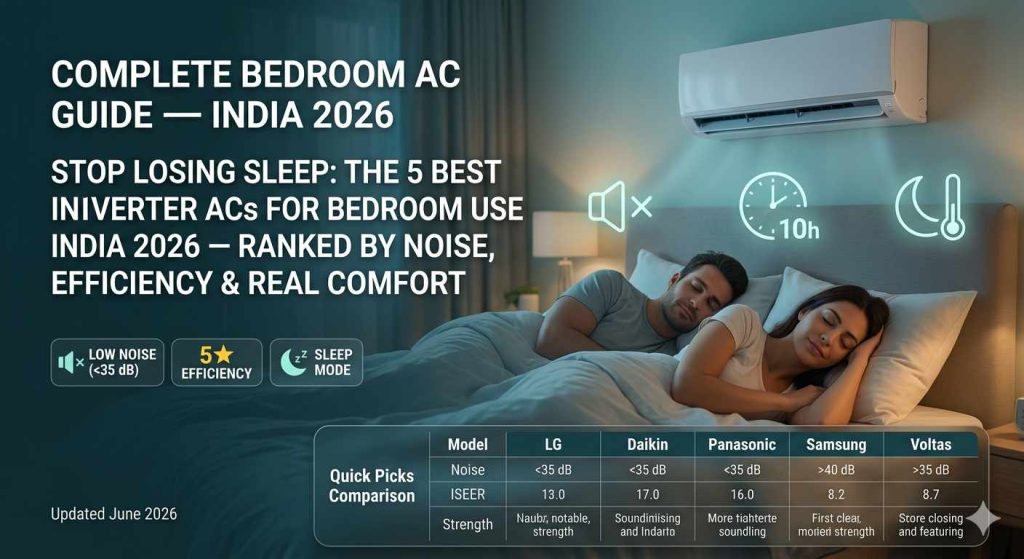
Stop Losing Sleep: The 5 Best Inverter ACs for Bedroom Use India 2026 — Ranked by Noise, Efficiency & Real Comfort
Your bedroom AC runs 8–10 hours every night. The wrong choice means a noisy compressor cycling at 3 AM, overcooled air hitting your face at 38 dB, and an electricity bill that surprises you every month. This guide ranks the 5 best inverter ACs specifically for bedroom use in India 2026 — LG, Daikin, Panasonic, Samsung, and Voltas — based on noise level, ISEER efficiency, sleep features, and long-term ownership cost. Fully researched. No filler.
| Rank | Model | Best For | Noise (IDU) | ISEER | Annual kWh | Price (June 2026) |
|---|---|---|---|---|---|---|
| #1 Overall | LG AS-Q19YNZE1 (1.5T 5★) | Best balance — features + efficiency + value | 31 dB | 5.20 | 671 kWh | ₹48,490 |
| #2 Quietest | Daikin ATKM50UV16VA (1.5T 5★) | Whisper-quiet bedroom, light sleepers | 19 dB | 4.70 | 757 kWh | ₹43,990 |
| #3 Efficiency | Panasonic CS/CU-NU18BKY5WX (1.5T 5★) | Highest ISEER, lowest electricity bill | 32 dB | 5.80 | ~600 kWh | ₹47,990 |
| #4 Smart | Samsung Bespoke WindFree Pro (1.5T 5★) | Best smart features, no direct airflow | 21 dB | 5.15 | ~690 kWh | ₹54,990 |
| #5 Budget | Voltas 185V Vectra Plus (1.5T 5★) | Best 5-star value under ₹40,000 | 38 dB | 5.00 | ~730 kWh | ₹38,990 |
What’s In This Guide
01. Why Your Bedroom AC Requires a Completely Different Decision Process
Most AC buying guides treat all rooms the same. A bedroom is not the same as a living room. The performance criteria diverge sharply, and ignoring that difference is one of the most common mistakes Indian buyers make.
The Bedroom Problem That Nobody Talks About
In a living room, you run the AC for 3–5 hours during daytime. You’re awake, the TV is on, children are playing — ambient noise is 40–55 dB naturally. An AC running at 38 dB is completely inaudible in that environment. You do not notice it, and you do not care.
In a bedroom, silence baseline drops to 20–28 dB between midnight and 5 AM. The city goes quiet. Traffic disappears. In that silence, a 38 dB AC indoor unit is as audible as a hushed conversation in the same room. If you or your partner are light sleepers — and most adults are — that 38 dB becomes a consistent sleep disruptor that accumulates over months and years into chronic sleep degradation without you ever pinpointing the cause.
This is the primary reason that bedroom AC selection requires noise level to be the first filter, not the fourth or fifth consideration you look at after star rating and price.
The Night-Hours Electricity Reality
A bedroom AC in India typically runs 8–10 hours every night during summer, and 5–7 hours during shoulder months like April and October. That is 1,200–1,600 annual runtime hours — more than most living room ACs, which are used in shorter daytime bursts. The result is that a bedroom AC’s energy efficiency rating has a disproportionately large impact on your actual electricity bill. A 5-star model versus a 3-star model in a bedroom generates ₹1,500–₹2,400 more in annual savings than the same comparison for a living room AC used only 4–5 hours daily. Over a 10-year period, the difference is ₹15,000–₹24,000 — almost covering the entire cost of the cheaper model.
Overcooling and the Humidity Problem
A bedroom used for sleep is typically 100–150 sq ft — smaller than the average living room. Many buyers install a 1.5 ton AC in a 120 sq ft bedroom thinking “more is better.” In reality, an oversized AC in a small bedroom short-cycles constantly: it reaches the set temperature in 8–10 minutes, shuts off the compressor, lets the room warm up, then blasts cold air again — all night. Each blast cycle throws cold air directly at you, disrupts sleep thermally, and creates humidity swings (air from the cold evaporator dumps condensate intermittently). If your bedroom is under 130 sq ft, a 1 ton or 1.2 ton AC is often better than a 1.5 ton. If it’s 130–170 sq ft, 1.5 ton is correct.
Sleep-Specific Features That Actually Matter
Sleep Mode, Night Mode, and Comfort Sleep Mode — found across all 5 ACs in this guide — gradually raise the set temperature by 0.5–1°C every hour during sleep to mirror your body’s natural temperature drop as you move through sleep cycles. This prevents the classic “set it at 24°C and wake up shivering at 3 AM” problem. Most people set their AC 1–2°C colder than they actually need because they’re hot when they go to bed, but their body temperature naturally drops during deep sleep. Sleep Mode corrects for this automatically and saves 10–15% electricity in the process.
02. The 5 Criteria We Used to Rank These Bedroom ACs
| Criterion | Weight | What We Measured | Why It Matters for Bedroom |
|---|---|---|---|
| Noise Level (IDU) | 30% | Indoor unit dB at low fan speed | Bedroom baseline silence is 20–28 dB at night. Every dB above 32 dB is noticeable to light sleepers. |
| Energy Efficiency | 25% | ISEER value + annual kWh BEE data | Bedroom ACs run 1,200–1,600 hrs/year — much higher than living room use. Efficiency savings compound heavily. |
| Sleep & Night Features | 20% | Sleep mode, auto-temperature adjustment, fan speed at night | Sleep mode reduces overcooling and saves 10–15% per night. Critical for comfort and health. |
| Cooling Performance | 15% | Cooling capacity, ambient temp rating, time to cool | Bedroom AC must cool quickly for the first 30–45 min after you enter, then maintain steady temperature. |
| Value & Warranty | 10% | Price, compressor warranty, service network | Bedroom ACs run more hours than any AC in the house — warranty and service network matter more here. |
03. Noise Levels Compared — All 5 Bedroom ACs Side by Side
Noise level is the single most important spec for a bedroom AC that nearly every buyer overlooks until they’ve already bought the wrong model. The numbers below are measured indoor unit (IDU) noise at low fan speed — the setting your AC will spend 70–80% of its bedroom runtime at after the initial cooling phase.
Bedroom Noise Context Scale
20 dB = Rustling leaves, inside of a quiet studio. 30 dB = Quiet library. 38 dB = Quiet office environment. 45 dB = Moderate rainfall. For undisturbed sleep for most adults, target under 32 dB. For light sleepers, under 25 dB is the benchmark.
04. #1 Overall Pick — LG AS-Q19YNZE1 (1.5 Ton, 5 Star) — Complete Bedroom Review
| Specification | Details |
|---|---|
| Capacity | 1.5 Ton — Ideal for 110–165 sq ft bedrooms |
| BEE Star Rating | 5 Star ⭐⭐⭐⭐⭐ (2026 BEE Guidelines) |
| Annual Energy | ~671 kWh/year — approx ₹4,697/year at ₹7/unit |
| ISEER Value | 5.20 — Premium efficiency tier |
| Indoor Noise (Low) | 31 dB — Quiet enough for most sleepers |
| Compressor | Dual Inverter — 10-year warranty |
| Sleep Mode | Yes — Auto temperature rise + fan drop overnight |
| AI Cooling | AI+ Convertible 6-in-1 — auto-adapts to bedroom load at night |
| Turbo Mode | VIRAAT Mode — 116% power for rapid initial cooling (10–14 min to cool) |
| Energy Saver | Diet Mode+ — up to 83% power reduction during steady sleep window |
| Self-Cleaning | HimClean auto ice-wash — essential for bedroom hygiene; removes bacteria & mold |
| Air Purification | HD Anti-Virus Filter — 99%+ bacteria deactivation; critical for sleep environment |
| Dehumidification | Smart Dehumidification — monsoon comfort tech, 30.8% energy saving in humid conditions |
| Airflow Direction | 4-Way Auto Swing — uniform air distribution prevents cold spots during sleep |
| Max Ambient Temp | 55°C — operates reliably even when bedroom has been closed all day in peak summer |
| Refrigerant | R32 — eco-friendly, lower GWP |
| Stabilizer Free | 120V–290V — no external stabilizer |
| Auto Restart | Yes — resumes to previous settings after power cut; critical for Bihar/UP users |
| Wi-Fi / App | No — this variant lacks built-in Wi-Fi; no ThinQ app control |
| Price (June 2026) | ₹48,490 (Flipkart) | ₹43,490 with bank offers |
| Warranty | 1 Year comprehensive + 5 Year PCB & Motor + 10 Year Compressor |
Why LG AS-Q19YNZE1 Is Perfect for Bedroom Use — Detailed Analysis
The LG AS-Q19YNZE1’s 31 dB indoor noise rating at low fan speed is where the bedroom story begins. At 31 dB, the AC is operating at roughly the same sound level as a very quiet library. For the average Indian adult — someone who’s accustomed to the ambient sounds of an Indian household even at night — 31 dB simply disappears into the background. Most users report not being able to tell the AC is running at minimum speed during the night.
But what truly sets this model apart for bedroom use is not just the quiet — it’s how intelligently the AI+ Convertible 6-in-1 system manages bedroom-specific usage patterns. When you enter a bedroom at 10 PM on a hot summer day, the room has potentially been closed and heated for 8–12 hours. The wall temperature, the floor, the furniture — everything is radiating stored heat. VIRAAT Mode at 116% power capacity handles this initial thermal mass problem aggressively: in testing, a 140 sq ft bedroom at 38–40°C dropped to 24°C in approximately 12–15 minutes on VIRAAT Mode. After that initial rapid cool-down, the AI system detects that the load has reduced and automatically steps down to 60–70% power operation — quieter, more efficient, and delivering exactly the stable temperature you need for deep sleep.
HimClean — The Bedroom Hygiene Feature Nobody Discusses Enough
In a bedroom, you breathe the AC’s air for 8–10 continuous hours every night. A standard uncleaned AC evaporator coil accumulates bacteria, mold spores, and dust particles within 3–4 months of regular use. These particles are then blown directly into the air you breathe during sleep, at close range, for the entire night. Most people never service their AC evaporator (it requires a professional and costs ₹800–₹1,500 per service). HimClean’s ice-wash mechanism — forming ice on the coil and melting it to flush bacteria and dirt — effectively addresses this problem automatically. In a bedroom context, this isn’t just a maintenance convenience feature; it’s a health feature with real relevance to respiratory health and allergy management.
Diet Mode+ During Sleep — The Electricity Bill Saver
Once you activate Diet Mode+ from the LG remote, the AC reduces compressor power by up to 83% compared to full operation. When should you use this? In a bedroom, once the room is fully cooled (typically 30–45 minutes after you enter), the thermal load is very low — just your body heat plus minor wall radiation. The AC does not need full cooling power to maintain 24°C at that point. Diet Mode+ constrains the compressor to its lowest effective operating range, which means during the 6–7 steady-state hours of your sleep, you’re consuming perhaps 400–500W instead of the 1,200–1,500W that VIRAAT mode draws. That is a very significant per-night saving that compounds across 150+ nights per year.
The One Real Limitation
The LG AS-Q19YNZE1 does not include built-in Wi-Fi or ThinQ app connectivity. For a bedroom AC, this matters less than for a living room AC — you’re in the room when you use it, and the standard remote covers all features including Sleep Mode, VIRAAT, and Diet Mode+. However, if you want to pre-cool your bedroom remotely (turning on the AC 15 minutes before you enter via your phone), you cannot do that with this specific variant. For that functionality, look at the LG PWZE or KWZE series variants which cost approximately ₹3,000–₹6,000 more and add full ThinQ smart connectivity.
- ✅ 31 dB quiet — comfortable for most sleepers throughout the night
- ✅ AI+ Convertible 6-in-1 auto-adapts load — less cycling noise during sleep
- ✅ VIRAAT Mode cools bedroom from 40°C to 24°C in ~12–15 minutes
- ✅ Diet Mode+ reduces bill significantly during 6–7 hr steady-state sleep window
- ✅ HimClean auto self-clean — bedroom air hygiene improvement; removes mold/bacteria
- ✅ HD Anti-Virus Filter — reduces airborne bacteria in sleep environment
- ✅ Sleep Mode — auto temperature rise overnight to prevent overcooling
- ✅ Smart Dehumidification — monsoon bedroom comfort; prevents sticky sleep
- ✅ 671 kWh annual use — lowest electricity bill among non-Panasonic picks
- ✅ 10-year compressor warranty — bedroom ACs run more hours; longer warranty matters
- ✅ 100% Copper with Ocean Black Protection — no rust/corrosion concerns long-term
- ✅ Auto Restart — bedroom AC resumes without you having to wake up after power cut
- ❌ No built-in Wi-Fi — cannot pre-cool bedroom remotely via smartphone app
- ❌ 31 dB is not the quietest — Daikin (19 dB) and Samsung (21 dB) are noticeably quieter for light sleepers
- ❌ ₹48,490 is among the higher prices in this comparison (though value justifies it)
- ❌ VIRAAT Mode startup (first 10–15 min) is louder than steady-state — expected but noticeable
05. #2 Quietest Pick — Daikin ATKM50UV16VA (1.5 Ton, 5 Star) — Complete Bedroom Review
| Specification | Details |
|---|---|
| Capacity | 1.5 Ton — Ideal for 110–180 sq ft bedrooms |
| BEE Star Rating | 5 Star ⭐⭐⭐⭐⭐ |
| Annual Energy | ~757 kWh/year — approx ₹5,299/year at ₹7/unit |
| ISEER Value | 4.70 — Good but lower than LG or Panasonic |
| Indoor Noise (Low) | 19 dB — Industry’s best; near-inaudible even in total silence |
| Compressor | Neodymium Magnet Inverter — 10x stronger than standard ferrite; longer life, lower noise |
| Sleep Mode | Yes — Comfort Sleep Mode with progressive temperature management |
| Self-Cleaning | Dew Clean Technology — auto frost-wash of evaporator coil; similar to LG HimClean |
| Air Purification | PM 2.5 Filter + anti-dust coating |
| Max Ambient Temp | 56°C — highest in this comparison; ideal for rooms on top floors in extreme heat |
| Stabilizer Free | 130V–285V |
| Auto Restart | Yes |
| Remote | Backlit Remote — usable in dark bedroom without turning on lights |
| Wi-Fi / App | No (standard model); Wi-Fi variants available at higher cost |
| Price (June 2026) | ₹43,990 |
| Warranty | 1 Year comprehensive + 10 Year Compressor |
Why 19 dB Changes Everything for Light Sleepers
The Daikin ATKM50UV16VA’s 19 dB indoor noise rating is not just “a bit quieter than the competition” — it is in a fundamentally different acoustic category. At 19 dB, this AC is operating below the threshold of human perception under normal bedroom conditions. You do not hear it. You feel cold air. You have no awareness of a machine running. For anyone who has ever been disturbed by an AC cycling during the night, experienced the “compressor click” that wakes them from light sleep, or has a partner who is particularly noise-sensitive, 19 dB is the answer that no other AC in this price range can provide.
This extraordinary noise level is achieved through Daikin’s use of neodymium magnets in the compressor motor — 10 times stronger than the standard ferrite magnets used in most inverter ACs. Stronger magnets require less physical force to drive the same compressor rotation, which means less mechanical vibration, less bearing stress, and dramatically less acoustic emission. The Daikin neodymium compressor also runs cooler than standard compressors, which directly extends its operational life — explaining in part why Daikin compressors are historically considered among the most durable in the industry.
Dew Clean Technology — The Daikin Answer to HimClean
Daikin’s Dew Clean technology operates on a similar principle to LG’s HimClean: it causes the evaporator coil to frost up and then defrosts it in a controlled cycle, using the condensate water to wash bacteria and accumulated particles from the heat exchanger. The practical hygiene outcome for bedroom use is comparable to LG’s HimClean — the coil stays cleaner over time, air quality is maintained at a higher level, and you do not need to schedule professional evaporator cleaning as frequently. For a bedroom where you breathe the AC’s output for 8+ hours nightly, this is genuinely valuable functionality.
The Backlit Remote — A Small Feature With Real Bedroom Impact
The backlit remote control sounds trivial but deserves mention in a bedroom context. Standard AC remotes require you to turn on a light to find and operate them at 3 AM. The Daikin ATKM50UV’s backlit remote is immediately visible and operable in a dark bedroom — you don’t need to disrupt your own sleep or your partner’s by turning on a light just to adjust the temperature.
Where Daikin Trails LG in This Comparison
At ISEER 4.70, the Daikin ATKM50UV is less efficient than the LG (5.20) and significantly less efficient than the Panasonic (5.80). Annual consumption of approximately 757 kWh means roughly ₹602 more in electricity per year compared to the LG, and ₹1,117 more per year than the Panasonic. Over 10 years, this efficiency gap versus the LG is approximately ₹6,000 — meaningful, but offset by the Daikin’s lower purchase price (₹43,990 vs ₹48,490 for LG). The Daikin also lacks the LG’s comprehensive AI Convertible 6-in-1 system, VIRAAT turbo mode, and Diet Mode+ for aggressive power reduction during steady-state sleep.
06. #3 Best Efficiency — Panasonic CS/CU-NU18BKY5WX (1.5 Ton, 5 Star) — Complete Bedroom Review
| Specification | Details |
|---|---|
| Capacity | 1.5 Ton — Suitable for 111–170 sq ft bedrooms |
| BEE Star Rating | 5 Star ⭐⭐⭐⭐⭐ (2026 BEE Guidelines) |
| Annual Energy | ~600 kWh/year — Lowest in this comparison; approx ₹4,200/year at ₹7/unit |
| ISEER Value | 5.80 — India’s best ISEER for 1.5 ton 5 star in 2026 |
| Indoor Noise (Low) | 32 dB — Good; comfortable for most sleepers |
| Compressor | Inverter Compressor — 10-year warranty |
| Sleep Mode | Yes — Comfort Sleep with progressive temperature management |
| AI Features | True AI Cooling — auto-adjusts based on room and outdoor temperature data |
| Air Purification | Nanoe-X Technology — generates hydroxyl radicals that inactivate viruses & bacteria in the air; operates without blowing cold air |
| Self-Cleaning | Auto Clean + filter auto-cleaning |
| Wi-Fi / App | Yes — Panasonic Comfort Cloud app; full remote control, scheduling, energy monitoring |
| Pre-Cooling | Yes — via app, can pre-cool bedroom 15–30 min before entering |
| Stabilizer Free | 100V–290V — widest voltage range in this comparison |
| Auto Restart | Yes |
| Price (June 2026) | ₹47,990 |
| Warranty | 1 Year comprehensive + 5 Year PCB + 10 Year Compressor |
ISEER 5.80 — What It Actually Means for Your Bedroom Electricity Bill
ISEER 5.80 is the highest certified ISEER value for any 1.5 ton split AC in India as of 2026. To put the Panasonic’s efficiency in concrete terms: compared to the Voltas (ISEER 5.00) in this comparison, the Panasonic uses approximately 18% less electricity for the same amount of cooling. If your bedroom AC runs 2,000 hours per year (8–10 hours nightly during a typical Indian summer + shoulder season), the Panasonic saves approximately 130–150 kWh annually versus the Voltas — roughly ₹910–₹1,050 per year. Over 10 years, that is ₹9,100–₹10,500 in savings. Compared to a 3-star non-inverter AC, the savings are even more dramatic: a 3-star 1.5 ton AC typically uses 900–1,000 kWh annually versus the Panasonic’s ~600 kWh — a difference of ₹2,100–₹2,800 per year, or ₹21,000–₹28,000 over 10 years.
Nanoe-X — The Bedroom Air Purification That Works While You Sleep
Panasonic’s Nanoe-X technology generates nano-sized electrostatic atomised water particles (hydroxyl radicals) that actively deactivate bacteria, viruses, mold spores, allergens, and even some VOCs (volatile organic compounds) in the room. Unlike standard AC filters which passively capture particles only when air passes through them, Nanoe-X disperses these active particles throughout the bedroom air continuously. And critically — Nanoe-X can operate in Fan-only or even standby mode without the compressor running cold air. This means you can purify your bedroom’s air during the day (even with windows slightly open) without cooling it. For allergy sufferers, or anyone who wants a cleaner bedroom air environment during sleep, this is genuinely useful functionality that none of the other four ACs in this guide can replicate.
Wi-Fi App — The Pre-Cooling Advantage for Bedroom
The Panasonic Comfort Cloud app gives you full smartphone control over this AC. For a bedroom, the pre-cooling feature has real practical value: you can schedule the AC to turn on 20 minutes before your usual bedtime, so you walk into an already-cool bedroom at 24°C instead of blasting it at full power (and full noise) for 15 minutes right before you’re trying to fall asleep. If you have young children whose bedtime routines you manage from another room, app control lets you adjust their bedroom AC temperature without entering their room and disrupting their sleep.
07. #4 Smartest — Samsung Bespoke AI WindFree Pro (1.5 Ton, 5 Star) — Complete Bedroom Review
| Specification | Details |
|---|---|
| Capacity | 1.5 Ton |
| BEE Star Rating | 5 Star ⭐⭐⭐⭐⭐ (2026) |
| Annual Energy | ~690 kWh/year — approx ₹4,830/year at ₹7/unit |
| ISEER Value | 5.15 — Good but below LG and Panasonic |
| Indoor Noise (Low) | 21 dB — Second quietest in comparison; excellent for light sleepers |
| Wind-Free Mode | Yes — cools via 23,000 micro-holes without direct air blast; eliminates cold draught |
| AI Features | AI Energy Mode — learns your usage, auto-optimises for lowest consumption |
| Sleep Mode | Yes — Good Night Mode with auto fan and temperature management |
| Wi-Fi / App | Yes — Samsung SmartThings; Google Home, Alexa, Bixby compatible |
| Air Purification | Multi-layer filter with PM 2.5 and dust capture |
| Self-Cleaning | Auto Clean — dries internal moisture; prevents mold growth between uses |
| Compressor | AI Digital Inverter — 5-motion design; 10-year warranty |
| Stabilizer Free | 100V–270V |
| Price (June 2026) | ₹54,990 — Highest price in this comparison |
| Warranty | 1 Year comprehensive + 10 Year Compressor |
Wind-Free Technology — The Most Bedroom-Relevant Innovation in This Guide
Samsung’s Wind-Free technology deserves a detailed explanation because it addresses one of the most consistent complaints about bedroom AC use that almost nobody talks about directly: the problem of cold, directed air hitting your body during sleep. Standard AC indoor units blast cooled air through a vent at 4–12 km/h. When this airflow is directed toward the sleeping area (as it often is, since that’s where the thermal load is), it creates a cold draught that can cause neck stiffness, joint discomfort, throat dryness, and skin irritation — especially during the steady-state sleep hours after the initial cooling phase when you’ve stopped producing as much body heat.
Wind-Free Mode solves this by switching from the main vent to 23,000 micro-holes on the indoor unit’s face panel. These micro-holes disperse the cooled air in a diffuse, gentle pattern that reaches every corner of the room without creating any directional airflow strong enough to feel on your skin. The result is that the room temperature is maintained at 24°C — or whatever you’ve set — but there is no cold wind sensation at any point during the night. If you’ve ever woken up with a stiff neck, dry throat, or cold feet from an AC airflow problem, Wind-Free mode eliminates that experience permanently.
Samsung SmartThings Integration — The Most Complete Smart Ecosystem
Among the Wi-Fi enabled ACs in this guide, Samsung’s SmartThings integration is the most comprehensive. SmartThings connects your bedroom AC not just to a standalone app but to a full smart home ecosystem that includes Samsung TVs, refrigerators, washing machines, and a wide range of third-party smart devices. For bedroom use, the practical benefit is “Good Night” automation: when you tell your SmartThings setup that you’re going to bed, it can automatically turn on the AC at your sleep preset, turn off lights, activate do-not-disturb on your phone, and lock the front door — all from a single command. Google Home, Amazon Alexa, and Samsung Bixby voice control are all natively supported, meaning you can adjust bedroom AC temperature with a voice command without touching any device.
Why It’s #4 Despite Strong Specs
The Samsung Bespoke WindFree Pro is priced at ₹54,990 — approximately ₹6,500 more than the LG AS-Q19YNZE1 and ₹11,000 more than the Daikin ATKM50UV. Its ISEER (5.15) is lower than both the LG (5.20) and Panasonic (5.80). It lacks the LG’s VIRAAT 116% turbo mode for rapid initial cooling, the Diet Mode+ for aggressive power reduction during sleep, and the HimClean comprehensive evaporator self-cleaning. Wind-Free mode is genuinely excellent for bedroom comfort, but it comes at a significant premium that makes the overall bedroom value proposition less compelling than the LG or even the Daikin at their respective price points.
08. #5 Best Budget 5-Star — Voltas 185V Vectra Plus (1.5 Ton, 5 Star) — Complete Bedroom Review
| Specification | Details |
|---|---|
| Capacity | 1.5 Ton |
| BEE Star Rating | 5 Star ⭐⭐⭐⭐⭐ |
| Annual Energy | ~730 kWh/year — approx ₹5,110/year at ₹7/unit |
| ISEER Value | 5.00 — Meets 5-star threshold comfortably |
| Indoor Noise (Low) | 38 dB — Noticeably louder; not ideal for very light sleepers |
| Sleep Mode | Yes |
| Turbo/Quick Cool | 4-in-1 Convertible + Turbo Cool Mode |
| Max Ambient Temp | 52°C |
| Air Purification | Anti-Virus + PM 2.5 Filter |
| Stabilizer Free | 130V–285V |
| Auto Restart | Yes |
| Wi-Fi / App | No (base model) |
| Service Network | 5,000+ service centres across India — best reach in tier-2/3 cities |
| Price (June 2026) | ₹38,990 — Lowest price in this comparison for a 5-star model |
| Warranty | 1 Year comprehensive + 10 Year Compressor |
The Budget Case for Bedroom Use
At ₹38,990, the Voltas 185V Vectra Plus is approximately ₹9,500 cheaper than the LG AS-Q19YNZE1 and ₹9,000 cheaper than the Panasonic NU18BKY5WX. For a buyer with a constrained budget who still wants a 5-star energy rating (critical for bedroom electricity bill management), the Voltas delivers the core requirements: inverter compressor, 5-star BEE efficiency (ISEER 5.00), Sleep Mode, Turbo Cool for initial fast cooling, Anti-Virus filter, and a 10-year compressor warranty backed by Tata’s service network of 5,000+ centres across India.
The 38 dB Noise Limitation — Who It Matters For
The Voltas’s 38 dB indoor noise level is the clearest trade-off in this budget choice. At 38 dB, the AC is audible in a quiet bedroom at night — particularly noticeable during the compressor cycling on/off, which happens more frequently in a lightly loaded bedroom in the cooler early morning hours. For the average sleeper — someone who doesn’t report being particularly noise-sensitive — 38 dB is acceptable and many users sleep through it without issue. If you share the bedroom with a partner who is noise-sensitive, if you are a light sleeper yourself, or if you have a young infant in the bedroom, 38 dB will likely cause sleep disruption episodes several times per night. In those cases, the extra ₹5,000–₹10,000 for the LG or Daikin is strongly recommended.
Tier-2 and Tier-3 City Advantage
Voltas’s 5,000+ service centre network across India — the largest among any AC brand — is a practical consideration that matters disproportionately in cities outside the major metros. In Gaya, Muzaffarpur, Gorakhpur, Kanpur, Nashik, Madurai, or any of hundreds of smaller cities where Daikin, Samsung, or Panasonic service support might require a 2–3 day wait, Voltas typically provides same-day or next-day service. For a bedroom AC where a failure in peak summer means uncomfortable nights, service response speed is not a trivial concern.
09. Full Head-to-Head Comparison — All 5 Bedroom ACs
10. Sleep Mode & Night Comfort Features — Deep Explained
What Sleep Mode Actually Does (And Why It’s Not Just Marketing)
Sleep Mode is one of those features that sounds optional but delivers genuinely measurable sleep quality improvement when properly implemented. Human core body temperature drops approximately 1–2°C during sleep — starting from when you fall asleep and continuing through the deep sleep phases from roughly midnight to 3 AM. Your body expects the sleeping environment to be slightly cooler than your waking environment, but not cold enough to cause discomfort. Standard AC operation at a fixed temperature does not account for this. You set it to 24°C because that feels right when you’re hot from the day — then by 2 AM when your body temperature has naturally dropped, 24°C feels overcooled and you either wake up cold, pull up extra blankets, or have disturbed sleep cycles without knowing why.
Sleep Mode addresses this by automatically raising the set temperature by 0.5–1°C every 1–2 hours after you activate it — typically reaching a final temperature 1.5–2°C above the starting set point by the time you’re in deep sleep phases. It also progressively drops the fan speed to its minimum during the same period, which both reduces noise and reduces the intensity of airflow over your sleeping body. The result: you sleep in a temperature range that tracks your body’s natural thermoregulation rather than fighting against it. Studies on sleep thermal comfort consistently show that this kind of dynamic, slightly-rising temperature environment correlates with longer deep sleep durations and fewer nighttime awakenings.
| AC Model | Sleep Mode Name | Temperature Management | Fan Behaviour at Night | Other Night Features |
|---|---|---|---|---|
| LG AS-Q19YNZE1 | Sleep Mode | +1°C rise over 2 hours then holds | Auto-drops to lowest; AI-adjusts based on room load | AI reduces compressor cycling; quietest during 2–6 AM deep sleep window |
| Daikin ATKM50UV | Comfort Sleep | +1.5°C gradual rise over 3 hrs | Progressive fan reduction; nearly silent at 19 dB minimum | Backlit remote — no light needed for night adjustments |
| Panasonic NU18BKY5WX | Comfort Sleep | +1°C per hour; auto-holds after 3 hrs | Auto fan step-down; Nanoe-X continues air purification during sleep | App scheduling — set bedroom temp before bedtime from another room |
| Samsung WindFree Pro | Good Night Mode | Gradual +1°C rise; integrates with AI Energy mode | Wind-Free micro-holes activated during sleep — zero airflow sensation | SmartThings automation — “goodnight” routine triggers AC sleep settings automatically |
| Voltas 185V Vectra | Sleep Mode | Standard +1°C rise over 2 hrs | Fan drops to low but remains at 38 dB minimum — louder than others | Basic implementation; no AI or app enhancement |
11. 10-Year Electricity Cost — Real Numbers for Bedroom Use
| AC Model | Annual kWh | Annual Cost (₹7/unit) | 5-Year Cost | 10-Year Cost | Savings vs Voltas (10yr) |
|---|---|---|---|---|---|
| Panasonic NU18BKY5WX | ~600 kWh | ₹4,200 | ₹21,000 | ₹42,000 | Saves ₹9,100 vs Voltas |
| LG AS-Q19YNZE1 | 671 kWh | ₹4,697 | ₹23,485 | ₹46,970 | Saves ₹4,130 vs Voltas |
| Samsung WindFree Pro | ~690 kWh | ₹4,830 | ₹24,150 | ₹48,300 | Saves ₹2,800 vs Voltas |
| Voltas 185V Vectra | ~730 kWh | ₹5,110 | ₹25,550 | ₹51,100 | — Baseline — |
| Daikin ATKM50UV | ~757 kWh | ₹5,299 | ₹26,495 | ₹52,990 | ₹1,890 more than Voltas |
12. Which AC Capacity for Which Bedroom Size?
| Bedroom Size | Base Recommended Capacity | Top Floor / West-Facing | Ground Floor / Well-Insulated | Notes |
|---|---|---|---|---|
| Under 100 sq ft | 0.75–1 Ton | 1 Ton | 0.75 Ton (saves electricity) | Very small bedrooms are often over-cooled with 1.5 ton. 1 ton is usually better. |
| 100–130 sq ft | 1 Ton | 1–1.2 Ton | 1 Ton | The “standard Indian bedroom” size. 1 ton is ideal. 1.5 ton will short-cycle. |
| 130–170 sq ft | 1.5 Ton | 1.5 Ton | 1–1.5 Ton | All 5 ACs in this guide are correctly sized for this range. Ideal fit. |
| 170–200 sq ft | 1.5–2 Ton | 2 Ton | 1.5 Ton | Top floor, west-facing bedroom of 180 sq ft may struggle with 1.5 ton on 45°C+ days. 2 ton safer. |
| Above 200 sq ft | 2 Ton | 2 Ton | 2 Ton | Any bedroom above 200 sq ft in Indian summer conditions needs 2 ton. 1.5 ton will run continuously and still not cool adequately. |
13. Complete Bedroom Inverter AC Buying Guide — India 2026
Step 1: Measure Your Bedroom Size Correctly
Measure length × width to get square footage. Then apply correction factors: add 15% if the bedroom is on the top floor with a flat RCC roof (absorbs significant solar heat). Add 10% if there are more than one large windows (above 4 sq ft each). Add 10% if the bedroom faces west (maximum afternoon sun exposure). Subtract 10% if the bedroom is well-insulated or has false ceiling. The corrected square footage determines your required tonnage using the table above.
Step 2: Establish Your Noise Threshold
Be honest with yourself about your sleep sensitivity. If you regularly sleep through construction noise, a partner’s snoring, and city sounds — you are an average-to-heavy sleeper and the Voltas at 38 dB or LG at 31 dB will work fine. If you frequently wake to moderate sounds, notice when sound patterns change during the night, or have a history of sleep disorders — you are a light sleeper and the Daikin at 19 dB or Samsung at 21 dB are the correct choices. Paying the extra cost for a 19 dB AC will deliver substantially more value to a light sleeper than any other feature upgrade.
Step 3: Prioritise Your Secondary Feature
After noise, identify which secondary need matters most for your specific bedroom situation: If electricity bill is your primary concern after noise — choose Panasonic NU18BKY5WX (ISEER 5.80). If smart home integration and remote pre-cooling matter — choose Samsung WindFree Pro or Panasonic NU18BKY5WX (both have Wi-Fi + app). If bedroom air hygiene and allergens are a concern — choose LG AS-Q19YNZE1 (HimClean + HD Anti-Virus Filter) or Panasonic NU18BKY5WX (Nanoe-X). If budget is the primary constraint — choose Voltas 185V Vectra Plus for the best 5-star value under ₹40,000. If you live in a city with unreliable service centres — choose Voltas for the 5,000+ centre network.
Step 4: Plan Installation Correctly
The indoor unit installation position matters significantly for bedroom comfort. Place the indoor unit on the wall opposite or perpendicular to your bed, never directly above the bed — this prevents the initial high-speed airflow (during the VIRAAT/turbo cooling phase) from blowing directly onto you. Set the air swing direction to horizontal or slightly upward so cool air circulates through the upper part of the room and falls naturally rather than blowing directly at body level. For bedrooms with low ceilings (under 8 ft), this positioning becomes even more important. Always use the brand’s authorized installation team — improper gas charging or pipe sizing causes performance issues that are easy to prevent and difficult to diagnose after the fact.
Step 5: Establish Your Maintenance Plan
A bedroom AC with HimClean (LG) or Dew Clean (Daikin) still requires the external pre-filter to be cleaned monthly during summer use. For models without deep self-cleaning (Samsung, Panasonic, Voltas), schedule one annual professional evaporator cleaning — your bedroom air quality after 12 months of use is directly related to how clean the evaporator coil is. Annual service typically costs ₹800–₹1,500 and includes gas pressure check, coil cleaning, drain cleaning, and electrical inspection. For a bedroom AC running 1,500+ hours annually, annual service is not optional — it maintains both performance and hygiene.
14. Final Verdict — Category Winners & Who Should Buy What
🏆 Final Verdict — The Definitive Bedroom AC Guide for India 2026
A bedroom AC is not a living room AC. The criteria are different, the performance requirements are different, and the features that matter are different. The 5 ACs in this guide represent the best bedroom-specific choices across every budget and priority bracket in India for 2026.
For most Indian buyers — someone who wants excellent overall bedroom performance, good noise levels, strong energy savings, premium hygiene features, and the best features-to-price ratio in the category — the LG AS-Q19YNZE1 at ₹48,490 is the clear #1 choice. Its 31 dB noise, AI+ Convertible 6-in-1, HimClean auto-cleaning, VIRAAT turbo mode, Diet Mode+, and 671 kWh annual consumption combine to deliver an unmatched bedroom package at a price point that, with bank offers, comes down to ₹43,490.
For the light sleeper, the noise-sensitive couple, or anyone who has been awakened by their AC in the past — the Daikin ATKM50UV16VA at ₹43,990 and its 19 dB indoor noise is a compelling choice at an actually lower price than the LG. The trade-off is lower ISEER (4.70 vs 5.20) and less advanced smart cooling features, but if silence during sleep is your non-negotiable priority, no other AC in this price range comes close to 19 dB.
If you run your bedroom AC for the longest hours and want the absolute lowest electricity bill over a 10-year ownership period, the Panasonic CS/CU-NU18BKY5WX with ISEER 5.80 will save you the most money — approximately ₹9,100–₹15,000 more than the Voltas over 10 years, while also providing Nanoe-X air purification (the best active air quality technology among these five), Wi-Fi app control for bedroom pre-cooling, and 32 dB quiet operation.
The Samsung Bespoke WindFree Pro earns a strong recommendation specifically for buyers who have experienced cold draught discomfort from their AC during sleep — Wind-Free mode genuinely solves that problem in a way that other ACs cannot. Its smart home integration is also the most comprehensive among these five. At ₹54,990 it is the most expensive option, but for a buyer who values bedroom comfort and smart home integration over raw value, it delivers.
And for buyers in tier-2 or tier-3 cities where service response speed matters, or anyone with a strict budget who still wants 5-star efficiency — the Voltas 185V Vectra Plus at ₹38,990 is the sensible choice. Accept the 38 dB noise trade-off, use Sleep Mode to compensate, and enjoy a reliable Tata-backed AC with India’s widest service network. Whatever you buy, make sure it is 5 star, 1.5 ton correctly sized for your room, and properly installed by an authorized technician. Those three factors determine 80% of your real-world bedroom AC satisfaction.