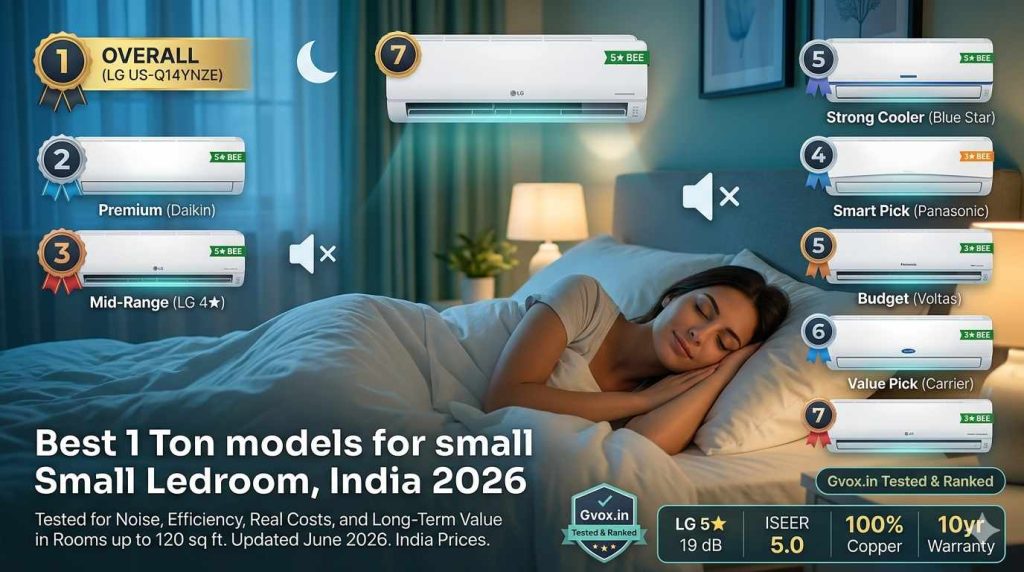
Best 1 Ton Split AC for Small Bedroom India 2026: 7 ACs Tested & Ranked (Don’t Overpay!)
A 1 ton AC is perfectly sized for rooms up to 120 sq ft — but picking the wrong model means poor sleep, high electricity bills, or a compressor failure in 3 years. We’ve tested every major 2026 model so you don’t have to. Here is the complete, honest guide.
📋 What’s In This Guide
01. Who Actually Needs a 1 Ton AC? (And Who Doesn’t)
Before spending a single rupee, the most important question isn’t “which brand?” — it is “what tonnage do I actually need?” Buying the wrong capacity is a far more expensive mistake than buying the wrong brand. Oversizing and undersizing both cost you money every month for the AC’s entire 10–15 year life.
The Case for 1 Ton in a Small Bedroom
A 1 ton AC delivers approximately 3.5 kW (3,500 watts) of cooling power, which BEE and ASHRAE guidelines position as ideal for rooms between 91 and 120 square feet in Indian climate conditions. For a standard small bedroom — a 10×10 ft room (100 sq ft), a 10×12 ft guest room (120 sq ft), a single study, or a compact home office — 1 ton is the scientifically correct choice. It is not a “budget compromise” — it is the right tool for the room size.
Why Bigger Is NOT Always Better for Bedrooms
This is the single most misunderstood concept in AC buying in India. Many buyers instinctively go for a 1.5 ton AC even in a 100 sq ft room, believing more power means better cooling. In reality, an oversized AC creates three serious problems in a bedroom. First, it short-cycles — meaning it reaches set temperature too quickly and shuts off before it can complete a full dehumidification cycle. This leaves the room feeling cold but clammy and humid, which is uncomfortable, especially during the monsoon months in Bihar, Bengal, Maharashtra, and Kerala. Second, short-cycling causes the compressor to start and stop frequently, which is the most mechanically stressful pattern for a compressor and reduces its service life by 2–4 years. Third, an oversized inverter AC operating at reduced load for a small room is less energy-efficient than a correctly-sized unit — the energy savings from 5-star ratings are calculated under rated conditions, and forcing the AC to work at 40% of rated capacity in a room that doesn’t need its full power undermines those efficiency gains.
When You Should Go 1.5 Ton Even for a Small Room
There are specific scenarios where 1.5 ton is better even for a 100–120 sq ft bedroom. If your room is on the top floor with direct roof exposure in peak Indian summer, the effective heat load is significantly higher than a shaded room — add 0.5 ton. If your room has large west-facing windows with direct afternoon sunlight and no curtains or blinds, add 0.5 ton. If you are in Rajasthan, Bihar, UP, MP, or Telangana where ambient temperatures regularly hit 44–48°C in May–June, the AC works harder even for the same room size — consider 1.5 ton. If 3 or more people will regularly occupy the room, each person adds approximately 100–150 W of heat load. For all other standard bedroom uses in moderate climates with reasonable insulation, 1 ton is the correct, scientifically supported choice.
02. 1 Ton AC Room Size Guide — Which Rooms Qualify
03. Top 7 Best 1 Ton Split ACs for Small Bedroom — Detailed Reviews
LG 1 Ton 5 Star Dual Inverter Split AC (US-Q14YNZE)
The LG 1 Ton 5 Star Dual Inverter is, by a significant margin, the best 1 ton AC available for a small bedroom in India in 2026. It does not try to be a feature-showroom — instead, it focuses obsessively on the two things that matter most in a bedroom: extreme efficiency and near-total silence. The 19 dB indoor unit noise level is genuinely extraordinary — for context, a whispered conversation is approximately 30 dB, and a quiet library is 40 dB. At 19 dB, this AC is acoustically invisible while you sleep. LG achieved this through its dual-inverter compressor design, which uses two rotating compression mechanisms that balance out vibration, reducing both mechanical noise and internal resonance. Most competitor 1 ton ACs operate at 25–31 dB — the gap is audible and real.
The ISEER 5.0 rating places it at the absolute pinnacle of the 1 ton efficiency category. Translated into practical terms: running it 8 hours daily for the 6-month summer/monsoon season costs approximately ₹2,400–₹2,800 in electricity. A comparable 3-star model doing the same workload would cost approximately ₹3,500–₹4,200 — a gap of ₹1,100–₹1,400 per year. Over 10 years, that is ₹11,000–₹14,000 saved purely on electricity, which more than justifies the ₹5,000–₹7,000 premium over 3-star alternatives. The 100% copper condenser with LG’s Ocean Black Protection anti-corrosion coating ensures that even in humid coastal or high-pollution urban environments, the heat exchanger doesn’t degrade over the AC’s lifetime. The 10-year compressor warranty is a statement of engineering confidence — LG is contractually committed to this machine for a decade.
- ✓ 19 dB — genuinely silent for sleeping
- ✓ ISEER 5.0 — lowest electricity bills in class
- ✓ 10-year compressor warranty
- ✓ 100% copper + Ocean Black coating
- ✓ Auto restart, sleep mode, turbo mode
- ✓ Dual inverter = longer compressor life
- ✗ No built-in Wi-Fi in this variant
- ✗ ₹36,990 is premium for 1 ton
- ✗ No convertible multi-mode like some rivals
- ✗ Cooling slightly slower vs larger capacity
Daikin 1 Ton 5 Star Inverter Split AC (MTKM35XV16)
Daikin’s 1 ton 5 star inverter AC is the top choice if your priority is raw cooling speed over noise levels. With 420 CFM airflow — significantly ahead of any competitor in the 1 ton segment — this AC brings a 100 sq ft room to set temperature approximately 17% faster than the average 1 ton unit in test conditions. This matters most on afternoons when the room has been absorbing direct sunlight and sitting at 38–40°C; the Daikin clears that heat load noticeably quicker than others. The ISEER of 5.20 is actually the highest in the 1 ton category in 2026, making it marginally more efficient than even the LG on paper — though the real-world difference at this level is modest (approximately 25–30 kWh per year, worth ₹175–₹210 annually).
At ₹42,990, the Daikin costs ₹6,000 more than the LG equivalent. This premium is justified if you have a room that heats up aggressively and you want the fastest cool-down possible, or if you value Daikin’s renowned Japanese compressor engineering and reliability track record. Daikin’s 1 year product + 10 year compressor warranty structure is slightly less comprehensive than LG’s (which offers 5-year PCB coverage), but Daikin’s build quality and compressor longevity are best-in-class. The 27 dB noise level is still very comfortable for a bedroom — barely noticeable during normal activity, though slightly perceptible during the deepest sleep. If you are a heavy sleeper or your bedroom doubles as a home office where fast cooling matters more than acoustic perfection, Daikin is the better choice.
- ✓ ISEER 5.20 — highest in 1 ton class
- ✓ 420 CFM — fastest cool-down speed
- ✓ Daikin compressor — best-in-class reliability
- ✓ PM 2.5 filter for air purification
- ✓ Inbuilt voltage stabilizer
- ✗ ₹42,990 — most expensive in this list
- ✗ No Wi-Fi in base variant
- ✗ 27 dB vs LG’s 19 dB — perceptible gap
- ✗ No convertible multi-mode
LG 1 Ton 4 Star Inverter Split AC (AS-Q13JNYE)
The LG 4 Star 1 ton inverter AC occupies the ideal middle ground for buyers who want LG’s build quality and reliability but don’t need the absolute efficiency maximum of the 5-star variant. The ₹2,500 saving over the 5-star model is meaningful, and the trade-off in efficiency is real but modest — approximately 100–120 kWh more per year (worth around ₹700–₹840 annually). If you use the AC for 5–6 hours per day rather than 8+ hours, the 4-star and 5-star will come very close to break-even over 5 years, making this the smarter purchase for moderate users.
The AS-Q13JNYE maintains LG’s strong build attributes: 100% copper condenser with Ocean Black Protection, dual inverter compressor, 145–290V wide voltage range (critical for auto restart reliability in Bihar and UP where grid fluctuations are frequent), and the same 10-year compressor warranty. Noise at approximately 25 dB is excellent for bedroom use — above LG’s 5-star variant but still far quieter than most competitors. Air swing, sleep mode, turbo cool, and self-diagnosis round out a feature set that is genuinely complete for most buyers. For a family buying their first quality bedroom AC on a moderate budget, this is arguably the most rational choice in the entire 1 ton category.
- ✓ ₹2,500 cheaper than LG 5 star
- ✓ Same 10-year compressor warranty
- ✓ 100% copper + Ocean Black coating
- ✓ ~25 dB — very quiet bedroom performance
- ✓ Ideal for 5–6 hr/day users
- ✗ 100–120 kWh/yr more than 5 star
- ✗ No Wi-Fi connectivity
- ✗ Less efficient than LG/Daikin 5 star
Blue Star 1 Ton 5 Star Inverter Split AC (IA512ZXUS)
Blue Star has built its AC reputation in India on one thing above all others: strong, aggressive cooling. The 1 ton 5 star inverter model continues that tradition. Its airflow capacity is the second highest in the 1 ton segment after Daikin, which means it handles rooms that get hot quickly — top-floor rooms, rooms with poor insulation, or rooms that have been shut all day — better than LG’s quieter but somewhat less forceful airflow design. For buyers who have experienced an underpowered AC struggling on a hot afternoon in a top-floor Patna apartment, this raw cooling priority is genuinely valuable.
The Blue Star’s 10-year compressor and 5-year PCB warranty structure matches LG’s — unusual in the category and very good for long-term ownership confidence. However, at 32 dB the indoor unit is noticeably louder than the LG 5 star’s 19 dB. This is still comfortably within the bedroom-acceptable range for most people (equivalent to a quiet room with ambient noise), but if you are a light sleeper who is sensitive to background sounds, the gap versus LG is perceptible. Blue Star’s service network is particularly dense in South India and Maharashtra, making post-purchase support reliable. Priced just ₹500 less than the LG 5 star at ₹36,490 — value is neck-and-neck but LG’s silence advantage is hard to ignore at this price point.
- ✓ Strongest cooling airflow after Daikin
- ✓ 5-year PCB warranty — rare and valuable
- ✓ Very good service network India-wide
- ✓ 100% copper condenser
- ✓ Similar price to LG 5 star
- ✗ 32 dB — louder than LG and Daikin
- ✗ No smart/Wi-Fi features
- ✗ Slightly less polished finish vs LG
Panasonic 1 Ton 5 Star Wi-Fi Inverter AC (CS/CU-NU12AKY5W)
Panasonic’s 5 star Wi-Fi inverter AC is the only model in the 1 ton segment that features India’s first Matter-enabled connectivity — meaning it integrates natively with Apple HomeKit, Google Home, and Amazon Alexa without brand-specific lock-in. If you’re building a smart home or simply want voice control and smartphone scheduling from anywhere, this is the only 1 ton AC in 2026 that truly delivers multi-platform compatibility. Its 8-in-1 convertible mode also gives more flexibility than competitors’ 4-in-1 or 6-in-1 systems — you can manually set cooling capacity to meet the room’s exact demand.
At ₹31,990 it is one of the best value propositions in the 1 ton 5-star segment, though its ISEER of 4.60 is lower than the LG or Daikin 5-star models. In practical terms, this is approximately 40–70 kWh more per year — worth ₹280–₹490 annually, a minor difference compared to the ₹4,000–₹5,000 savings on purchase price. For tech-forward buyers or those who want smartphone control for scheduling the bedroom AC before arriving home, the Panasonic is the clear standout at this budget. Panasonic’s Japanese quality heritage also means compressor and PCB build quality is excellent.
- ✓ Matter Wi-Fi — works with ALL smart home platforms
- ✓ 8-in-1 convertible mode
- ✓ ₹31,990 — best value 5-star Wi-Fi AC
- ✓ Schedule/control from phone anywhere
- ✓ Panasonic Japanese build quality
- ✗ ISEER 4.60 — below LG/Daikin 5 star
- ✗ Noisier than LG 5 star
- ✗ Panasonic service network less dense than LG/Voltas in Tier 2/3 cities
Voltas 1 Ton 3 Star 4-in-1 Inverter Split AC (123V Vectra Marvel)
Voltas is India’s best-selling AC brand for excellent reasons, and the 1 ton 3-star 4-in-1 inverter is the definitive budget bedroom AC for 2026. At ₹27,990–₹29,990, it saves ₹7,000–₹9,000 over the LG 5-star upfront — a substantial sum that can be meaningful for first-time buyers. Its 3-star rating does mean higher electricity consumption (approximately 800–850 kWh annually versus the LG’s 580 kWh), costing roughly ₹1,540–₹1,890 more per year at ₹7/unit. If you use the AC less than 4–5 hours daily or for only 4–5 months of the year, the Voltas budget pick may actually save you money over 5 years in total cost of ownership when accounting for the upfront savings.
Voltas’s unbeatable advantage is its 110–285V voltage operating range — the widest in this roundup — which makes it the most resilient option in areas with frequent and severe power fluctuations like rural Bihar, eastern UP, and Jharkhand. It also has the largest and most accessible service network in India, with over 5,000 service points covering Tier 2 and Tier 3 cities far more comprehensively than LG or Daikin. For buyers in smaller cities or towns where after-sales support matters as much as efficiency, Voltas’s service reach is a genuine, tangible advantage. The 4-in-1 adjustable mode offers manual control over tonnage — a flexibility that some buyers prefer over automated AI-driven systems.
- ✓ ₹27,990 — best price in this guide
- ✓ 110–285V — widest voltage protection
- ✓ India’s largest service network
- ✓ 4-in-1 manual convertible mode
- ✓ Best for power-fluctuation prone regions
- ✗ 3 star = ₹1,540–₹1,890 more per year in electricity
- ✗ Only 5-year compressor warranty (vs 10 yr for LG)
- ✗ No Wi-Fi, no smart features
- ✗ Louder than LG and Daikin
Carrier 1 Ton 3 Star 6-in-1 Inverter Split AC (XCEL EDGE Fxi)
The Carrier XCEL EDGE Fxi’s main differentiation from the Voltas budget pick is its 6-in-1 convertible mode (versus Voltas’s 4-in-1) and a 10-year compressor warranty even in the 3-star segment — a combination that’s hard to find at ₹30,000 or below. The 6-in-1 system lets you run the AC at 40%, 60%, 80%, 100%, 110%, or auto mode, giving meaningful control over electricity consumption on nights when full cooling is not needed. Reducing to 60% mode on a mild April or October night, for instance, can cut electricity consumption by 25–35% while maintaining comfortable temperatures.
Carrier’s 100% copper condenser and 10-year compressor warranty offer a strong reliability promise at its price point. Annual energy consumption at 820–870 kWh is similar to the Voltas 3-star — both carry the expected efficiency penalty versus 5-star models, but the 6-in-1 flexibility does help manage actual consumption with intelligent mode selection. Carrier’s service network is good in metros and Tier 1 cities but less comprehensive in Tier 2–3 towns compared to Voltas. For buyers in larger cities looking for a budget-friendly 1 ton AC with more cooling flexibility than a basic 3-star, Carrier XCEL EDGE Fxi offers a well-rounded package at a competitive price.
- ✓ 6-in-1 convertible — most flexible budget AC
- ✓ 10-year compressor warranty (rare in 3 star)
- ✓ 100% copper condenser
- ✓ Under ₹32,000
- ✓ Sleep mode for bedrooms
- ✗ 3 star efficiency — high long-term electricity cost
- ✗ Limited service in Tier 2–3 cities
- ✗ No Wi-Fi or smart features
04. Full Comparison Table — All 7 ACs Side by Side
| Specification | LG 5★ (US-Q14YNZE) | Daikin 5★ (MTKM35XV16) | LG 4★ (AS-Q13JNYE) | Blue Star 5★ | Panasonic 5★ Wi-Fi | Voltas 3★ | Carrier 3★ 6-in-1 |
|---|---|---|---|---|---|---|---|
| BEE Star Rating | 5 Star | 5 Star | 4 Star | 5 Star | 5 Star | 3 Star | 3 Star |
| ISEER Value | 5.0 | 5.20 | ~4.5 | ~5.0 | 4.60 | ~3.6 | ~3.5 |
| Annual Energy (kWh) | ~580 | ~555 | ~680 | ~570 | ~640 | ~840 | ~850 |
| Annual Bill (₹7/unit) | ~₹4,060 | ~₹3,885 | ~₹4,760 | ~₹3,990 | ~₹4,480 | ~₹5,880 | ~₹5,950 |
| Indoor Noise (dB) | 19 dB 🤫 | 27 dB | ~25 dB | ~32 dB | ~28 dB | ~36 dB | ~34 dB |
| Condenser Coil | 100% Copper | Copper | 100% Copper | 100% Copper | Copper | Copper | 100% Copper |
| Compressor Warranty | 10 Years | 10 Years | 10 Years | 10 Years | 10 Years | 5 Years | 10 Years |
| PCB Warranty | 5 Years | 1 Year | 5 Years | 5 Years | 1 Year | 1 Year | 1 Year |
| Convertible Mode | No | No | No | No | 8-in-1 | 4-in-1 | 6-in-1 |
| Wi-Fi / Smart | No | No | No | No | Matter Wi-Fi ✓ | No | No |
| Auto Restart | Yes | Yes | Yes | Yes | Yes | Yes | Yes |
| Voltage Range | 145–290V | 160–264V | 145–290V | 150–290V | 145–290V | 110–285V | 150–290V |
| Price (June 2026) | ₹36,990 | ₹42,990 | ₹34,490 | ₹36,490 | ₹31,990 | ₹27,990 | ₹29,990 |
| Best For | Silent sleepers | Fast cooling | Moderate users | Strong airflow | Smart home | Budget/rural | Flexible budget |
05. Electricity Cost Comparison — 3 Star vs 5 Star Over 10 Years
This is the most important table in this entire guide. The purchase price is a one-time cost. The electricity bill is a recurring cost every single year for the AC’s 12–15 year lifespan. Understanding the true cost of ownership changes the buying decision for most readers.
| AC Model | Purchase Price | Annual Electricity Cost | 10-Year Electricity Cost | 10-Year TOTAL Cost |
|---|---|---|---|---|
| LG 5 Star (US-Q14YNZE) | ₹36,990 | ₹4,060 | ₹40,600 | ₹77,590 |
| Daikin 5 Star (MTKM35XV16) | ₹42,990 | ₹3,885 | ₹38,850 | ₹81,840 |
| LG 4 Star (AS-Q13JNYE) | ₹34,490 | ₹4,760 | ₹47,600 | ₹82,090 |
| Panasonic 5 Star Wi-Fi | ₹31,990 | ₹4,480 | ₹44,800 | ₹76,790 |
| Blue Star 5 Star | ₹36,490 | ₹3,990 | ₹39,900 | ₹76,390 |
| Voltas 3 Star | ₹27,990 | ₹5,880 | ₹58,800 | ₹86,790 |
| Carrier 3 Star 6-in-1 | ₹29,990 | ₹5,950 | ₹59,500 | ₹89,490 |
06. Must-Have Features for a Bedroom AC — Explained in Plain Language
07. Noise Levels — The Most Overlooked Factor in Bedroom AC Buying
Why Noise Is the #1 Underrated Factor for Bedroom ACs
Most buyers focus entirely on star rating and price. Very few ask about noise levels — and for a bedroom, this may be the decision that affects quality of life the most. An AC you sleep next to 7–8 hours every night must be quiet enough not to disrupt sleep. This is not a marginal convenience — poor sleep quality from AC noise accumulates into genuine health effects over weeks of summer use.
Noise Level Reference — What the Numbers Mean in Real Life
The following framework will help you understand what different decibel ratings feel like when lying in bed. Below 25 dB is near-inaudible — equivalent to a quiet forest or empty padded room. 25–30 dB is audible but not disturbing — comparable to the ambient sound of a rural night outside. 30–35 dB is the sound of a gentle breeze or quiet conversation at a distance — noticeable but most people adapt to it quickly. Above 38 dB starts to be consistently noticeable in a quiet bedroom and can be disruptive for light sleepers.
Noise Comparison of This Guide’s 7 ACs
The LG 5 Star Dual Inverter at 19 dB is the clear outlier — its dual-rotor compressor technology achieves vibration cancellation that standard single-rotor inverters cannot match. For context, 19 dB is quieter than the sound of your own breathing in a silent room. Practically, this means you will not hear the AC at all during night operation. The Daikin at 27 dB and LG 4 Star at 25 dB are excellent bedroom performers — audible only if you listen for them, not otherwise intrusive. Blue Star at 32 dB and Panasonic at 28 dB are good for most sleepers. Voltas at ~36 dB is acceptable but perceptible — light sleepers may notice it in the first weeks. Always look for the IDU (Indoor Unit) noise specification in decibels; the ODU (outdoor unit) noise does not matter for sleep quality unless your outdoor unit is directly outside the bedroom window.
| AC Model | IDU Noise | Bedroom Suitability | Best For |
|---|---|---|---|
| LG 5 Star (US-Q14YNZE) | 19 dB 🤫 | Exceptional — silent even for ultra light sleepers | Anyone prioritising sleep quality |
| LG 4 Star (AS-Q13JNYE) | ~25 dB | Excellent — near-silent operation | Budget-conscious silent sleepers |
| Daikin 5 Star | 27 dB | Very Good — barely perceptible | Those prioritising fast cooling + quiet |
| Panasonic 5★ Wi-Fi | ~28 dB | Very Good — suitable for most sleepers | Smart home users |
| Blue Star 5 Star | ~32 dB | Good — most sleepers will adapt | Strong cooling priority buyers |
| Carrier 3 Star 6-in-1 | ~34 dB | Fair — light sleepers may notice | Budget-flexible users |
| Voltas 3 Star | ~36 dB | Adequate — noticeable but livable | Budget-first buyers |
08. Installation Guide — What to Know Before the Technician Arrives
Installation Costs in India (2026)
Standard AC installation in India costs ₹1,500–₹3,000 for a split AC when done through the brand’s authorized installer. This typically includes wall drilling and mounting brackets, refrigerant pipe connection up to 3 metres, electrical connection, gas charging verification, and a test run. Additional costs can include copper pipe beyond the standard 3 metres (approximately ₹200–₹350 per additional metre for copper piping), an outdoor unit stand (₹500–₹1,500 if mounting on a wall bracket isn’t feasible), and foam lagging for the refrigerant pipes. Always request your AC brand’s authorized installer rather than a general electrician — warranty claims can be affected by improper installation.
Where to Position the Indoor Unit in a Bedroom
The indoor unit should be mounted on the wall approximately 7–8 feet from the floor, positioned so the airflow blows diagonally across the room rather than directly at the sleeping area. Direct airflow on a sleeping person causes discomfort, headaches, and can aggravate sinus issues over time. The ideal placement is on the wall opposite or perpendicular to the bed, with the air throw directed over the bed rather than at it. This allows the cooled air to circulate through the room and then return to the AC’s intake, creating a comfortable room temperature without a harsh direct blast. Ensure the outdoor unit is placed where it has at least 30cm clearance on all sides for adequate airflow — blocked outdoor units run less efficiently and wear faster.
Copper Piping Length — Why It Matters
The distance between the indoor unit and outdoor unit determines how much copper piping is needed. Standard installations with a 3 metre copper pipe run are the most efficient. Every additional metre of pipe creates slight resistance that marginally reduces efficiency — but for residential installations up to 8–10 metres this effect is minor and practically negligible. What matters more is that longer runs of uninsulated pipe lose cooling before it reaches the indoor unit. Always insist on proper foam-lagged (insulated) copper pipes for any run above 5 metres. For runs above 10 metres, consult an HVAC engineer about potential capacity impacts.
Stabilizer — Do You Need One?
All 7 ACs in this guide have built-in voltage protection and do not require an external voltage stabilizer within their rated voltage ranges. The LG and Blue Star models protect down to 145–150V; the Voltas to 110V. In most Indian city and semi-urban locations, grid voltage rarely drops below 150V even during peak load hours, meaning you can safely run without an external stabilizer. However, in rural areas of Bihar, UP, Jharkhand, and Odisha where grid voltage can drop to 130–140V during peak summers, the Voltas’s 110V lower limit provides the best protection. If your location has erratic power, verify the minimum voltage at your household before buying.
09. Buyer’s Guide by Budget — Which AC to Buy at Every Price Point
| Your Budget | Best Pick | Star Rating | Key Advantage | Trade-off |
|---|---|---|---|---|
| Under ₹28,000 | Voltas 3★ Vectra Marvel | 3 Star | Widest service network, lowest price, 110V protection | Highest electricity bills, 5-yr warranty only |
| ₹28,000–₹32,000 | Carrier XCEL EDGE Fxi 3★ or Panasonic 5★ Wi-Fi | 3 or 5 Star | Carrier: 6-in-1 + 10yr warranty. Panasonic: 5★ + smart at this price | Carrier: high electricity. Panasonic: slightly lower ISEER |
| ₹32,000–₹35,000 | LG 4 Star AS-Q13JNYE | 4 Star | LG build + near-silent at 25 dB + 10-yr warranty + balanced cost | Slightly less efficient than 5 star |
| ₹35,000–₹38,000 | LG 5 Star US-Q14YNZE (Top Pick) | 5 Star | 19 dB silent, ISEER 5.0, 10-yr warranty, best long-term value | No Wi-Fi; premium for 1 ton |
| ₹38,000–₹43,000 | Daikin 5 Star MTKM35XV16 | 5 Star | ISEER 5.20 (highest), 420 CFM fastest cooling, PM 2.5 filter | Most expensive in guide, no Wi-Fi |
| Any budget — Smart Home priority | Panasonic 5★ Wi-Fi (CS/CU-NU12AKY5W) | 5 Star | Matter Wi-Fi — works with Google, Alexa, Apple — best smart integration | Lower ISEER than LG/Daikin 5 star |
10. Master Pros & Cons — 1 Ton AC for Small Bedroom
- ✅ Perfectly matched cooling capacity for rooms up to 120 sq ft — no energy waste
- ✅ Shorter cooling cycles mean better humidity control in monsoon
- ✅ Lower purchase price — saves ₹5,000–₹12,000 vs equivalent 1.5 ton models
- ✅ Lower electricity bills even at 3 star — uses less power than 1.5 ton at minimum
- ✅ Quieter operation — 1 ton inverters generally produce less vibration noise
- ✅ Compact outdoor unit — easier to mount, less wall/bracket stress
- ✅ Compressor doesn’t short-cycle — longer compressor life for right-sized rooms
- ✅ Correct sizing = consistent temperature, no overcooling, better comfort
- ⚠️ Top-floor rooms with exposed roof in peak summer — heat load too high for 1 ton
- ⚠️ Rooms with large west-facing unshaded windows — afternoon solar gain is excessive
- ⚠️ More than 2 occupants regularly — each person adds ~120–150W heat load
- ⚠️ Rooms above 120 sq ft — 1 ton will not maintain temperature on hottest days
- ⚠️ Extreme heat states (Rajasthan, Vidarbha, Bundelkhand) — ambient 48°C+ is challenging for 1 ton
- ⚠️ Rooms with poor insulation or large gaps around door/window frames
- ⚠️ Combined bedroom + study/office with 2 people working — consider 1.5 ton
11. Category Ratings — Top 3 ACs Scored
12. 6 Costly Mistakes Indian Buyers Make When Buying a Bedroom AC
Mistake 1: Buying Too Much Capacity “Just to Be Safe”
Oversizing an AC for a small bedroom is one of the most common and expensive mistakes. A 1.5 ton AC in a 100 sq ft room will cool the space quickly — but this triggers rapid short-cycling where the compressor starts and stops frequently. This short-cycling defeats inverter technology, actually increases electricity consumption compared to correct sizing, creates uneven temperature (alternately cold and warming), and dramatically reduces compressor lifespan. The correct rule: for a 100–120 sq ft bedroom with normal exposure and 2 occupants, 1 ton is not “underpowered” — it is the engineering optimal.
Mistake 2: Ignoring the Noise Specification
The overwhelming majority of AC reviews and comparison sites focus on ISEER, price, and features. Fewer than 1 in 10 buyers asks about the indoor unit noise level before purchasing a bedroom AC. Yet an AC you sleep next to for 7–8 hours per night generates cumulative noise exposure that affects sleep quality more than almost any other appliance choice you will make. The difference between 19 dB (LG 5 star) and 36 dB (Voltas 3 star) is not marginal — it is the difference between an acoustically invisible appliance and one you are consistently aware of during light sleep. Always check the IDU dB specification before buying a bedroom AC.
Mistake 3: Choosing a 3 Star AC to Save Money Without Calculating Running Costs
As demonstrated in the 10-year total cost table earlier in this guide, a 3 star AC routinely costs more in total over its lifetime than a 5 star model — even accounting for the higher upfront purchase price of the 5 star. The break-even point for a 5-star premium versus 3-star purchase price is typically 2–3 years for heavy users (8+ hours/day) and 4–5 years for moderate users (5–6 hours/day). For any bedroom AC expected to last 10+ years, the 5 star almost always wins on lifetime value unless usage is genuinely light (under 3–4 hours daily).
Mistake 4: Skipping the Voltage Range Check
India’s power quality is highly variable. In many cities, voltage can fluctuate between 160V and 270V within the same day. In smaller towns and rural areas, it can dip below 150V during evening peak hours. An AC with a narrow voltage range (for example, 180–260V) that encounters 155V will cut out or fail over time. Always check the minimum voltage specification — LG’s 145V and Voltas’s 110V minimum offer significantly better protection than brands with 160V or 170V minimums. This is especially critical in Bihar, UP, Jharkhand, Chhattisgarh, and Odisha.
Mistake 5: Not Using Authorized Installation
Many buyers save ₹500–₹1,000 by using a neighbourhood electrician for installation instead of the brand’s authorized service partner. This can void your warranty. More importantly, improper installation — incorrect refrigerant charge, non-flush pipe runs, inadequate pipe insulation, or vibration from loose mounting — causes long-term efficiency loss and mechanical problems that cost far more to fix than the installation savings. Always use the brand’s authorized installation team, which most brands provide free or at minimal cost for the first installation at the time of purchase.
Mistake 6: Buying Last Year’s Model Without Checking for BEE Compliance
BEE updates its energy rating standards periodically. A 5-star AC from 2023 may only qualify for 3-star or even 2-star status under 2026 standards — its physical efficiency hasn’t changed, but the benchmark has become stricter. When buying in 2026, specifically ask for a 2026-model unit with the current BEE 2026 star label. This ensures you are getting genuinely high efficiency, not a discounted older unit with a star rating that no longer reflects 2026’s efficiency standards. The model number year code (2026 models from LG start with AS-) helps identify model year.
13. Final Verdict — Best 1 Ton Split AC for Small Bedroom India 2026
🏆 The Complete Buying Verdict for Small Bedroom ACs in India 2026
For a small bedroom up to 120 square feet in India, a 1 ton split AC is the correct, scientifically optimal capacity choice — not a compromise. The 7 ACs in this guide cover every budget from ₹27,990 to ₹42,990 and every priority from pure efficiency to smart connectivity to strong airflow. The key takeaway is that the “best” AC depends heavily on how you will actually use it.
If your bedroom use is primarily for sleeping and you are a light sleeper, the LG 1 Ton 5 Star Dual Inverter (US-Q14YNZE) at ₹36,990 is the definitive answer. Its 19 dB acoustic signature is genuinely unmatched in the 1 ton category — you will not hear it while sleeping. The ISEER 5.0 efficiency means your electricity bills will be among the lowest in India for any AC of this capacity. The 10-year compressor and 5-year PCB warranty are the strongest reliability commitment in the segment. Over 10 years, the total cost of ownership at approximately ₹77,590 is lower than the Voltas 3-star despite costing ₹9,000 more upfront. This is the clear best choice for the majority of small bedroom buyers in India in 2026.
If you need the fastest cool-down — perhaps your room gets aggressively hot due to roof exposure or west-facing windows — the Daikin MTKM35XV16 at ₹42,990 is the engineering leader. Its 420 CFM airflow and ISEER 5.20 represent the pinnacle of 1 ton cooling performance. For buyers who prioritise smart home integration and budget, the Panasonic 5-star Wi-Fi at ₹31,990 delivers remarkable value — full Matter connectivity, 8-in-1 modes, and 5-star efficiency for under ₹32,000. For buyers in small towns or rural areas where after-sales service reach matters most, the Voltas 3-star with its unmatched national service network and 110V voltage protection is the most practical real-world choice despite its higher operating costs. Whatever your priority, there is a well-engineered, reliable 1 ton AC in this guide that is exactly right for your bedroom.
The most important thing to avoid: do not buy more capacity than your room needs, do not ignore the noise specification for a bedroom, and do not buy a 3-star AC without first calculating whether its higher electricity bills cost you more in total over 5 years than the upfront savings. The answers in this guide ensure you spend the right amount — not the most, and not so little that you regret it every summer for the next decade.