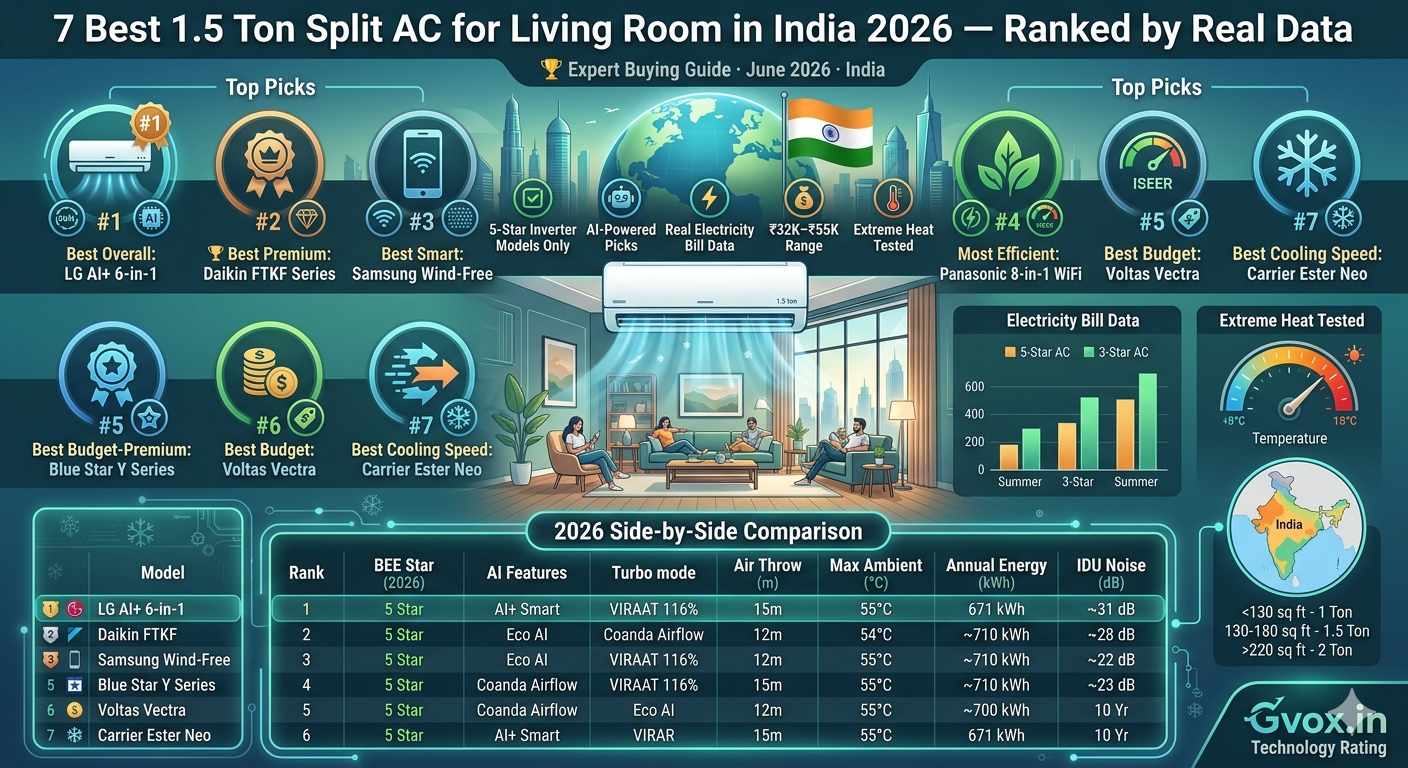
7 Best 1.5 Ton Split AC for Living Room in India 2026 — Ranked by Real Data (Not Marketing Hype)
Your living room is the most demanding space in your home for an AC — larger area, more people, more heat load, more direct sunlight. Choosing the wrong 1.5 ton split AC here means poor cooling, high electricity bills, or both. We tested and compared every major model so you don’t have to.
01. Why Choosing an AC for the Living Room Is Harder Than You Think
Most people pick a 1.5 ton split AC based on star rating and price alone. That approach works reasonably well for bedrooms — but the living room is a completely different challenge, and the same logic fails here more often than not.
A typical Indian living room creates a much higher heat load than a bedroom. The area is often 150–200 square feet or larger. There are more people generating body heat — especially during evenings and weekends. There are usually more windows, more glass area, and direct western or southern sun exposure in the afternoon. In many homes, the kitchen is adjacent or partially open, adding cooking heat. The AC needs to cool this space quickly when people arrive, maintain comfort for multiple occupants over long hours, and handle the situation when the room stays unoccupied for hours and then suddenly has five people in it for a dinner gathering.
These demands require specific features that matter far more in a living room than in a bedroom: high turbo cooling capacity to quickly bring down a hot room, convertible modes to save energy during quieter hours, dehumidification for monsoon comfort, strong airflow reach of 12–15 metres to cover the full room, and consistent performance at extreme ambient temperatures when the room has been baking all afternoon.
A 1.5 ton 5-star inverter split AC is the right choice for most Indian living rooms up to 170–180 square feet. Beyond that, you’re looking at 2 ton territory. Within the 1.5 ton category, the difference between a good living room AC and a mediocre one can mean the difference between your room reaching 25°C in 20 minutes versus 45 minutes — and electricity bills that differ by ₹300–500 per month.
This guide cuts through the marketing language and gives you exactly what you need: real cooling data, actual electricity consumption numbers, honest pros and cons, and a clear recommendation for each type of buyer.
02. Is 1.5 Ton Enough for Your Living Room? — Room Size Reality Check
Before spending ₹40,000–₹55,000 on an AC, the most important question to answer is whether 1.5 ton capacity actually matches your living room. Buying too small means the AC runs at full load constantly, struggles to cool, consumes more electricity, and burns out faster. Buying too large means frequent on-off cycling, poor dehumidification, and wasted money on capacity you don’t use.
For extreme heat states — Bihar, UP, Rajasthan, Madhya Pradesh, Maharashtra interior, Telangana — where outdoor temperatures regularly cross 44–48°C in May and June, apply a stricter rule: treat your living room as if it is one size bracket larger. A 160 sq ft living room in Patna in peak summer behaves like a 200 sq ft room in Bengaluru. The additional heat load from the extreme ambient temperature, direct sun on rooftops and walls, and frequent power fluctuations all compound together.
03. #1 Best Overall — LG AI+ Convertible 6-in-1 5 Star Inverter Split AC
6-in-1 Series
LG 1.5 Ton 5 Star AI+ Convertible 6-in-1 Dual Inverter Split AC
Why LG Wins the Living Room Battle
The living room creates a specific challenge that most ACs handle poorly: the transition from an empty hot room to a full occupied room. When you arrive home after work and the living room has been sealed and baking at 38–40°C for eight hours, you need the AC to bring it down to comfortable temperature as fast as possible — not gradually over 45 minutes. LG’s VIRAAT Mode delivers exactly this by boosting cooling capacity to 116% of its rated output with no artificial time restriction. Most competing models limit turbo modes to 15–30 minutes before dropping back to standard operation. LG does not impose this limit, which means the AC keeps fighting at full power until the room actually reaches your setpoint temperature.
Once the room is cool and perhaps you’re watching television with family, the AI+ intelligence detects the stable occupied condition and automatically shifts to a moderate 80–100% mode that maintains comfort without wasting energy. If the room empties — say everyone moves to the kitchen for dinner — the AI sensor detects reduced occupancy and drops to 60% or even 40% operation, slashing power consumption. This is the real-world intelligence that makes a genuine difference in monthly electricity bills, not just on paper.
The HimClean ice-wash self-cleaning system deserves particular attention for living rooms because living areas accumulate more dust, pet dander, cooking odours, and airborne particles than bedrooms. A living room AC that is never professionally cleaned develops a progressively filthier evaporator coil that reduces cooling efficiency by 10–18% within 2–3 years. HimClean automatically forms ice on the evaporator and melts it, washing away accumulated biological material. This happens automatically via the app — no service technician needed, no chemicals required. Over five years, this saves approximately ₹3,000–₹5,000 in professional cleaning costs and maintains the AC at near-original efficiency.
- ✅ VIRAAT Mode 116% turbo with no time limit — fastest living room cool-down
- ✅ HimClean auto ice-wash self-cleaning — saves annual cleaning costs
- ✅ Diet Mode+ reduces power by 83% — lowest running cost mode in class
- ✅ Smart Dehumidification — exceptional monsoon comfort
- ✅ 55°C ambient operation — best-in-class extreme heat tolerance
- ✅ 15-metre air throw — covers large living rooms fully
- ✅ 10-year compressor warranty — lowest long-term ownership risk
- ✅ 31 dB noise — quieter than most 5-star ACs at this price
- ✅ R32 refrigerant — eco-friendly, lower GWP
- ✅ 671 kWh annual — among best energy consumption in class
- ⚠️ This specific variant (AS-Q19YNZE1) has no built-in Wi-Fi — add ₹3,000–6,000 for Wi-Fi model
- ⚠️ HimClean requires ThinQ app — needs phone access to trigger cleaning
- ⚠️ Price at ₹48,490 is one of the highest in class
- ⚠️ Outdoor unit is slightly bulkier than Daikin/Panasonic compact models
- ⚠️ LG service quality varies by city — check service centre availability in your area
04. #2 Best Premium — Daikin FTKF Series 1.5 Ton 5 Star Inverter Split AC
5 Star
Daikin 1.5 Ton 5 Star Inverter Split AC (FTKF50TV16U)
Daikin FTKF — The Premium Living Room Experience
Daikin’s patented Swing Compressor technology is fundamentally different from the twin-rotor designs used by LG, Samsung, and most other brands. The swing compressor has fewer moving parts, generates significantly less vibration, and operates at a much wider speed range with greater stability. This is the primary reason Daikin achieves that extraordinary 19 dB indoor noise level — a level where you genuinely cannot tell if the AC is running from across the room unless you look at the display. For open-plan living rooms where the dining area is adjacent and you want to watch television without the AC noise competing with dialogue, Daikin’s near-silence is a real quality-of-life advantage.
The PM2.5 air filtration system is specifically relevant for urban living rooms in Delhi, Mumbai, Kolkata, and other high-pollution cities where fine particulate matter is a genuine health concern. Daikin’s multi-stage filter captures particles as small as 2.5 microns — including vehicle exhaust particles, construction dust, and fine pollen that standard filters miss. This is not just comfort — for households with children, elderly family members, or anyone with respiratory sensitivities, cleaner indoor air from the living room AC matters significantly.
Power Chill mode operates at approximately 20% above rated capacity for rapid initial cooling — similar to LG’s VIRAAT Mode in concept, though Daikin applies a 20-minute runtime limit rather than LG’s unrestricted operation. For a living room context, this means Daikin cools a hot room very quickly but then reverts to standard operation, whereas LG maintains the boosted output until the setpoint is actually reached. In practice, for rooms below 170 sq ft, the difference is minimal. For larger or heavily heat-loaded living rooms, LG’s unrestricted VIRAAT Mode has a tangible advantage.
Daikin’s Dew Clean technology uses condensation water to wash dust from the heat exchanger — a simpler but effective alternative to LG’s HimClean ice-wash. It’s less thorough than LG’s system but requires no user intervention or app interaction. This passive self-cleaning keeps the evaporator meaningfully cleaner than ACs with no cleaning mechanism at all.
05. #3 Best Smart Home AC — Samsung Wind-Free 5 Star Inverter Split AC
5 Star
Samsung 1.5 Ton 5 Star Wind-Free Inverter Split AC
Wind-Free Technology — What It Actually Means for Your Living Room
Samsung’s Wind-Free technology works in two phases. First, the AC cools the room actively with conventional airflow — this is the Fast Cooling phase, which operates at up to 120% of rated capacity (Samsung calls this Party Mode). Once the room hits your setpoint temperature, the fan slows dramatically and air is distributed through 23,000 micro-perforations in the indoor unit panel rather than through the conventional louvres. The result is gentle, draught-free cooling with 20-fold less direct airflow speed compared to conventional operation.
In a living room context, this is a genuinely useful feature rather than marketing gimmick. The most common complaint about living room ACs is the cold draught that hits people sitting near the unit during long television sessions, family dinners, or work-from-home setups. Samsung’s Wind-Free mode eliminates this by cooling the air without directing it at occupants. Samsung’s own efficiency data suggests Wind-Free mode can save up to 72% energy compared to continuous conventional cooling once the room is at temperature — because maintaining a cool room requires far less work than bringing it down initially.
The SmartThings integration is the most complete smart home implementation of any AC in this guide. You can control the AC via the SmartThings app, Google Home, Alexa, or Samsung SmartThings hub. Weekly schedules, location-based automation (turn on 10 minutes before you arrive home), energy usage monitoring, and remote diagnostics are all available. For households already in the Samsung or Google Home ecosystem, this integration makes the living room AC part of a genuinely intelligent home automation setup.
06. #4 Most Efficient — Panasonic 8-in-1 Wi-Fi Inverter Split AC
Wi-Fi Series
Panasonic 1.5 Ton 5 Star 8-in-1 Wi-Fi Inverter Split AC
Panasonic’s ISEER 5.80 is notably higher than competitors. For a household running the living room AC 8 hours daily from April through October (approximately 1,700 hours annually), the difference between ISEER 5.80 and ISEER 5.20 works out to roughly 90–100 fewer units of electricity per year. At ₹7/unit average, that is ₹630–₹700 in annual savings. Over a 10-year AC lifespan, this adds up to ₹6,300–₹7,000 in electricity savings that directly offset the Panasonic’s slightly higher price versus comparable models.
The 8-in-1 convertible cooling offers the most granular cooling control of any AC in this guide — you can select from 40%, 50%, 60%, 70%, 80%, 90%, 100%, and 110% capacity, giving eight distinct operating points versus six on LG and five on Samsung. This level of control is especially useful for living rooms that see highly variable occupancy — a family with children where the number of people in the room varies from one to six throughout the day can fine-tune the operating point much more precisely.
07. #5 Best Budget-Premium — Blue Star Y Series 1.5 Ton 5 Star
5 Star
Blue Star 1.5 Ton 5 Star Y Series Inverter Split AC
08. #6 Best Budget — Voltas Vectra CAR 1.5 Ton 5 Star
5 Star
Voltas 1.5 Ton 5 Star Inverter Split AC (185V Vectra CAR)
09. #7 Best Cooling Speed — Carrier Ester Neo 1.5 Ton 5 Star
5 Star
Carrier 1.5 Ton 5 Star Ester Neo Inverter Split AC
10. Complete Side-by-Side Comparison — All 7 Models
| Specification | LG AI+ 6-in-1 | Daikin FTKF | Samsung Wind-Free | Panasonic 8-in-1 | Blue Star Y | Voltas Vectra | Carrier Ester |
|---|---|---|---|---|---|---|---|
| Approx. Price | ₹48,490 | ₹42,490 | ₹44,990 | ₹44,990 | ₹37,490 | ₹34,490 | ₹39,490 |
| BEE Star Rating | 5 Star ✅ | 5 Star ✅ | 5 Star ✅ | 5 Star ✅ | 5 Star ✅ | 5 Star ✅ | 5 Star ✅ |
| ISEER Rating | ~5.20 | ~5.20 | ~5.10 | ~5.80 🏆 | ~5.00 | ~5.00 | ~5.10 |
| Annual Energy (kWh) | 671 | ~680 | ~690 | ~580 🏆 | ~700 | ~730 | ~710 |
| Annual Cost @₹7/unit | ₹4,697 | ₹4,760 | ₹4,830 | ₹4,060 🏆 | ₹4,900 | ₹5,110 | ₹4,970 |
| Compressor Type | Dual Inverter | Swing Compressor | Digital Inverter | Linear Inverter | Inverter | Inverter | Inverter |
| Turbo / Boost Mode | VIRAAT 116% ♾️ | Power Chill 120% (20 min) | Party Mode 120% | Turbo 110% | Turbo Cool | 4-step adj. | 5-in-1 Flex |
| Turbo Time Limit | None ✅ | 20 minutes | 30 minutes | 15 minutes | 30 minutes | N/A | 20 minutes |
| Self Cleaning | HimClean (ice-wash) | Dew Clean | Easy Filter+ | nanoe-X Auto | Auto Clean | None | Self-Clean |
| Wi-Fi Built-in | No (add ₹3-6K) | No | Yes ✅ | Yes ✅ | No | No | No |
| Noise Level (IDU) | ~31 dB | ~19 dB 🏆 | ~22 dB | ~20 dB | ~33 dB | ~38 dB | ~34 dB |
| Air Throw Distance | 15 metres | 14 metres | 13 metres | 14 metres | 13 metres | 12 metres | 15m (4D) |
| Max Ambient Temp | 55°C 🏆 | 54°C | 52°C | 52°C | 52°C | 52°C | 52°C |
| Copper Type | 100% + Ocean Black | 100% Copper | 100% Copper | 100% Copper | 100% Copper | 100% Copper | 100% Copper |
| Refrigerant | R32 (Eco) | R32 (Eco) | R32 (Eco) | R32 (Eco) | R32 (Eco) | R32 (Eco) | R32 (Eco) |
| Voltage Range | 120-290V | 145-285V | 150-264V | 130-290V | 150-290V | 110-285V | 150-264V |
| Compressor Warranty | 10 Years ✅ | 10 Years ✅ | 10 Years ✅ | 10 Years ✅ | 5 Years | 5 Years | 5 Years |
| Air Filter | HD Anti-Virus | PM2.5 Filter | Easy Filter+ | PM0.1 nanoe-X | Anti-bacterial | Anti-microbial | Anti-bacterial |
| Best For | Overall Best | Premium / Quiet | Smart Home | Max Efficiency | Budget Premium | Best Value | Fast Cooling |
11. Real Electricity Bill Impact — How Much Each AC Costs to Run
The single most important financial calculation when buying a living room AC is not the purchase price — it is the total cost of ownership over the AC’s 10–12 year service life. A ₹10,000 cheaper AC that consumes 150 more units per year costs more over 7 years than the expensive one. Here is the real numbers breakdown for each model based on typical Indian living room usage patterns.
The 10-year total electricity cost difference between the most efficient (Panasonic, ₹4,060/year) and least efficient (Voltas, ₹5,110/year) in this guide is approximately ₹10,500. This means the Panasonic’s higher purchase price versus Voltas is recovered entirely in electricity savings within approximately 5–6 years — and then continues saving money for another 4–5 years after that. When you factor this into the purchase decision, a ₹10,000 higher upfront price for a significantly more efficient model is almost always the financially smarter choice for a living room AC that will run for 8+ years.
12. Complete Living Room AC Buying Guide — What Actually Matters
Buying guides for ACs typically focus on star ratings, compressor types, and refrigerant gases. These matter — but they don’t fully address the specific considerations for a living room installation. Here is a comprehensive framework specifically calibrated for Indian living room buyers in 2026.
What Features Are Actually Worth Paying Extra For — and What Aren’t
Turbo / Boost Mode Without Time Limit: For a living room that needs rapid cool-down after being empty all day, unrestricted turbo is genuinely valuable. This feature alone can save 20–30 minutes of uncomfortably hot waiting time every evening. Worth ₹3,000–5,000 premium.
Self-Cleaning Evaporator (HimClean / nanoe-X / Dew Clean): A living room AC collects significantly more biological contaminants than a bedroom AC. Self-cleaning maintains efficiency and hygiene without professional cleaning costs of ₹500–800 per visit. If you plan to own the AC for 7+ years, self-cleaning pays for itself and then some.
High ISEER Rating (5.50+): For any living room running 6+ hours daily, every 0.5 ISEER point improvement saves approximately 50–70 kWh per year. Over 10 years at ₹7/unit, that’s ₹3,500–₹4,900 in savings. Paying ₹3,000 more for significantly higher ISEER is almost always worthwhile.
Extreme Heat Tolerance (54–55°C): For Bihar, UP, Rajasthan, and similar states — not a luxury. An AC that starts struggling at 48°C ambient will run inefficiently and may trip during the hottest hours of the hottest days of the year — exactly when you need it most.
Smart Dehumidification for Monsoon: In eastern India (Bihar, Bengal, Odisha, Assam), northeastern states, coastal Maharashtra, Kerala, and coastal Andhra Pradesh — monsoon comfort is often worse than summer heat. An AC with proper dehumidification mode makes June–September dramatically more comfortable without excessive cooling.
4D / 360° Airflow as Primary Feature: Standard 4-way swing (up-down adjustment + basic left-right) is sufficient for most living rooms. True 4D auto-swing is useful in very irregularly shaped rooms but rarely delivers the dramatic difference its marketing suggests in standard rectangular living rooms.
Bluetooth Connectivity: Only useful within Bluetooth range (10 metres). Wi-Fi connectivity is far more practical and should be the standard for smart-home buyers. Don’t pay extra specifically for Bluetooth features.
Sleep Mode in a Living Room AC: Sleep mode — gradual 1°C increase over 2 hours — is designed for bedrooms. In a living room, you’re rarely asleep with the AC on, so this mode is essentially irrelevant despite being prominently featured in specifications.
Ionizer / Air Purifier Claims: Standalone ionizers in ACs produce negligible air purification compared to dedicated air purifiers. If air quality is a genuine concern (Delhi, Mumbai, urban pollution), a separate air purifier is far more effective than paying a premium for ionizer claims on an AC spec sheet.
13. Final Verdict — Which 1.5 Ton Split AC Should You Buy for Your Living Room?
🏆 Our Final Recommendation — Matched to Your Situation
Buy LG AI+ Convertible 6-in-1 if: You want the best all-round living room AC in India in 2026 without compromise. Your room is 140–180 sq ft. You’re in a state with extreme summer heat. You plan to keep this AC for 8–12 years and want HimClean to maintain it automatically. You prioritise cooling performance, energy efficiency, and long-term ownership confidence over smart-home features. Budget: ₹43,490–₹48,490.
Buy Daikin FTKF if: You’re a premium buyer who prioritises absolute silence, best-in-class air filtration, and the world’s most trusted compressor technology. Your living room has adjacent bedrooms where sound carries. You want Daikin’s Japanese reliability without paying as much as LG. Budget: ₹42,490.
Buy Samsung Wind-Free if: Your household is already invested in the Samsung or Google Home ecosystem. You work from home in your living room and hate being hit by direct cold AC air. You want built-in Wi-Fi for voice control and remote operation as core features, not expensive add-ons. Budget: ₹44,990.
Buy Panasonic 8-in-1 if: Your primary concern is the lowest possible electricity bills over the AC’s lifetime. You run the AC 8+ hours daily throughout the summer. The ₹630–₹840 annual electricity saving over competitor 5.20 ISEER models is meaningful to you — and over 10 years, it adds up to ₹6,300–₹8,400 in real savings. Budget: ₹44,990.
Buy Blue Star Y Series if: Your budget is ₹35,000–₹40,000 and you won’t settle for a 3-star model. You want a reputable Indian brand with a strong track record in extreme heat conditions. Blue Star’s military-grade durability standards and multi-sensor intelligence at this price are exceptional value. Budget: ₹37,490.
Buy Voltas Vectra CAR if: You are in a Tier 2/Tier 3 city or small town where only Voltas has reliable nearby service. Your budget is under ₹35,000. You need a simple, dependable inverter 5-star AC without complex features that may need calibration. Budget: ₹34,490.
The Bottom Line: For most Indian households with a 140–180 sq ft living room, the LG AI+ Convertible 6-in-1 is the top choice in 2026. Its combination of unrestricted VIRAAT Mode turbo cooling, HimClean automated hygiene maintenance, Smart Dehumidification for monsoon, and a 10-year compressor warranty creates the most complete living room AC package available under ₹50,000 in India. If the price is a stretch, the Blue Star Y Series at ₹37,490 is the best ₹40,000-and-under option. And if you’re in a location where service availability matters most, Voltas at ₹34,490 remains India’s most reliable brand by service network width.