Best 1.5 Ton Inverter AC for Medium Rooms in India (2026) – Don’t Buy Before Reading This
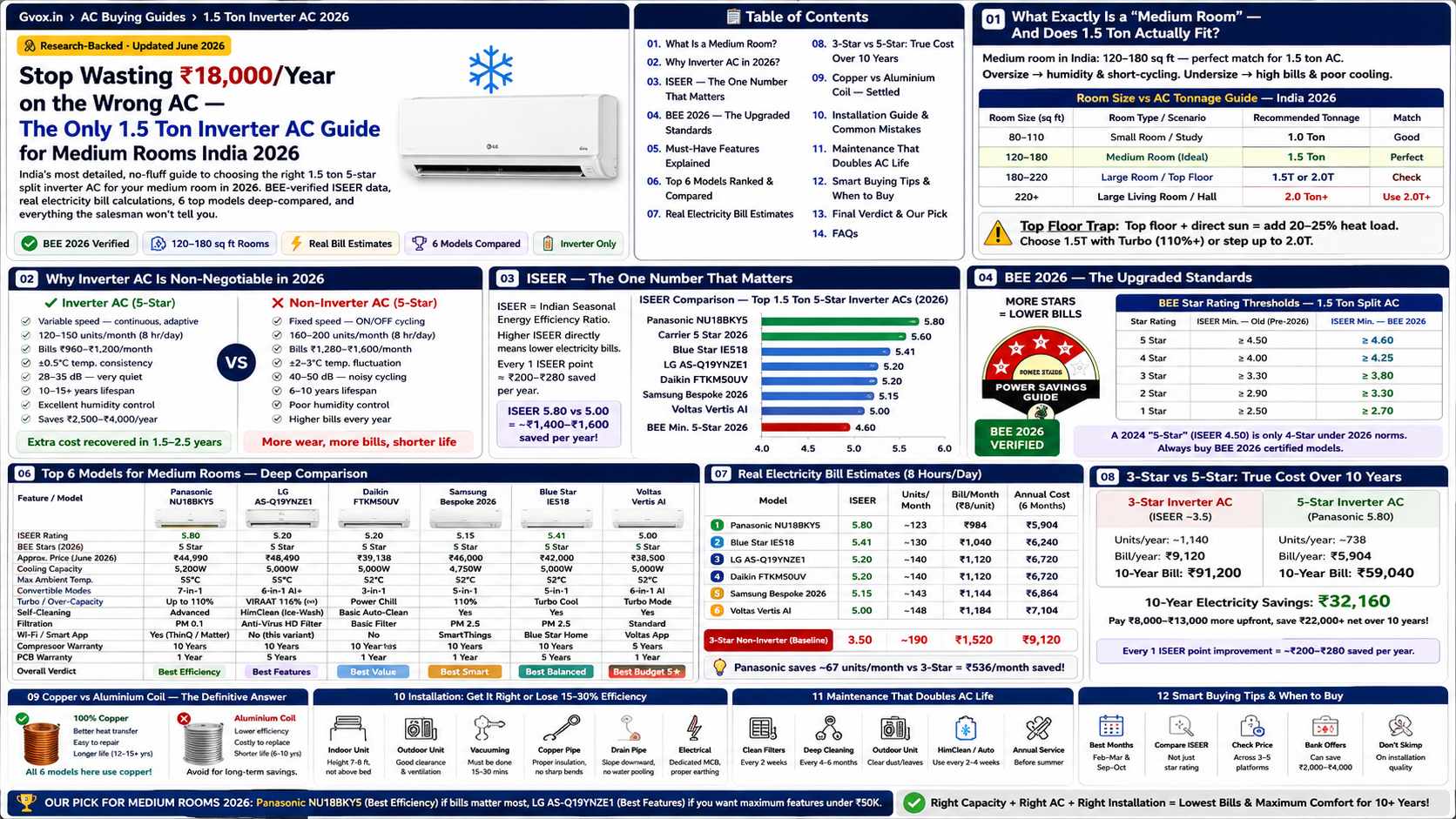
India’s most detailed, no-fluff guide to choosing the right 1.5 ton 5-star split inverter AC for your medium room in 2026. BEE-verified ISEER data, real electricity bill calculations, 6 top models deep-compared, and everything the salesman won’t tell you.
📋 Table of Contents
01. What Exactly Is a “Medium Room” — And Does 1.5 Ton Actually Fit?
Before buying any AC, the single most important decision is capacity — measured in tons. Get this wrong and you either spend ₹6,000–₹10,000 extra per year on electricity (undersized AC running at 100% all the time), or you get uncomfortable humidity and short-cycling (oversized AC shutting off before properly dehumidifying the room).
In India, a “medium room” typically refers to spaces measuring between 120 and 180 square feet. This covers the vast majority of Indian master bedrooms (which average 150–170 sq ft in urban apartments), standard children’s rooms, small living rooms, and home offices. According to AC tonnage data, over 55% of all residential AC sales in India are 1.5 ton models — precisely because this room size is the dominant use case.
A 1.5 ton split AC delivers approximately 18,000 BTU (British Thermal Units) of cooling capacity, which works out to roughly 5,000–5,200 watts of cooling power. At rated conditions (35°C ambient), this is the industry-standard match for a properly insulated 150 sq ft room with 2 occupants, 10-foot ceiling, and middle-floor installation.
The Practical Room-Size Matrix
Here’s how different room scenarios map to the ideal AC tonnage — and where 1.5 ton sits in this picture:
Factors That Increase Your Room’s Effective Heat Load
Beyond square footage, these factors can require you to size up or choose a 1.5T model with higher-than-rated peak capacity:
- Direct western/southern sun exposure: Rooms receiving 4+ hours of direct afternoon sun absorb significantly more heat through walls and windows.
- High ceilings (above 10 ft): A 12-ft ceiling room needs approximately 15% more cooling for the same floor area.
- Number of occupants: Each additional person beyond 2 adds roughly 600 BTU of heat to the room — relevant if you have 4 people in one room.
- Electronic heat sources: A desktop computer and gaming setup can add 400–800W of heat continuously. A kitchen — never put a 1.5T in a hot kitchen.
- Building material: Older construction with brick walls retains more daytime heat than modern insulated concrete structures.
- Climate zone: Bihar, UP, Rajasthan, and Madhya Pradesh experience ambient temperatures 4–8°C higher than coastal cities during peak summer. Choose models rated to operate at 52°C ambient or above.
02. Why Inverter AC Is Non-Negotiable in 2026 — The Complete Technical Case
The word “inverter” in an inverter AC does not refer to the home inverter (UPS) you use during power cuts. It refers to an electronic inverter drive that controls the speed of the compressor motor — the heart of the AC. Understanding this distinction is crucial because it explains every performance and efficiency advantage of modern inverter ACs.
A conventional fixed-speed (non-inverter) AC has only two states: fully ON (compressor running at 100% speed) and fully OFF. When the room temperature drops to the set temperature, the compressor shuts down completely. When the room warms up again, it restarts at full power. This constant on-off cycling is mechanically stressful and thermally inefficient — the startup phase consumes a surge of electricity every single time.
An inverter AC compressor never fully shuts down during use. Instead, it slows down to a very low speed (sometimes as low as 20–30% of rated speed) once the room approaches the target temperature, then maintains that temperature continuously with minimal power draw. It only ramps back up to high speed when the heat load increases — like when someone opens a window or more people enter the room.
What This Means in Real Numbers
For a 1.5 ton AC running 8 hours daily in Indian summer conditions:
| Parameter | ✅ Inverter AC (5-Star) | ❌ Non-Inverter AC (5-Star) |
|---|---|---|
| Compressor Operation | Variable speed — continuous, adaptive | Fixed speed — ON/OFF cycling |
| Startup Power Surge | Minimal — gradual ramp up | High surge every cycle restart |
| Monthly Units (8 hrs/day) | 120–150 units (ISEER 5.2–5.8) | 160–200 units (typical fixed speed) |
| Monthly Bill (₹8/unit) | ₹960–₹1,200 | ₹1,280–₹1,600 |
| Temperature Consistency | ±0.5°C — very steady | ±2–3°C — fluctuates as unit cycles |
| Noise Level | 28–35 dB at low speed (very quiet) | 40–50 dB — louder cycling |
| Compressor Lifespan | 10–15+ years with proper maintenance | 6–10 years — wear from cycling |
| Humidity Control | Excellent — continuous low-speed operation dehumidifies steadily | Poor — off cycles allow humidity to return |
| Annual Energy Savings vs | ₹2,500–₹4,000 saved vs 3-star non-inverter | Baseline |
| Payback Period | Extra cost recovered in 1.5–2.5 years | — |
03. ISEER — The Single Number That Determines Your Electricity Bill
Most AC buyers focus on the number of stars. But two 5-star ACs can have dramatically different electricity consumption — because the star rating is a range, not a fixed number. The metric that actually determines how much your AC costs to run is the ISEER: Indian Seasonal Energy Efficiency Ratio.
ISEER is calculated by India’s Bureau of Energy Efficiency (BEE) and measures how many units of cooling (in watts) the AC delivers per watt of electricity consumed, averaged across a full Indian cooling season. A higher ISEER directly means lower electricity bills. Unlike SEER ratings used in the US (calculated at a single temperature), ISEER accounts for the full temperature distribution of the Indian cooling season — from the relatively mild spring months to peak June heat — making it genuinely relevant to Indian conditions.
Under BEE 2026 norms, the minimum ISEER for a 5-star 1.5 ton split AC is 4.60. The current market leader (Panasonic CS/CU-NU18BKY5WX) achieves an ISEER of 5.80 — 26% higher than the minimum 5-star threshold. That 26% gap directly translates to 26% lower electricity consumption at equal usage hours.
04. BEE 2026 Rating Norms — Why the Year on the Label Matters
If you are buying an AC in 2026 and someone offers you a leftover 2024 or 2025 model at a heavy discount, there is something critical to understand: India’s Bureau of Energy Efficiency revised its energy labelling standards effective January 1, 2026, raising the bar for each star rating tier.
Under the older pre-2026 standards, an AC could achieve a 5-star rating with an ISEER as low as 4.0 (for split ACs). Under BEE 2026 norms, the minimum ISEER for 5-star is 4.60. This means a 2024 model labelled “5-star” may have delivered the same efficiency as a 2026 model that now qualifies for only 3 or 4 stars.
The practical effect is significant: 2026 BEE-certified 5-star ACs consume approximately 10–15% less electricity than their equivalently-rated 2024 counterparts. Buying the current-year model is not just about getting the latest features — it is a genuine financial decision with multi-year bill implications.
How to Verify BEE 2026 Certification
When purchasing, check the star label on the AC box and the product listing for “BEE 2026” or a label validity date of 2026 onward. Alternatively, search the model number on the BEE star label database at bee.gov.in — the official source that shows the exact ISEER rating and certification year for every registered AC model in India.
| Star Rating | ISEER Minimum — Old (Pre-2026) | ISEER Minimum — BEE 2026 |
|---|---|---|
| ⭐⭐⭐⭐⭐ 5 Star | ≥ 4.50 | ≥ 4.60 |
| ⭐⭐⭐⭐ 4 Star | ≥ 4.00 | ≥ 4.25 |
| ⭐⭐⭐ 3 Star | ≥ 3.30 | ≥ 3.80 |
| ⭐⭐ 2 Star | ≥ 2.90 | ≥ 3.30 |
| ⭐ 1 Star | ≥ 2.50 | ≥ 2.70 |
05. The 12 Features That Actually Matter — Explained Without Jargon
AC marketing is full of terms designed to sound impressive without explaining what they do in practice. Below is a clear, jargon-free explanation of the features that genuinely matter for Indian home users — and the ones that are primarily marketing.
06. Top 6 Models for Medium Rooms — Deeply Ranked & Compared
Below are the six best 1.5 ton 5-star inverter split ACs available in India in 2026, ranked by overall value proposition for medium rooms. Each model is evaluated on ISEER efficiency, cooling performance, key features, reliability indicators, price, and warranty. No paid placements influence these rankings — they are based on BEE-certified technical data and published specifications.
| Specification | Panasonic NU18BKY5 | LG AS-Q19YNZE1 | Daikin FTKM50UV | Samsung Bespoke 2026 | Blue Star IE518 | Voltas Vertis AI |
|---|---|---|---|---|---|---|
| ISEER Rating | 5.80 ⭐ Best | 5.20 | 5.20 | 5.15 | 5.41 | 5.00 |
| BEE Stars | 5 Star (2026) | 5 Star (2026) | 5 Star | 5 Star (2026) | 5 Star | 5 Star (2026) |
| Approx. Price (June 2026) | ₹44,990 | ₹48,490 | ₹39,138 | ₹46,000 | ₹42,000 | ₹38,500 |
| Cooling Capacity | 5,200W | 5,000W | 5,000W | 4,750W | 5,000W | 5,000W |
| Max Ambient Temp | 55°C | 55°C | 52°C | 52°C | 52°C | 52°C |
| Turbo / Over-Capacity Mode | 7-in-1 upto 110% | VIRAAT 116% (no time limit) | Power Chill | 5-in-1 110% | Turbo Cool | Turbo Mode |
| Convertible Modes | 7-in-1 | 6-in-1 AI+ | 3-in-1 | 5-in-1 | 5-in-1 | 6-in-1 AI |
| AI / Smart Adaptation | True AI (Matter-enabled) | Deep Learning AI+ | Basic inverter | AI WindFree | Limited AI | Voltas AI |
| Self-Cleaning | Yes (advanced) | HimClean (ice-wash) | Basic auto-clean | Yes | Yes | Yes |
| PM 2.5 Filtration | PM 0.1 | Anti-Virus HD Filter | Basic filter | PM 2.5 | PM 2.5 | Standard |
| Wi-Fi / Smart App | Yes (ThinQ / Matter) | No (this variant) | No | SmartThings | Blue Star Home | Voltas App |
| Refrigerant | R32 | R32 | R32 | R32 | R32 | R32 |
| Stabilizer-Free Range | 130V–290V | 120V–290V | 145V–290V | 145V–290V | 145V–290V | 130V–290V |
| Auto Restart | Yes | Yes | Yes | Yes | Yes | Yes |
| Compressor Warranty | 10 Years | 10 Years | 10 Years | 10 Years | 10 Years | 5 Years |
| PCB Warranty | 1 Year | 5 Years | 1 Year | 1 Year | 5 Years | 1 Year |
| Overall Verdict | Best Efficiency | Best Features | Best Value | Best Smart | Best Balanced | Best Budget 5★ |
The Panasonic CS/CU-NU18BKY5WX carries the highest ISEER of 5.80 among all BEE 2026-certified 1.5 ton split ACs — making it the most electricity-efficient model you can buy in this category today. Its True AI cooling system, described as India’s first Matter-enabled AC, adapts cooling based on room conditions in real time. The PM 0.1 filtration is industry-leading — capturing particles even smaller than the standard PM 2.5 threshold. At ₹44,990, it delivers the lowest lifetime electricity cost of any model in this segment, and the 55°C ambient operation rating makes it suitable for the harshest Indian summer conditions. The 7-in-1 convertible system provides more granular control than most competitors’ 5-in-1 or 6-in-1 implementations.
- Highest ISEER 5.80 — lowest bills in class
- PM 0.1 filtration — best air quality
- Wi-Fi + Matter smart home support
- 55°C ambient rating
- 7-in-1 convertible — most flexible
- Consistent Panasonic reliability history
- PCB warranty only 1 year (not 5 years like LG)
- Less known brand premium features vs LG
- No ice-wash deep clean system
- Wi-Fi setup can be complex for non-tech users
The LG AS-Q19YNZE1 is the most feature-laden 1.5 ton AC under ₹50,000, sacrificing some efficiency (ISEER 5.20 vs Panasonic’s 5.80) in exchange for the most practical day-to-day feature set. VIRAAT Mode at 116% with no time restriction is a unique differentiator — most competitors cap turbo at 15–30 minutes. HimClean’s ice-wash evaporator cleaning is the most advanced self-cleaning technology available in this segment, effectively replacing annual professional cleaning. The 5-year PCB warranty provides significantly more protection against the most common post-warranty failure point (PCB boards). Diet Mode+ at 83% power reduction offers the most aggressive power-saving mode available. The 10-year compressor warranty + 5-year PCB combination makes this the most warranty-backed purchase in the category.
- VIRAAT 116% unlimited turbo
- HimClean ice-wash self-cleaning
- 5-Year PCB warranty
- 55°C ambient operation
- Diet Mode+ — 83% power reduction
- Smart Dehumidification for monsoon
- No built-in Wi-Fi in this variant
- ISEER 5.20 — not the most efficient
- Most expensive of the top 3
- Slightly heavier outdoor unit
Daikin has built a deserved reputation for cooling performance and compressor reliability over decades in the Indian market. The FTKM50UV16VA delivers ISEER 5.20 and solid 5,000W cooling at a price point significantly below both Panasonic and LG. Its primary advantage is the Daikin brand’s well-established service network (one of the strongest in India) and its consistent mechanical reliability track record. However, compared to Panasonic and LG, it lacks advanced smart features, has only 3-in-1 convertible modes (not 5-in-1 or 7-in-1), no PM 2.5 filtration, and is rated only to 52°C ambient. For buyers who prioritize reliability and price over cutting-edge features, Daikin delivers excellent core performance at the most competitive price in the 5-star inverter category.
- Most affordable 5-star option (₹39,138)
- Best-in-class Daikin service network
- ISEER 5.20 — good efficiency
- Proven long-term reliability
- R32 refrigerant
- Max ambient only 52°C (not 55°C)
- Only 3-in-1 convertible (limited flexibility)
- No PM 2.5 filtration
- No Wi-Fi / smart features
- No advanced self-cleaning
Samsung’s Bespoke 2026 model brings the most polished smart home integration of any AC in this segment. SmartThings compatibility, AI WindFree draughts-free cooling mode, and the premium Bespoke aesthetic make it the obvious choice for smart home enthusiasts. However, it carries a slight efficiency penalty (ISEER 5.15) and notably offers only 4,750W of actual cooling capacity — closer to 1.35 ton than the claimed 1.5 ton. For a 130–150 sq ft room this is fine; for a 170–180 sq ft room, the lower actual cooling capacity may result in slower cooling times on peak summer days.
- Best smart home integration (SmartThings)
- AI WindFree gentle cooling
- Premium Bespoke design
- 10-year compressor warranty
- Good brand service network
- Only 4,750W capacity (not true 1.5T)
- ISEER 5.15 — lower than top 3
- Highest price for mid-tier efficiency
- Max ambient 52°C
Blue Star occupies an interesting middle ground: ISEER 5.41 places it second in efficiency among the group, 5-in-1 convertible modes, PM 2.5 filtration, 5-year PCB warranty, and genuine 5,000W cooling capacity — all at approximately ₹42,000. For buyers who want better efficiency than LG or Daikin without paying Panasonic’s premium, Blue Star is a legitimately strong choice. Its one weakness is a smaller service network compared to Panasonic, LG, or Daikin in tier-2 and tier-3 cities. In major urban areas, Blue Star service is fully adequate.
- ISEER 5.41 — 2nd highest efficiency
- 5-Year PCB warranty
- PM 2.5 filtration included
- Genuine 5,000W capacity
- Good mid-range price
- Smaller service network in smaller cities
- Max ambient 52°C
- No unlimited turbo mode
- Limited AI adaptation
Voltas is India’s #1 selling AC brand by volume, and the Vertis AI Zest Gold 2026 delivers a genuine 5-star BEE rating at the most accessible price point. ISEER 5.00 is the lowest in this group but still comfortably above the 4.60 minimum 5-star threshold. The 6-in-1 AI convertible is a strong feature. However, the compressor warranty is only 5 years versus 10 years for most competitors — a significant long-term consideration. Best suited for buyers with a strict budget who still want 2026 BEE 5-star compliance.
- Lowest price in the 5-star group
- 6-in-1 AI convertible
- Voltas app connectivity
- India’s largest AC service network
- BEE 2026 5-star certified
- Lowest ISEER (5.00) — highest bills in group
- Only 5-year compressor warranty
- No PM 2.5 filtration
- Max ambient 52°C
07. Real Electricity Bill Estimates — No Guesswork, Just Math
The most useful question when buying any AC is: how much will it actually add to my electricity bill? Below are detailed monthly and annual bill estimates for each model, calculated at 8 hours daily usage — a typical Indian household AC pattern during peak summer months (April–September). All calculations use ₹8 per unit (kWh) as the average Indian electricity tariff.
| Model | ISEER | Units/Month (8hr) | Bill/Month (₹8/unit) | Annual Cost (6 months) | Savings vs 3-Star |
|---|---|---|---|---|---|
| Panasonic NU18BKY5 | 5.80 | ~123 units | ₹984 | ₹5,904 | Save ₹5,400/yr |
| Blue Star IE518 | 5.41 | ~130 units | ₹1,040 | ₹6,240 | Save ₹4,800/yr |
| LG AS-Q19YNZE1 | 5.20 | ~140 units | ₹1,120 | ₹6,720 | Save ₹4,200/yr |
| Daikin FTKM50UV | 5.20 | ~140 units | ₹1,120 | ₹6,720 | Save ₹4,200/yr |
| Samsung Bespoke 2026 | 5.15 | ~143 units | ₹1,144 | ₹6,864 | Save ₹4,000/yr |
| Voltas Vertis AI | 5.00 | ~148 units | ₹1,184 | ₹7,104 | Save ₹3,700/yr |
| Typical 3-Star Non-Inverter (baseline) | 3.50 | ~190 units | ₹1,520 | ₹9,120 | — |
08. 3-Star vs 5-Star: What’s the True 10-Year Cost Difference?
The most common money-saving mistake Indian buyers make is choosing a 3-star AC to save ₹5,000–₹10,000 upfront, without calculating what that decision costs over 10 years of ownership. Let’s do the math clearly.
A typical 1.5 ton 3-star inverter AC costs approximately ₹30,000–₹35,000. A 1.5 ton 5-star inverter AC costs ₹38,000–₹48,000. The premium is ₹8,000–₹13,000. Now look at 10-year electricity cost:
- 3-Star Inverter AC (ISEER ~3.5): ~190 units/month × 6 months = 1,140 units/year × ₹8 = ₹9,120/year. Over 10 years: ₹91,200 in electricity.
- 5-Star Inverter AC — Panasonic (ISEER 5.8): ~123 units/month × 6 months = 738 units/year × ₹8 = ₹5,904/year. Over 10 years: ₹59,040 in electricity.
- 10-Year Electricity Savings: ₹91,200 − ₹59,040 = ₹32,160 saved.
- Net gain after paying the ₹10,000 premium: ₹22,160 profit — money kept in your pocket over 10 years by choosing 5-star.
This calculation doesn’t even account for rising electricity tariffs (which have increased 6–8% annually in most Indian states), making the 5-star AC’s advantage grow larger each year. The math is unambiguous: for any household using the AC more than 500 hours per year, a 5-star inverter AC is the correct financial decision every single time.
09. Copper vs Aluminium Condenser Coil — The Definitive Answer
This debate confuses many buyers. Here is the definitive answer for Indian conditions:
Copper condenser coils are better in every way that matters for Indian home use — and all six models in this guide use 100% copper coils. Copper has higher thermal conductivity than aluminium, meaning it transfers heat more efficiently, resulting in slightly better cooling performance per watt. More importantly for Indian conditions:
- Repairability: Copper coils can be repaired (welded/soldered) at any AC service centre across India. Aluminium coils must be replaced entirely if damaged — costing ₹8,000–₹20,000 versus ₹500–₹2,000 for copper repair.
- Corrosion resistance: In coastal areas (Mumbai, Chennai, Vizag, Kochi), saline sea air corrodes aluminium coils significantly faster than copper. Many manufacturers apply Ocean Black Protection coating to copper coils for additional resistance.
- Longevity: A well-maintained copper coil AC operates for 12–15+ years. Aluminium coil ACs in Indian conditions typically see coil degradation at 6–10 years.
All 5-star models in this guide use 100% copper condensers. If a cheaper AC you’re considering has an aluminium condenser, factor in the higher long-term maintenance cost before comparing sticker prices.
10. Installation Guide — The Step That Determines Whether Your AC Works Properly
Even the best AC will underperform significantly if installed incorrectly. Indian installation quality varies enormously — from brand-authorized technicians who follow proper protocols to informal local installers who cut corners in ways that reduce efficiency by 15–30% and can void your warranty. Here is what correct installation looks like and what to verify.
11. Maintenance Guide — How to Double Your AC’s Effective Life
The single most neglected aspect of AC ownership is maintenance. Most Indian households clean the filters once a year (or less) and wonder why their AC’s efficiency drops 20–30% over 3–5 years. Here is the maintenance schedule that keeps a quality inverter AC operating at near-original efficiency for 12–15 years.
| Frequency | Task | Why It Matters | DIY or Professional? |
|---|---|---|---|
| Every 2–3 Weeks | Clean indoor air filter | Clogged filter reduces airflow by up to 25%, forcing the compressor to work harder. Increases electricity consumption 8–15%. | ✅ DIY — rinse under tap water, air dry |
| Monthly | Check & clear drain pipe | Blocked drain causes water overflow, ceiling/wall damage, and indoor mold. 5-minute check prevents expensive repairs. | ✅ DIY — pour water into drain pan, verify flow |
| Monthly (Model-Specific) | Run HimClean / Auto Clean | LG HimClean ice-wash removes biofilm, bacteria, and mold from evaporator before they reduce efficiency. Other brands: run dry mode for 30 min after cooling to prevent mold. | ✅ DIY — one button/app tap |
| Pre-Season (March) | Professional coil cleaning | Evaporator and condenser coils accumulate dust, pollen, and biological growth that filter cleaning cannot address. 25–30% efficiency loss possible without annual deep clean. | 👨🔧 Professional required — chemical wash |
| Pre-Season (March) | Refrigerant level check | Slow refrigerant leaks from micro-cracks are common. Low refrigerant reduces cooling dramatically while increasing compressor strain. Check if cooling performance has dropped. | 👨🔧 Professional — requires gauges |
| Annual | Condenser fin cleaning | Outdoor unit fins (the thin metal slats) get clogged with dust, leaves, and debris. Clogged fins reduce heat rejection efficiency, increasing compressor load. | 👨🔧 Professional or careful DIY with soft brush |
| Annual | Electrical connection check | Loose terminals at indoor/outdoor unit cause voltage drop, PCB damage, and in extreme cases fire. Visual check for discolouration around terminals. | 👨🔧 Professional |
| Every 3–5 Years | Copper pipe insulation check | Foam insulation on refrigerant pipes degrades over time, causing heat gain/loss and condensation-related water damage inside walls. | 👨🔧 Professional — replace if cracked |
12. Smart Buying Tips — When to Buy, Where to Buy & What to Negotiate
Timing your AC purchase strategically can save ₹3,000–₹12,000 compared to peak-summer pricing. Here is everything you need to know to buy at the best possible price while avoiding common pitfalls.
When to Buy
- Best time (Price): November–January. AC prices are typically 8–15% lower during winter off-season. Online platforms like Flipkart and Amazon run clearance sales. Service centres also tend to have more availability for installation during this period.
- Good time (Balance): February–March. Stock of new 2026 models fully available, prices haven’t peaked yet. Amazon and Flipkart Republic Day and Holi sales in this period offer additional bank card discounts.
- Worst time (Price): May–June. Peak demand = minimal discounting. Prices often ₹3,000–₹8,000 above the platform’s average selling price. Delivery and installation slots are heavily booked — 5–10 day waits common.
Where to Buy
- Flipkart / Amazon: Generally the best prices for online purchase. Bank EMI offers from HDFC, SBI, ICICI, and Axis Bank frequently reduce effective price by ₹2,000–₹6,000. Compare prices across both platforms on the day of purchase — they fluctuate.
- Brand Flagship Stores: Useful for negotiating installation packages and extended warranty deals. Rarely the lowest price but offer the most seamless purchase-to-installation experience.
- Local Authorized Dealers: Best for rural and tier-2/3 cities where service network matters. Can negotiate free installation, extended warranty, and copper pipe inclusions. Build a relationship with a dealer who will prioritize your service calls.
What to Always Negotiate / Request
- Free installation with copper pipe (up to 5 metres included — worth ₹1,500–₹3,000)
- Extended warranty upgrade (from 1 to 3 or 5 years comprehensive — often available at ₹1,500–₹3,000 which is worth it for the PCB coverage)
- Free first service (many brands offer this — always ask)
- Bank card no-cost EMI (makes the effective price equivalent to cash while keeping your money invested)
- Old AC buy-back / exchange offer (₹2,000–₹5,000 additional discount if you’re replacing an old unit)
13. Final Verdict — Our Definitive Recommendations for 2026
🏆 Final Verdict: Which 1.5 Ton Inverter AC Should You Buy for a Medium Room in India 2026?
For Maximum Electricity Savings (Best ISEER) → Panasonic CS/CU-NU18BKY5WX (₹44,990). If your primary goal is the lowest electricity bills over 5–10 years, the Panasonic’s ISEER 5.80 is unmatched in this category. Its PM 0.1 filtration, Wi-Fi connectivity, and 7-in-1 convertible modes make it a complete package, not just an efficiency champion. For households running the AC 8+ hours daily, this model pays its premium back vs Daikin in under 3 years of electricity savings alone.
For Maximum Features + Peak Cooling → LG AS-Q19YNZE1 (₹48,490). If you live in extreme-heat states like Bihar, UP, Rajasthan, or Madhya Pradesh and want the most capable AC regardless of efficiency, the LG’s unlimited VIRAAT 116% turbo, HimClean ice-wash cleaning, Diet Mode+, 5-year PCB warranty, and 55°C ambient rating make it the most practically equipped AC in this segment. You pay slightly more in electricity than the Panasonic, but you get features that genuinely matter every single day in Indian summer conditions.
For Best Price-to-Performance → Daikin FTKM50UV16VA (₹39,138). If you want a 5-star inverter AC from a trusted brand at the lowest cost of entry, Daikin’s FTKM50UV delivers ISEER 5.20, proven reliability, India’s best service network, and solid cooling at a price ₹5,000–₹9,000 below most competitors. It’s not the most feature-rich, but it will cool your room reliably for 12+ years with minimal fuss.
The Universal Truth: Any 5-star BEE 2026-certified inverter AC from the brands above is an excellent purchase for a medium room in India in 2026. The worst decision is a 3-star non-inverter at any price — it will cost you ₹25,000–₹40,000 more in electricity over 10 years while delivering inferior comfort. Choose based on your priority: efficiency (Panasonic), features (LG), or value (Daikin) — but always choose 5-star inverter.
| Criteria | Panasonic NU18BKY5 | LG AS-Q19YNZE1 | Daikin FTKM50UV |
|---|---|---|---|
| Energy Efficiency | 10/10 ⭐ | 8/10 | 8/10 |
| Cooling Performance | 9/10 | 10/10 ⭐ | 9/10 |
| Feature Set | 9/10 | 10/10 ⭐ | 7/10 |
| Value for Money | 9/10 | 7/10 | 10/10 ⭐ |
| Smart Features | 9/10 | 6/10 | 5/10 |
| Warranty Coverage | 8/10 | 10/10 ⭐ | 8/10 |
| India Climate Suitability | 9/10 | 10/10 ⭐ | 8/10 |
| Overall Score | 9.1/10 | 8.7/10 | 7.9/10 |
14. Frequently Asked Questions
Best 1.5 Ton Inverter AC for Medium Rooms in India (2026) – Don’t Buy Before Reading This