Xiaomi Pad 8 Review: iPad Killer Finally Here?
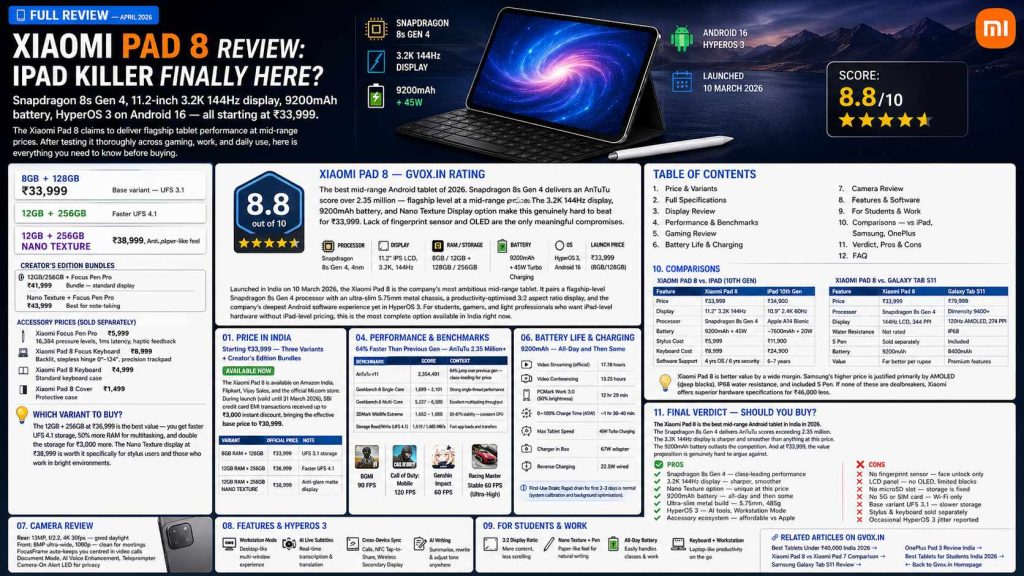
Snapdragon 8s Gen 4, 11.2-inch 3.2K 144Hz display, 9200mAh battery, HyperOS 3 on Android 16 — all starting at ₹33,999. The Xiaomi Pad 8 claims to deliver flagship tablet performance at mid-range prices. After testing it thoroughly across gaming, work, and daily use, here is everything you need to know before buying.
📋 Quick Summary — Xiaomi Pad 8
Launched in India on 10 March 2026, the Xiaomi Pad 8 is the company’s most ambitious mid-range tablet. It pairs a flagship-level Snapdragon 8s Gen 4 processor with an ultra-slim 5.75mm metal chassis, a productivity-optimised 3:2 aspect ratio display, and the company’s deepest Android software experience yet in HyperOS 3. For students, gamers, and light professionals who want iPad-level hardware without iPad-level pricing, this is the most complete option available in India right now.
📑 Table of Contents
01. Xiaomi Pad 8 Price in India
The Xiaomi Pad 8 is available on Amazon India, Flipkart, Vijay Sales, and the official Mi.com store. During launch (valid until 31 March 2026), SBI credit card EMI transactions received up to ₹3,000 instant discount, bringing the effective base price to ₹30,999.
| Variant | Official Price | Note |
|---|---|---|
| 8GB RAM + 128GB | ₹33,999 | UFS 3.1 storage |
| 12GB RAM + 256GB | ₹36,999 | Faster UFS 4.1 |
| 12GB RAM + 256GB Nano Texture | ₹38,999 | Anti-glare matte display |
| Creator’s Edition (12GB/256GB + Focus Pen Pro) | ₹41,999 | Bundle — standard display |
| Creator’s Edition (Nano Texture + Focus Pen Pro) | ₹43,999 | Best for note-taking |
Accessory Prices (Sold Separately)
02. Xiaomi Pad 8 Full Specifications
03.Xiaomi Pad 8 Display Review — 3.2K 144Hz, Nano Texture Option
The 11.2-inch IPS LCD display is the Xiaomi Pad 8’s centrepiece. The 3200×2136 resolution at 345 PPI means text, photos, and video look razor-sharp — individual pixels are completely invisible in normal use. The 144Hz adaptive refresh rate makes scrolling, gaming, and UI navigation noticeably smoother than 60Hz tablets, and the 3:2 “Golden Aspect Ratio” is meaningfully better for reading documents, websites, and e-books compared to wider 16:10 screens.
Colour reproduction covers the DCI-P3 wide gamut with 12-bit depth supporting 68 billion colours. Dolby Vision and HDR10+ support means streaming content on Netflix and Prime Video looks cinematic. At 800 nits peak brightness in High Brightness Mode, the display holds up well in brightly lit rooms, though direct sunlight remains a challenge for the standard glossy variant.
Standard vs. Nano Texture Display
| Feature | Standard Display | Nano Texture Display |
|---|---|---|
| Finish | Glossy glass | Matte anti-glare |
| Glare Reduction | Standard | Up to 70% less reflection |
| Stylus Feel | Smooth glass | Paper-like friction |
| Best For | Movies, indoor media | Notes, outdoor, bright rooms |
| Price Premium | Base | +₹2,000 (₹38,999) |
TÜV Rheinland certifications for Low Blue Light, Flicker Free, and Circadian Friendly operation are included — making this a comfortable display for extended sessions. A Reading Mode simulates e-ink for books and documents. Wet Touch technology allows limited responsiveness with slightly damp fingers.
04. Xiaomi Pad 8 Performance & Benchmarks
The Snapdragon 8s Gen 4 (4nm) with Adreno 825 GPU is a genuine flagship-class chip at a mid-range price. The 64% AnTuTu improvement over the previous generation is not just a benchmark number — it translates to noticeably snappier app launching, smoother multitasking, faster export times, and better sustained gaming performance. The 12GB LPDDR5T RAM variant handles split-screen with three apps and a floating window without any stuttering.
| Benchmark | Score | Context |
|---|---|---|
| AnTuTu v11 | 2,354,401 | 64% jump over previous gen — class-leading for price |
| Geekbench 6 Single-Core | 1,699–2,101 | Strong single-thread performance |
| Geekbench 6 Multi-Core | 5,227–6,580 | Excellent multitasking throughput |
| 3DMark Wildlife Extreme | 1,652–1,688 | 83–87% stability — consistent sustained GPU |
| Storage Read/Write (UFS 4.1) | 1,619 / 1,485 MB/s | Fast app loads and file transfers |
| BGMI | 90 FPS | Stable at max settings |
| Call of Duty: Mobile | 120 FPS | Very High settings |
05.Xiaomi Pad 8 Gaming Review
For gaming, the Xiaomi Pad 8 is in a class of its own at this price. The combination of Snapdragon 8s Gen 4, Adreno 825 GPU, 144Hz display, quad Dolby Atmos speakers, and effective thermal management creates a genuinely premium gaming experience. The 11.2-inch 3.2K display makes games look spectacular, and the 144Hz refresh rate makes fast-action games feel dramatically more fluid than 60Hz alternatives.
🎮 Gaming Performance Results
Thermal management is a particular strength. Extended gaming sessions produce minimal heat accumulation — there is no sudden performance throttling mid-game, which is a problem on many cheaper Android tablets. Game Turbo Mode further optimises CPU and GPU resource allocation for peak gaming performance.
06.Xiaomi Pad 8 Battery Life & Charging
The 9200mAh battery is one of the largest in any tablet at this price, and it delivers accordingly. In real-world use, most users get through a full day of heavy work, streaming, and gaming, with battery to spare. Light users can comfortably go two days between charges. The battery is rated for 17.78 hours of continuous video streaming and 13.25 hours of video conferencing — practical numbers that match real-world experience.
07.Xiaomi Pad 8 Camera Review
Tablet cameras are always secondary to the screen, battery, and processor — and the Xiaomi Pad 8 is no different. The 13MP rear camera handles daylight photography and document scanning very well. The Document Mode in HyperOS 3 automatically straightens, enhances, and corrects skewed documents — genuinely useful for students and professionals. The 8MP ultra-wide front camera is where most users will spend their time, and it delivers clean, clear 1080p video for meetings and online classes.
08.Xiaomi Pad 8 Features & HyperOS 3 Software
HyperOS 3 running on Android 16 is a significant improvement over previous Xiaomi software releases. Bloatware is notably reduced compared to Xiaomi phones, the UI is cleaner, and animations are smooth. Workstation Mode creates a desktop-like experience with a persistent bottom dock and flexible floating windows — useful for productivity sessions with a keyboard attached.
HyperAI Tools
Cross-Device Features
With a Xiaomi phone, the Pad 8 enables call and network synchronisation (answer phone calls on the tablet), NFC Tap-to-Share for instant file transfers, and Wireless Secondary Display mode that works with both Windows and Mac computers. These are genuine productivity multipliers if you are already in the Xiaomi ecosystem.
09. Xiaomi Pad 8 for Students & Work
The Xiaomi Pad 8 is purpose-built for student and light-professional use. The 3:2 display aspect ratio is wider than typical tablets at the same height — this means web pages, PDFs, and documents show more content per screen without excessive scrolling. The 144Hz refresh rate makes reading smoother and reduces eye fatigue during long sessions. The 3.2K resolution ensures even small text in textbooks and research papers remains crisp and readable.
For note-taking, the Nano Texture Display with Focus Pen Pro (₹43,999 Creator’s Edition) provides a paper-like stylus experience that most students who try it describe as genuinely better than writing on glass. AI Live Subtitles automatically transcribes and translates lectures and YouTube videos — a genuine study tool. For online classes, the 8MP FocusFrame front camera keeps you centred automatically, and the quad Dolby Atmos speakers deliver clear lecture audio without distortion even at high volumes.
With HyperOS 3’s Workstation Mode and the Focus Keyboard (₹8,999), the Pad 8 functions as a capable laptop replacement for note-taking, research, and light content creation. For students who currently consider a Chromebook or basic Windows laptop in this budget, the Xiaomi Pad 8 with keyboard offers a more portable, more versatile alternative.
10.Xiaomi Pad 8 Comparisons
Xiaomi Pad 8 vs. iPad (10th Gen)
| Feature | Xiaomi Pad 8 | iPad 10th Gen |
|---|---|---|
| Price | ₹33,999 | ₹34,900 |
| Display | 11.2″ 3.2K 144Hz LCD | 10.9″ 2.4K 60Hz LCD |
| Processor | Snapdragon 8s Gen 4 | Apple A14 Bionic |
| Battery | 9200mAh + 45W | ~7600mAh + 20W |
| Stylus Cost | ₹5,999 (Focus Pen Pro) | ₹11,900 (Apple Pencil) |
| Keyboard Cost | ₹8,999 | ₹24,900 (Magic Keyboard Folio) |
| App Ecosystem | Android (catching up) | iPadOS (more tablet apps) |
| Software Support | 4 yrs OS / 6 yrs security | 6–7 years |
Xiaomi Pad 8 vs. Samsung Galaxy Tab S11
| Feature | Xiaomi Pad 8 | Samsung Galaxy Tab S11 |
|---|---|---|
| Price | ₹33,999 | ₹79,999 |
| Processor | Snapdragon 8s Gen 4 | Dimensity 9400+ (higher AnTuTu) |
| Display | 144Hz, 344 PPI | 120Hz AMOLED, 274 PPI |
| Black Levels | LCD — limited blacks | AMOLED — perfect blacks |
| Water Resistance | Not rated | IP68 |
| S Pen | Stylus sold separately | S Pen included |
| Battery | 9200mAh | 8400mAh |
| Value | Far better per rupee | Premium justified by OLED + IP68 |
11. Final Verdict — Should You Buy?
🏁 Final Verdict — Xiaomi Pad 8
The Xiaomi Pad 8 is the best mid-range Android tablet available in India in 2026, and it is not particularly close. The Snapdragon 8s Gen 4 delivers AnTuTu scores exceeding 2.35 million — numbers that were in flagship territory just two years ago. The 3.2K 144Hz display is sharper and smoother than anything at this price. The 9200mAh battery outlasts the competition. And at ₹33,999, the value proposition is genuinely hard to argue against.
The compromises are real but manageable. No fingerprint sensor means relying on face unlock or PIN — annoying but functional. The LCD panel cannot match OLED’s deep blacks — visible in dark movie scenes but irrelevant for most daily use. No expandable storage and no SIM card slot limit flexibility for some users. And the stylus and keyboard are sold separately, adding meaningful cost if you want the full productivity experience.
For most buyers — students, gamers, professionals who need a portable productivity device, or anyone considering their first Android tablet — the Xiaomi Pad 8 is the recommendation without hesitation. It delivers iPad Air-class hardware at base iPad pricing, which in 2026 is a remarkable achievement.
✅ Pros
Snapdragon 8s Gen 4 — class-leading performance for the price. AnTuTu 2.35M+ puts it ahead of every rival tablet under ₹50,000.
3.2K 144Hz display — sharper and smoother than iPad at the same price. The 3:2 ratio is genuinely better for productivity and reading.
Nano Texture Display option — unique at ₹38,999. Paper-like stylus feel with 70% glare reduction. No rival offers this in the price range.
9200mAh battery — all-day and then some. 17+ hours streaming, 13+ hours meetings.
Ultra-slim metal build — 5.75mm, 485g. Feels significantly more premium than the price suggests.
HyperOS 3 on Android 16 — AI Live Subtitles, AI Writing, Workstation Mode are genuinely useful, not just marketing.
Accessory ecosystem — Focus Pen Pro (₹5,999) and Focus Keyboard (₹8,999) cost a fraction of Apple equivalents.
❌ Cons
No fingerprint sensor — face unlock only. A significant usability compromise that frustrates many users.
LCD panel — no OLED. Dark scenes in movies lack the deep blacks of Samsung Galaxy Tabs or iPad Pro. Not a dealbreaker but noticeable.
No microSD slot — storage is fixed at purchase. Choose 256GB if you install large games or store media locally.
No 5G or SIM card — Wi-Fi only. Requires phone hotspot or Wi-Fi for data on the go.
Base variant UFS 3.1 — the 128GB model has slower storage than the 256GB variants. Worth the extra ₹3,000 to upgrade.
Stylus and keyboard sold separately — full productivity setup adds ₹11,000–₹15,000 to the cost.
Occasional HyperOS 3 jitter — minor UI inconsistencies reported by some users. Expected to improve with updates.
🔗 Related Articles on Gvox.in
Frequently Asked Questions
- Official Product Page & FAQ: Xiaomi India Official Store
- Retail & Offer Details: Amazon.in (Product Listing)
- Technical Specifications: Xiaomi Official Specs Page