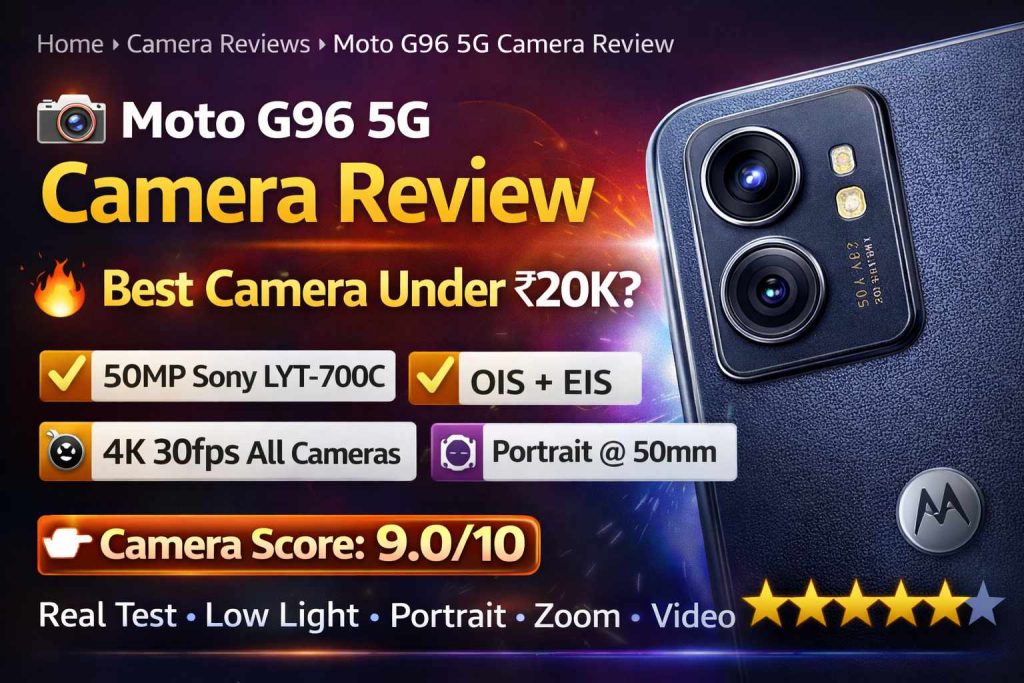
Moto G96 5G Camera Review — Sony Sensor, 4K Everywhere
The Moto G96 5G packs a 50MP Sony LYT-700C sensor with OIS in a ₹16,000–₹18,000 phone. Unusually, all three cameras — main, ultrawide, and selfie — support 4K 30fps recording. We put it through daylight, low light, portrait, zoom, and video tests to answer one question: is this the best camera phone under ₹20,000?
📋 Quick Summary — Moto G96 5G Camera
Most phones at this price use generic Samsung or Omnivision sensors without OIS. Motorola’s decision to use Sony’s LYT-700C sensor — a newer and better sensor than the LYT-600 found in the G86 Power — gives the G96 a tangible advantage in real-world image quality, particularly in low light and zoom crops. The result is a phone where every rupee spent translates directly to camera output.
📑 Table of Contents
01. Camera Specs Overview
The headline feature of the Moto G96 5G is its 50MP Sony LYT-700C sensor. Sony’s LYT (Lytia) series represents their latest generation of mobile camera sensors, and the 700C is a step above the LYT-600 used in the Moto G86 Power. The key advantage is better light-gathering capability and more efficient noise reduction — tangible differences that show up most clearly in low-light photography and when zooming into images.
📷 Full Camera Specifications
02. Main Camera — Daylight Photography
In daylight, the Moto G96 5G delivers a camera experience that punches significantly above its price. The most immediately noticeable quality is how it handles colours — unlike Realme and Vivo phones at this price which oversaturate and add artificial texture sharpening (especially on faces and hair), the G96 captures images that look natural and honest. What you see is genuinely what was in front of the lens, without AI-boosted beard texture or cartoonishly saturated skies.
HDR management is a particular strength. In situations with bright skies and shaded faces — the classic difficult scenario for any phone camera — the G96 consistently maintains sky detail without blowing out highlights, while simultaneously exposing the face correctly. This is a direct benefit of the Sony LYT-700C’s wider dynamic range capability combined with Motorola’s processing algorithm.
03. Low Light & Night Mode
Low-light photography is where the Sony LYT-700C sensor gap over the G86 Power’s LYT-600 becomes most visible. In side-by-side comparisons at night, the G96 produces significantly less noise, especially in shadow areas and textured surfaces. When zooming into identical shots of the same scene, the G96 consistently shows finer, cleaner detail.
Indoor photography in normal room lighting delivers good results — detail is well-preserved, grain is minimal, and colours don’t shift dramatically from the daylight profile. Night mode captures bright areas without over-exposure and manages to retain texture in darker zones, though very dark areas can appear flat. Autofocus in night mode works well for subjects at normal distance but can struggle at very close range — a limitation addressed more in the autofocus section below.
04. Portrait Mode — Three Focal Lengths
The portrait mode on the G96 offers three focal length options — 24mm (1x), 35mm (1.5x), and 50mm (2x) — all rendered from the same 50MP main sensor via crop. This is a thoughtful implementation: longer focal lengths produce more flattering perspective compression, giving shots a genuinely DSLR-like feel at 35mm and 50mm. The bokeh quality uses Motorola’s distinctive circular dot blur pattern, which some users find different from conventional bokeh — you cannot change the blur style, only the intensity.
At 1x (24mm), edge detection occasionally misidentifies eyeglasses as background and blurs them incorrectly — a known quirk observed during testing. Switching to 35mm (1.5x) or 50mm (2x) eliminates this problem almost entirely. Edge detection at these longer focal lengths is sharp and accurate, with clean subject separation. HDR handling in portrait mode is excellent — even backlit portraits retain face detail and sky tone simultaneously.
05. Ultrawide Camera — With Autofocus
The 8MP ultrawide camera covers 118.6° field of view — wide enough for architecture, group photos, and dramatic landscape shots. What sets it apart at this price is autofocus, which most ultrawide cameras at this budget lack. This enables macro-style close-up photography: insects, flowers, textures, and small product shots can all be captured at very close distances with the ultrawide lens, something the main camera struggles with due to its minimum focus distance.
Daylight ultrawide photos have higher-than-typical contrast — dark areas appear quite dark, which creates a punchy look that works well for certain subjects but may require slight editing for balanced scenes. Autofocus in the ultrawide works reliably for most subjects, though it can occasionally hunt in very low light. 4K 30fps video on the ultrawide is stable thanks to EIS and produces usable footage even while walking.
06. Selfie Camera — 32MP Natural Portraits
The 32MP selfie camera is one of the most capable front cameras in the sub-₹20,000 category. At 22mm equivalent field of view, it captures a wide frame — useful for group selfies and landscape-style self-portraits. Skin tones are rendered naturally without the aggressive whitening or artificial smoothing common on many Android phones in this range. Details in hair, fabric, and background remain sharp and authentic.
HDR management in selfies is noteworthy — even with the sun directly behind the subject, the G96 keeps the face well-exposed without washing out the sky or background. Portrait mode from the selfie camera also uses the depth information intelligently, with clean edge detection around hair and face. In low light, selfie photos retain good detail with minimal noise, though background lights can occasionally over-expose in night selfies.
07. Video Quality — 4K, 1080p60, Stabilisation
The G96’s most unique feature is the availability of 4K 30fps recording across all three cameras — main, ultrawide, and selfie. This is genuinely rare at ₹16,000–₹18,000 and gives vloggers, content creators, and travel photographers a level of versatility normally reserved for mid-range and flagship devices. Stabilisation is provided by OIS + EIS on the main camera and EIS on the ultrawide and selfie — the result is smooth, shake-free footage even while walking.
The main camera’s 4K video shows excellent colour, solid dynamic range, and natural noise levels. Switching between ultrawide and 1x during recording is possible, but causes a 1-second cut in both video and audio — avoid this mid-recording if continuity matters. Slow motion at 1080p 120fps is available from the main camera. Dual Video mode lets you record from both front and rear cameras simultaneously, useful for reaction-style vlogs.
08. Zoom Test — 1x to 10x
The Moto G96 5G uses digital zoom from the main 50MP Sony sensor — there is no dedicated optical telephoto lens. Maximum zoom is 10x. The high-resolution 50MP sensor helps maintain usable detail at moderate zoom levels, but results vary with distance.
At 5x, the 50MP sensor provides enough resolution to crop in while keeping acceptable sharpness — recommended as the practical maximum for sharing-quality shots. At 10x, photos become visibly soft with detail degradation, though basic subject recognition remains possible. Light control remains strong even at higher zoom levels — the exposure handles direct sunlight well — but pixel-level sharpness suffers as expected from a digital crop. For video zooming, 4K mode allows up to 2x digital zoom with maintained quality; switching to 1080p unlocks the wider zoom range.
09. Moto G96 vs Moto G86 Power — Camera Comparison
Both phones share many camera specifications on paper, but the sensor difference — Sony LYT-700C in the G96 versus Sony LYT-600 in the G86 Power — creates real-world differences that are most visible in zoom crops and low-light video. Here’s an honest comparison:
| Camera Feature | Moto G96 5G | Moto G86 Power |
|---|---|---|
| Main Sensor | Sony LYT-700C (Newer, Better) | Sony LYT-600 |
| OIS on Main | Yes | Yes |
| Ultrawide | 8MP with Autofocus | 8MP with Autofocus |
| Selfie FOV | Wider (22mm equiv.) | Slightly Narrower |
| Low-Light Video Noise | Less Noise, Cleaner | More Noise in Dark |
| Photo Detail (Zoomed In) | Better at Every Zoom Level | Decent but Less Sharp |
| Exposure in Bright Light | Occasional UW Overexposure | Slightly More Stable |
| Selfie 4K Video FOV | Wider | Standard |
| Display | Curved AMOLED | Flat AMOLED |
| Battery | 5500mAh | Larger Battery |
| Overall Camera Winner | G96 — Clear Win | G86 Power |
10. Final Verdict & Camera Settings Guide
🏁 Final Verdict — Moto G96 5G Camera
At ₹16,000–₹18,000, the Moto G96 5G is the best camera phone available. The Sony LYT-700C sensor with OIS gives it a measurable edge over everything else at this price — in daylight, in low light, in zoom crops, and in video quality. The decision to equip all three cameras with 4K 30fps recording is genuinely unusual and useful for content creators. Portrait mode at three focal lengths adds creative flexibility that more expensive phones often don’t provide.
The minor issues are real but manageable: autofocus occasionally hunts at very close range in low light, lens switching during video recording creates a small cut, and selfie video is limited to 30fps. None of these break the camera experience. For anyone whose phone purchase is primarily camera-driven and has a budget under ₹20,000 — Moto G96 5G is the recommendation with confidence.
✅ Camera Strengths
Sony LYT-700C sensor — best in class for this price range, real advantage in low light and zoom detail.
4K 30fps on all three cameras — main, ultrawide, and selfie. Unique feature at ₹16,000–₹18,000.
Natural colour science — no AI texture boost on faces, no over-whitening on selfies, no cartoon saturation.
Portrait mode with 3 focal lengths (24/35/50mm) — DSLR-like subject separation at 35mm and 50mm.
Autofocus ultrawide — enables macro photography that fixed-focus competition cannot match.
Strong HDR in all modes — sky and face simultaneously well-exposed in difficult lighting.
❌ Camera Limitations
Autofocus hunting at very close distances in low light — occasional miss at 1x macro range.
Lens switching during video creates ~1 second audio and video cut — not seamless.
Selfie video locked at 30fps — no 1080p 60fps option on the front camera.
Portrait mode at 24mm (1x) can incorrectly blur eyeglasses — use 35mm+ with glasses.
10x zoom results are soft — practical maximum is 5x for share-quality shots.
Ultrawide low-light performance average — noisy in very dark environments.