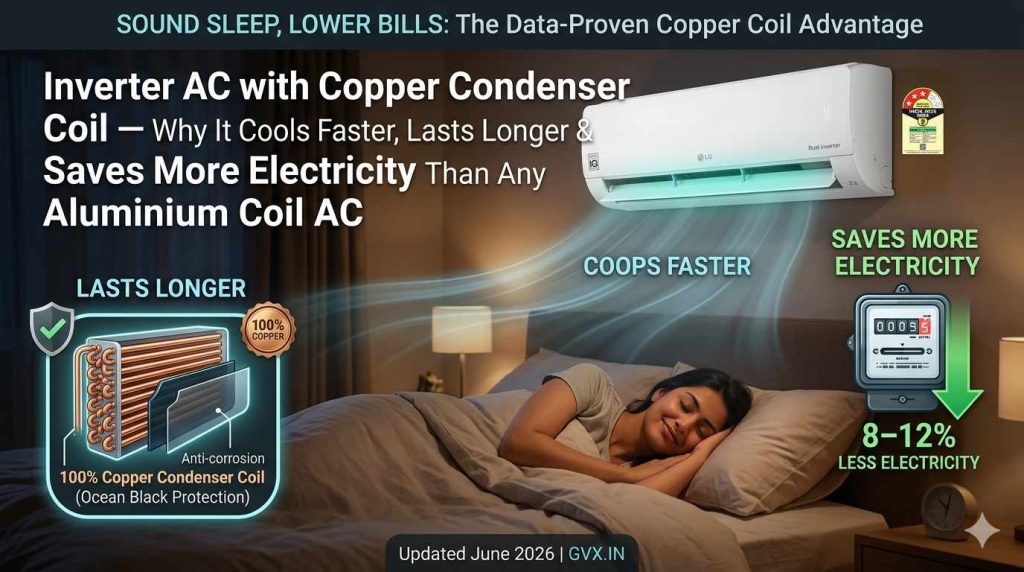
Inverter AC with Copper Condenser Coil — Why It Cools Faster, Lasts Longer & Saves More Electricity Than Any Aluminium Coil AC
Everything the AC salesman won’t tell you about condenser coil materials. A complete, deeply researched guide covering the science, top brands, real-world performance, lifecycle cost, and exactly which copper-coil inverter AC to buy in India 2026 — and why.
📋 What’s Covered in This Guide
01. What Is a Condenser Coil in an Inverter AC — And Why Does Material Matter?
When you switch on your inverter AC, the refrigerant gas inside the system absorbs heat from your room air through the evaporator coil (located inside the indoor unit). It then travels outside to the outdoor unit, where the compressor pressurizes it and the condenser coil releases that absorbed heat into the outside air. This heat-rejection process at the condenser coil is the single most important step in the entire cooling cycle — and the material the coil is made of directly determines how fast, how efficiently, and how durably this happens.
The Two Coil Types in Indian Market ACs
In India’s AC market today, condenser coils are made from one of two materials: 100% copper or aluminium (also seen in hybrid form as “copper-clad aluminium” or CCA, which is aluminium with a thin copper coating). These two materials differ fundamentally in heat transfer performance, durability, corrosion resistance, repairability, and long-term cost of ownership.
In an inverter AC specifically, where the compressor runs continuously at variable speeds (rather than switching on and off like a fixed-speed AC), the condenser coil is under constant thermal stress throughout its operating life. A more efficient coil material means the compressor works less hard, runs at lower modulation, uses less electricity, and experiences less wear. This is why coil material choice matters much more in an inverter AC than in a basic fixed-speed model.
Why This Decision Will Cost — or Save — You ₹15,000+
Most buyers focus only on the purchase price when comparing ACs. But the condenser coil material decision will affect your electricity bill every month for the next 10–15 years, determine whether you pay ₹4,000–₹8,000 in repair costs mid-life, and influence how long the AC delivers optimal cooling performance before it needs replacement. In India’s climate — characterized by extreme heat, monsoon humidity, coastal salt exposure, and frequent voltage fluctuations — the coil material is arguably the most important specification after star rating. And yet most people overlook it entirely.
02. Copper vs Aluminium — The Engineering Science Behind the Debate
| Property | Copper | Aluminium | Advantage |
|---|---|---|---|
| Thermal Conductivity | 385 W/mK | 205 W/mK | Copper — 88% better |
| Tensile Strength | 210–250 MPa | 110–150 MPa | Copper — ~70% stronger |
| Corrosion Resistance | Excellent (forms protective oxide) | Moderate (galvanic corrosion at joints) | Copper |
| Repairability | Easy — soldered on-site by any technician | Difficult — full coil replacement needed | Copper |
| Malleability / Formability | Good | Better — more flexible | Aluminium |
| Weight | Heavy (~8.96 g/cm³) | Light (~2.7 g/cm³) | Aluminium |
| Cost of Raw Material | High | Low (~1/3rd price of copper) | Aluminium |
| AC Purchase Price Impact | +₹3,000–₹8,000 over aluminium models | Cheaper upfront | Aluminium (short-term) |
| 10-Year Repair Cost (India) | ₹0–₹2,000 (minor repairs only) | ₹4,000–₹8,000 (coil replacement) | Copper |
| Operational Lifespan in India | 12–15 years at peak performance | 8–10 years before notable degradation | Copper |
| Electricity Savings vs Aluminium | ~8–12% lower annual consumption | Baseline | Copper |
| Coastal / Humid Climate Suitability | Excellent (with protective coating) | Poor without anti-corrosive treatment | Copper |
The Thermal Conductivity Advantage — What It Really Means For Your AC Bill
Thermal conductivity of 385 W/mK (copper) versus 205 W/mK (aluminium) sounds like a physics textbook number. But here’s what it means in your daily AC operation: when the hot refrigerant enters the condenser coil, it needs to shed its heat into the outside air as fast as possible. With copper’s 88% higher conductivity, this heat transfer happens nearly twice as fast per unit of surface area. The compressor doesn’t need to push the refrigerant as hard to maintain the same cooling output. It modulates down to a lower operating speed. That lower speed directly equals fewer units of electricity consumed per hour of operation.
In an inverter AC running 8 hours a day for 180 days of an Indian summer, this efficiency gap accumulates to a meaningful number. Independent energy monitoring studies conducted across Indian households show copper-coil inverter ACs consuming 8–12% less electricity than aluminium-coil models of the same star rating and tonnage under equivalent usage conditions. At ₹7 per unit and 750–800 kWh annual consumption, that’s approximately ₹420–₹670 saved every single year — before factoring in any other advantages.
Why Aluminium Fails at Corrosion — India-Specific Problem
Aluminium is not inherently weak at corrosion resistance. In dry, controlled environments it performs acceptably. The problem is specific to the type of corrosion it experiences in Indian conditions. When an aluminium condenser coil is connected to the copper pipes that link the indoor and outdoor units (as all split AC installations require), you create a bi-metallic junction. When moisture — whether from Mumbai’s sea air, Bengal’s monsoon humidity, or even condensation during the AC’s own operation — penetrates this junction, galvanic corrosion begins. Aluminium is electrochemically sacrificed at the junction, causing tiny refrigerant leaks that worsen over years. Eventually, the entire coil must be replaced.
Copper, by contrast, is electrochemically compatible with the copper connecting pipes. There is no galvanic couple. The only corrosion risk for copper is formicary corrosion (caused by organic acids combined with oxygen and moisture) — a risk that is entirely eliminated by the anti-corrosion coatings that all premium brands now apply as standard. This is a solvable problem. Galvanic corrosion on aluminium at copper junctions is fundamentally harder to prevent and will occur in most Indian installation environments over time.
03. 7 Concrete Reasons Why Copper Condenser Coil Wins for Indian Buyers
04. Anti-Corrosion Coatings — The Layer That Protects Your Copper Coil
Even copper is not immune to all forms of corrosion. In India’s diverse and often aggressive climate environments, premium AC brands add proprietary anti-corrosion coatings on top of their copper coils to provide an additional layer of protection — especially for coastal buyers and those in highly polluted industrial areas.
Types of Anti-Corrosion Coatings Available in 2026
Understanding these coating types helps you identify which AC is best protected for your specific location and climate:
| Coating Name | Brand | How It Works | Best For |
|---|---|---|---|
| Ocean Black Protection | LG | Epoxy-based black coating with anti-fungal, anti-bacterial, anti-corrosive properties. Applied to outdoor unit heat exchanger fins. | Coastal cities, humid climates, industrial areas |
| DNNS Self-Healing Coating | Daikin | Transparent coating with DNNS (Di-Nonyl Naphthalene Sulfonate) active agent that self-heals minor scratches and provides continuous corrosion barrier. | All climates. Most advanced coating in market 2026. |
| Durafin Ultra / Gold Fin | Samsung / Hitachi | Gold or clear hydrophilic fin coating that repels moisture and resists salt corrosion. Also improves heat transfer efficiency of fins by up to 8%. | Coastal + tropical humid zones |
| Blueevolution Fin Coating | Blue Star | Anti-corrosive hydrophilic coating on aluminium fins with anti-microbial properties. Reduces biofilm buildup on condenser surface. | High-humidity, high-pollution areas |
| Blue Fin / Copper Guard | Voltas / Carrier | Epoxy coating on condenser fins. Carrier’s X-Coating adds self-cleaning hydrophilic property that keeps fins cleaner between service intervals. | Coastal, semi-arid, and standard Indian climates |
| Anti-Corrosion Coating (standard) | Godrej, Lloyd, Panasonic | Standard epoxy or polyurethane coating on condenser fins. Provides protection in normal Indian residential environments. | Inland cities, moderate humidity |
05. Real Energy Savings — Proving the Numbers for India
How the Energy Math Works — Step by Step
A standard 1.5 ton 5-star inverter AC with aluminium condenser coil in India consumes approximately 730–800 kWh per year under BEE test conditions (1,600 hours). The equivalent copper coil model with the same star rating consumes approximately 650–710 kWh — a difference of 80–90 kWh per year. At ₹7/unit, that’s ₹560–₹630 in annual savings.
Where does this saving come from mechanically? The copper coil transfers heat out of the refrigerant faster per cycle. This means the refrigerant returns to the indoor evaporator at a lower temperature and pressure, allowing it to absorb more heat from the room per pass. The compressor’s inverter control detects the improved heat exchange rate and modulates down to a lower operating frequency — perhaps 42 Hz instead of 55 Hz for the same room condition. Lower frequency = lower power draw. The room still stays at 24°C, but the compressor is doing it on less electricity because the copper coil is doing its heat rejection job more efficiently.
Monthly Cost Breakdown at Different Usage Levels (Copper vs Aluminium 1.5T 5-Star)
| Daily Usage Hours | Aluminium Coil (units/month) | Copper Coil (units/month) | Monthly Saving | Annual Saving |
|---|---|---|---|---|
| 4 hours/day | 34–38 units | 30–33 units | ₹28–₹35 | ₹336–₹420 |
| 6 hours/day | 51–56 units | 45–50 units | ₹42–₹56 | ₹504–₹672 |
| 8 hours/day | 68–75 units | 60–67 units | ₹56–₹70 | ₹672–₹840 |
| 10 hours/day | 85–95 units | 75–84 units | ₹70–₹91 | ₹840–₹1,092 |
| 12 hours/day (peak summer) | 102–115 units | 90–101 units | ₹84–₹112 | ₹1,008–₹1,344 |
06. Top Brands with 100% Copper Condenser Coil — India 2026
- ✅ 100% copper condenser coil — all 4-star and 5-star models
- ✅ Ocean Black Protection anti-corrosion epoxy coating
- ✅ AI+ Convertible 6-in-1 technology (select models)
- ✅ Cools at up to 55°C ambient temperature
- ✅ VIRAAT Mode — 116% turbo cooling (select models)
- ⚠️ No Wi-Fi in base copper coil models; PWZE/KWZE series for smart features
- ✅ 100% copper condenser + evaporator coils
- ✅ DNNS self-healing anti-corrosion coating — most advanced in market
- ✅ Coanda 3D Airflow — 16-metre throw for large rooms
- ✅ Dew Clean Technology — auto coil moisture removal
- ✅ 5.7 ISEER (ATKM50XV) — among highest in 1.5 ton segment
- ✅ Cools at 52–55°C ambient temperature
- ✅ 100% copper condenser coil with Durafin Ultra coating
- ✅ Built-in Wi-Fi + Alexa / Google / Bixby voice control standard
- ✅ WindFree Cooling — 23,000 micro air holes for gentle cooling
- ✅ AI Energy Mode — auto-adjusts based on usage patterns
- ✅ Cools at 58°C — widest ambient range in premium segment
- ✅ 5-year comprehensive warranty (vs 1 year for LG)
- ✅ 100% copper condenser in all 4-star and 5-star split models
- ✅ Maha Adjustable Inverter — operates at 7 capacity levels
- ✅ Superdry mode — dehumidifies without over-cooling in monsoon
- ✅ Cools at 52°C — designed for North India’s extreme heat
- ✅ 4,500+ service centers — widest India service network
- ⚠️ ISEER typically 5.10–5.20, slightly below Daikin’s 5.70
- ✅ 100% copper condenser coil in Xpert and Emperia series
- ✅ X-Coating on fins — self-cleaning hydrophilic protection
- ✅ Dual HD + PM2.5 filters — best filtration in mid-range segment
- ✅ Flexicool — 8 different capacity modes
- ✅ Built-in Wi-Fi in most Xpert Lumo models
- ⚠️ Service network smaller than Voltas or LG in Tier 2/3 cities
- ✅ 100% copper condenser in all split AC models
- ✅ Blueevolution fin coating — anti-corrosive + hydrophilic
- ✅ Acoustic insulation compressor jacket — ultra-quiet operation
- ✅ PM2.5 anti-virus filter standard across range
- ✅ Self-diagnosis + Auto-restart as standard
- ⚠️ Service quality varies significantly by city — verify local network
07. Full Specifications Comparison Table — Top Copper Coil Inverter ACs 2026
08. Best Copper Coil Inverter AC Picks — Sorted by Budget
| Budget Range | Best Pick | Why This Model | Key Specs |
|---|---|---|---|
| Under ₹35,000 | Voltas 184V Vectra Pristine / Godrej 5-in-1 | Voltas offers the widest service network for Tier 2/3 cities. Godrej adds anti-leak technology + 5-year warranty at this price point. | 3–4 star, 100% copper, 5-in-1 convertible, auto restart, stabilizer-free operation |
| ₹35,000–₹42,000 | Voltas 185V Verdant Pearl / Lloyd 6-in-1 Stellar Art | Voltas 185V is the best all-round 5-star copper coil AC for Tier 2 Indian cities. Lloyd offers Golden Fins copper coils with 4-way swing at competitive pricing. | 5 star, 100% copper, adjustable inverter, 4-way swing, PM2.5 filter |
| ₹42,000–₹50,000 | LG AS-Q19YNZE1 / Samsung Bespoke AI | LG wins on features (VIRAAT 116% turbo, HimClean, Diet Mode+, 10-year warranty). Samsung wins on smart connectivity (built-in Wi-Fi, 58°C ambient, 5-year comprehensive). | 5 star, 100% copper, 5–6 mode convertible, turbo cooling, advanced self-clean |
| ₹50,000–₹60,000 | Daikin ATKM50XV / Samsung Bespoke AI WindFree | Daikin’s 5.70 ISEER is the most energy-efficient 1.5 ton AC in India. Best for bedrooms needing minimal noise (30 dB) and maximum long-term savings. Samsung WindFree adds draft-free cooling luxury. | 5 star, ISEER 5.70, DNNS coating, 3D Coanda airflow, Dew Clean, 10-year compressor |
| Above ₹60,000 | O General ASGG18CETAB / Hitachi iClean Pro | For buyers wanting maximum reliability and premium build quality regardless of price. O General’s Hyper Tropical technology and Hitachi’s Kenso copper coil with inverter-in-inverter compressor set a new benchmark. | 5 star, premium copper coil, up to 58°C operation, quadruple filtration, 12-year compressor warranty |
09. Installation & Maintenance — Critical Facts for Copper Coil AC Owners
Installation: Why Copper Pipes Are Non-Negotiable
Your copper condenser coil AC must always be connected with 100% copper connecting pipes between indoor and outdoor units. Never accept aluminium or PVC connecting pipes, regardless of what the installer suggests to save cost. Copper-to-copper joints are the only combination that maintains system integrity without galvanic corrosion risk. Standard installation pipe diameter for 1.5 ton ACs is ¼ inch (liquid line) and ⅜ inch (suction line). Always insulate the suction line with armaflex foam to prevent condensation losses.
Annual Servicing Schedule for Copper Coil ACs
Even the most durable copper coil requires regular maintenance to sustain its efficiency advantage. The recommended annual servicing schedule for Indian conditions is: April (pre-summer) — full indoor unit cleaning, evaporator coil wash, filter replacement, refrigerant pressure check. August (post-peak) — condenser coil external cleaning, fin straightening, drain pipe flushing. October (winter shutdown) — dry-run for 30 minutes to remove moisture, cover outdoor unit if in dusty area.
Avoid using highly acidic coil cleaning agents on copper — they can accelerate formicary corrosion. Use neutral pH (6.5–7.5) coil cleaners specifically designed for copper or labeled “copper-safe.” Most reputable service technicians are aware of this, but verify with your service provider.
Signs Your Copper Coil Needs Attention
Unlike aluminium coils which fail suddenly through leaks, copper coils give early warning signs: gradual increase in cooling time (indicates mineral or dirt buildup on coil surface), visible green-blue patina on the coil (early stage of formicary corrosion — get it cleaned and coated immediately), slight refrigerant hiss from outdoor unit (micro-leak forming at a joint — soldering repair is quick and cheap at this stage), or frost formation on outdoor coil in summer (low refrigerant charge — likely a micro-leak that can be found and repaired).
10. Lifecycle Cost Analysis — Copper Coil vs Aluminium Coil (10-Year Comparison)
| Cost Category | Copper Coil AC | Aluminium Coil AC | 10-Yr Difference |
|---|---|---|---|
| Purchase Price | ₹46,000 (avg, 5-star) | ₹39,000 (avg, 5-star equiv) | Copper costs ₹7,000 more |
| Annual Electricity Bill | ~₹22,540/yr (671 kWh × ₹7 × adj) | ~₹23,800/yr (equiv aluminium) | Copper saves ₹1,260/yr |
| 10-Year Electricity Savings | — | — | Copper saves ₹12,600 |
| Coil Repair/Replacement (10 yr) | ₹0–₹2,000 (minor soldering only) | ₹5,000–₹9,000 (1 full replacement likely) | Copper saves ₹3,000–₹7,000 |
| Annual Servicing Cost | ₹800–₹1,200/yr × 10 = ₹9,000–₹12,000 | ₹1,000–₹1,600/yr × 10 = ₹10,000–₹16,000 | Copper saves ₹1,000–₹4,000 |
| Extended Life Value | 15-yr lifespan = 5 extra years of value | 10-yr before major degradation | Copper: ₹10,000+ extra life value |
| TOTAL 10-YEAR COST (Purchase + Electricity + Repairs + Service) | ₹1,51,540–₹1,60,000 | ₹1,67,000–₹1,78,000 | Copper saves ₹15,460–₹18,000 over 10 years |
11. Who Absolutely Should — and Shouldn’t — Buy a Copper Coil Inverter AC
| Buyer Type / Situation | Copper Coil — Right Choice? | Why / Recommendation |
|---|---|---|
| Living in coastal city (Mumbai, Chennai, Kochi, Vizag) | ✅ STRONGLY YES | Salt-laden air destroys aluminium coils within 3–5 years. Copper + Ocean Black / Gold Fin coating is non-negotiable for coastal buyers. Even pay a premium for the best coating available. |
| Extreme heat states — Bihar, UP, Rajasthan, MP (40°C+ summers) | ✅ YES | Higher ambient temperatures stress the condenser coil more. Copper’s superior heat transfer means more reliable performance at 48–55°C outdoor conditions. Less compressor overload, lower breakdown risk. |
| Planning to keep AC for 8+ years | ✅ DEFINITELY YES | Break-even is 3.5–4.5 years. Every year after that is pure saving. A 10-year ownership window makes copper coil ₹15,000–₹18,000 cheaper in total than aluminium. |
| High monthly AC usage (8+ hours/day for 5+ months) | ✅ YES | Energy savings scale with usage hours. 8 hours/day users save ₹560–₹840/year on electricity alone — paying off the copper premium within 4 years just from bills. |
| Monsoon-heavy states (West Bengal, Kerala, Assam, Odisha) | ✅ YES | High humidity causes galvanic corrosion on aluminium coils at copper joints. Copper coils face no such galvanic risk. Also, copper coil efficiency advantages help manage humidity cycles better in monsoon operation. |
| Very limited budget (under ₹28,000) | ⚠️ POSSIBLY NO | Under ₹28,000, most copper coil options are 3-star and may have older compressor technology. A newer-generation aluminium coil model at a lower price with better compressor tech might offer more value. Evaluate case by case. |
| Renting a property for 1–2 years only | ⚠️ POSSIBLY NO | If you won’t own the AC for more than 2–3 years, you won’t reach the break-even point of the copper coil’s extra cost. In this case, a budget aluminium coil model might be more practical. |
| Rural dry inland climate (low humidity, no coastal influence) | 🟡 OPTIONAL | Galvanic corrosion risk is lower in dry inland climates. Copper still wins on efficiency and repairability, but the cost-benefit margin is slightly narrower. Still recommended if budget allows, but less critical than for coastal buyers. |
12. Final Verdict — Should You Buy an Inverter AC with Copper Condenser Coil?
🏆 Final Verdict: Yes — For the Vast Majority of Indian Buyers, Copper Condenser Coil Is the Clear, Correct Choice
This is not a close call. When you examine the full picture — thermal physics, Indian climate realities, repair economics, electricity savings, and 10–15 year lifecycle costs — copper condenser coil inverter ACs are unambiguously the smarter purchase for almost every Indian household. The only genuine exception is a buyer on a severely constrained budget who plans to use the AC for fewer than 3 years and lives in a low-humidity, non-coastal environment. For everyone else, the copper coil is the right decision.
The 88% superior thermal conductivity of copper means your inverter compressor does its job with less effort, cooling your room faster and running at lower modulation — which directly reduces your electricity bill every month for 12–15 years. The corrosion resistance advantage is not theoretical — it is the documented difference between an AC that still cools at 90% efficiency at year 10 versus one that needs a full condenser coil replacement at year 7 because galvanic corrosion at the copper-aluminium joint caused a refrigerant leak. The repairability advantage means a ₹1,000 solder job instead of a ₹6,000 coil replacement when something eventually goes wrong.
In India’s unique combination of brutal heat (40–50°C+), monsoon humidity, coastal salt air, and variable power supply, the copper condenser coil is not a luxury feature — it is an engineering necessity for any AC that needs to survive and perform for more than 5–6 years. The ₹3,000–₹8,000 premium over aluminium models is recovered in savings within 4 years and then continues generating value for the rest of the AC’s operational life. Buy the copper coil model. It is the financially and technically superior choice — not just on day one, but every day for the next decade.
For 2026 specifically, the best copper condenser coil inverter AC picks are: LG AS-Q19YNZE1 (best features under ₹50,000, VIRAAT Mode, HimClean), Daikin ATKM50XV (highest ISEER 5.70, best energy efficiency, DNNS coating), Samsung Bespoke AI (best smart connectivity, 58°C ambient, 5-year comprehensive warranty), and Voltas 185V series (best value + widest service network for Tier 2/3 cities). All four are 5-star rated, all have 100% copper condenser coils, and all are excellent long-term investments for Indian buyers in 2026.
- ✅ 88% better thermal conductivity = faster cooling, lower compressor strain
- ✅ 8–12% lower electricity consumption annually vs equivalent aluminium model
- ✅ On-site repairable by any technician — quick, cheap, no full replacement
- ✅ No galvanic corrosion risk at copper-to-copper pipe joints
- ✅ 12–15 year operational lifespan under Indian conditions
- ✅ Superior performance in coastal, humid, and extreme heat climates
- ✅ Lower annual maintenance cost — easier to clean and service
- ✅ Total lifecycle cost is ₹15,000–₹18,000 lower than aluminium over 10 years
- ✅ Better resale value — future buyers also value copper coil specification
- ⚠️ ₹3,000–₹8,000 higher purchase price vs equivalent aluminium model
- ⚠️ Higher AC unit weight (copper is heavier than aluminium)
- ⚠️ Still susceptible to formicary corrosion if organic acid exposure occurs without protective coating
- ⚠️ Break-even on price premium takes 3.5–4.5 years — not ideal for very short-term use
- ⚠️ Some budget copper models pair the coil with inferior compressors — always verify full specs